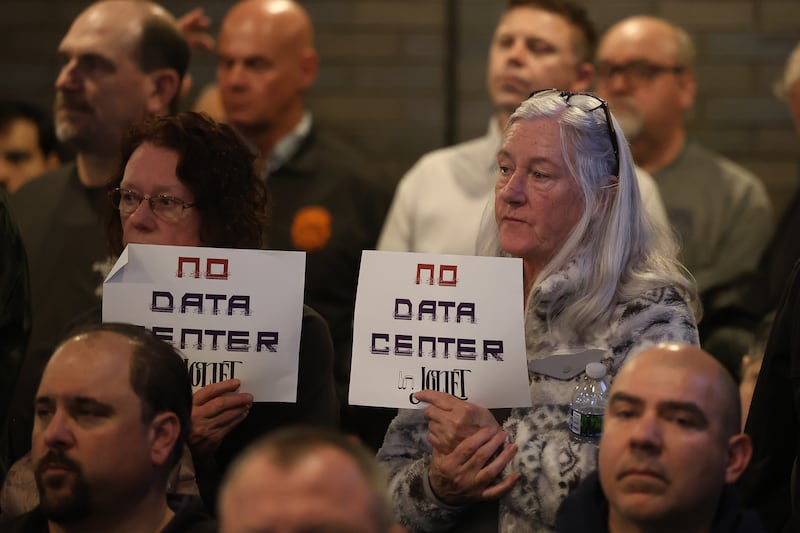
Residents packed city council chambers for hours in Joliet and Yorkville this spring as officials debated billion-dollar data center developments that promise huge tax revenue but raise fears over water use, energy demand and the future of their communities.
Across northern Illinois, proposals for massive data centers are drawing packed public meetings, heated debate and big financial promises as communities weigh whether the projects are an economic windfall or a long-term burden.
Illinois already has 139 operating data centers, with more than 120 additional facilities planned, according to data compiled by Pew Research. If those projects are completed, Illinois would rank fourth nationally in total data centers.
The boom is being fueled in part by growing demand for artificial intelligence computing infrastructure.
It’s become a hot topic to the extent that Illinois lawmakers are considering new limits on data centers after hearings held in early April.
City council members, village trustees and county board members have had meetings run long, sometimes to their surprise.
In Joliet, Hillwood and PowerHouse Data Centers received strong opposition for their 795-acre data center from much of the public during a March Joliet City Council meeting that lasted 6 1/2 hours.
It went so long that the council had to reconvene its meeting two days later.
The City Council approved it 8-1. Council member Cesar Cardenas said the data center is “good for Joliet.”
“We are the third largest city in Illinois, and with that comes opportunity,” Cardenas said.
But while local governments seem to be caught up in the momentum of data centers as a new engine to power economic development and tax revenue, residents are pushing back at the wave.
The city of Lockport on May 28 postponed indefinitely any proposals for a data center after getting massive pushback from residents from all sides of the political spectrum.
One major concern cited by critics is that they require significant water resources. Some have moved to a closed-loop system that is seen as sustainable, and high-efficiency water circulation systems where water is treated, recycled and reused.
:quality(70)/cloudfront-us-east-1.images.arcpublishing.com/shawmedia/Q37L5KC7TFDSLPQNCS4ZC6QYKU.png)
Guy Danskine, the head of Equinix’s western U.S. developments, said some data centers won’t use any more water than a typical office building. Equinix is the company building a data center north of Minooka on Ridge and Holt Road. It sponsored and attended the Minooka State of the Village Address in April.
There, Danskine gave his definition of these tech centers.
“Think about everything you have done on your phone and your computer today,” Danskine said. “If you have looked up the location on maps, if you did any banking services, healthcare records or used Facebook, it’s gone through a data center like Equinix to power the internet.”
Danskine said all of that information needs buildings like Equinix to keep connections running in the same way that roads and bridges are physical infrastructure.
Data centers are warehouse-like buildings that house computer servers that power the internet, cloud storage and more.
Data centers aren’t just powering AI, although that concern often gets expressed at local government meetings.
DeKalb resident Mike Carpenter, who has worked as a real estate professional for more than 30 years, said he is all for the data center.
“We have a phenomenal opportunity here to really increase our industrial tax base, which should segue into stabilized property taxes or even reduced property taxes,” Carpenter said. “Lower property taxes equate to higher property values. So, I urge the council’s support on this great project.”
As digital communication, not just the internet, grows, the need for data centers grows; it’s not just driven by AI, but AI does play a role.
There are 1,556 data centers being planned for construction across the country, although Pew Research counts the massive Project Cardinal data center project in Yorkville as 58 separate data centers. It also didn’t have the Equinix data center listed, nor did it have the proposed Morris and Coal City data centers.
Project Cardinal is a planned 1,037-acre data center that will be built along the Eldamain Corridor. It was approved on March 13 in an almost six-hour-long meeting.
Why do cities like data centers
If there’s going to be development, data centers often are preferred over the growth of logistics hubs and warehouses.
Minooka Mayor Ric Offerman made that clear during his State of the Village Address in early April.
“Equinix will have no semis when this is built,” Offerman said. “There won’t be one raggedy old semi coming out of there, unless it’s one of the hundreds that gets lost in this town every day.”
The increased traffic from semi-trailer trucks from warehouses is a frequent issue targeted by residents and elected officials alike in communities along Interstates 88 and 80.
Data centers, as Offerman pointed out, do not have semi-trucks coming in and out of them.
As Carpenter mentioned, data centers also provide substantial tax revenue to local taxing bodies.
The Joliet City Council on March 10 approved a development agreement with Pioneer Development, including a $51 million up-front offer to be paid over the next four years.
Likewise, in Yorkville, the developers for Project Steel and Project Cardinal data centers, respectively, combined to commit $91 million up front to the city over the next four years.
In DeKalb, 60.9% of Meta’s property taxes for its data center are paid to DeKalb School District 428, according to Capitol News Illinois. This helped the district construct a new school that opened last year.
:quality(70)/cloudfront-us-east-1.images.arcpublishing.com/shawmedia/25YUUVHM3RA45CXXCOYRNGPWX4.jpg)
Aindrea Hogan, the vice president of development for the Grundy Economic Development Council, said while data centers don’t usually employ many locally on-site, the people who do work there are well-compensated.
“They’ve been touted as a once-in-a-generation windfall in many areas, not only because of the significant tax revenue, but also for the long-term economic opportunities that they can help in local areas in which they support technological advancement.”
Residents who oppose data centers, however, see these big upfront money commitments as buying their influence.
After the Yorkville City Council in March gave its approval to the Project Cardinal project, one resident said, “You guys sold us out, shame on you.”
:quality(70)/s3.amazonaws.com/arc-authors/shawmedia/744709d3-0d08-4f13-a8f2-47f3f8ea9de6.png)