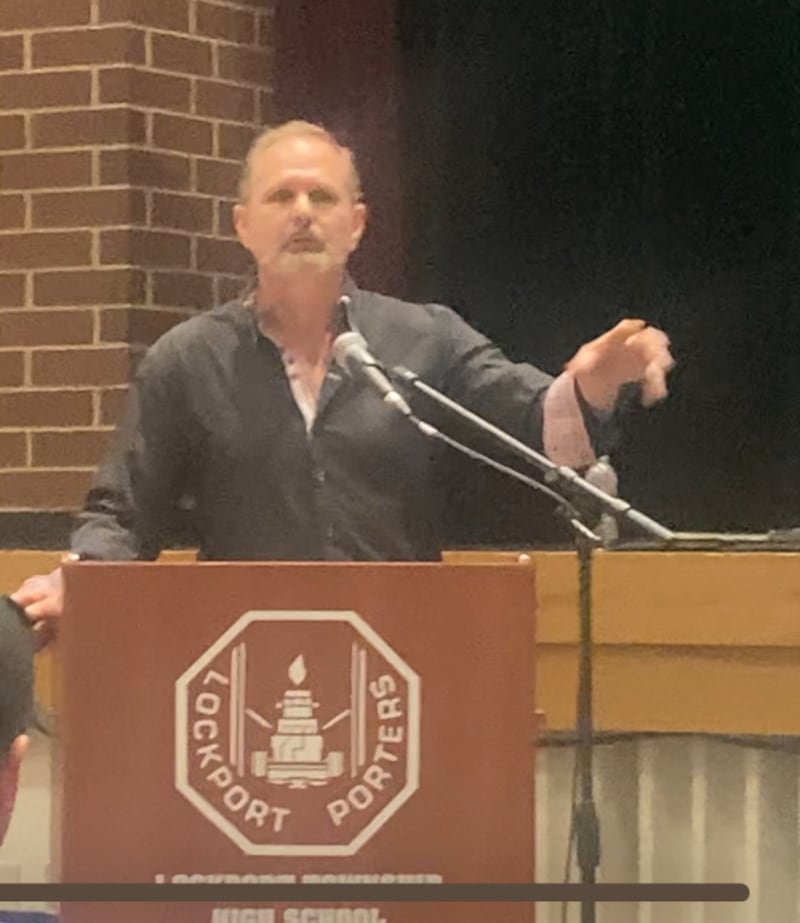
Residents from Lockport and the surrounding community packed the auditorium at Lockport Township High School’s East Campus Tuesday for the first of three scheduled workshops discussing the possibility of a data center in the city.
About 200 people attended the workshop, the majority of whom were vocally opposed to the idea.
There is currently no specific proposal or development plan under consideration for the Star Innovation District, the 165-acre parcel of land along the canal that was formerly the Chevron oil refinery.
However, the city did sign a letter of intent with VME Development in September which promised not to sell the property for several months while VME explored options for potentially shopping the property to data centers.
That letter of intent expires in early July, but could be extended.
Many residents expressed frustration Tuesday that the city had not talked about this possibility more publicly before this month when the letter of intent has existed since fall. Mayor Steven Streit insisted that the agreement is not indicative of a larger commitment.
:quality(70)/cloudfront-us-east-1.images.arcpublishing.com/shawmedia/JRHNN54YX5GM5OTDMCN2NPL4D4.jpeg)
Streit urged residents and the city “to come together as a community” in coming up with a development for the Chevron property, emphasizing there is “nothing official actually happening right now.”
During the meeting, Lockport Township High School District 205 Superintendent Dr. Robert McBride acted as a moderator and posed common questions, as well as several submitted attendee questions, to Streit and a panel of experts.
The guest speakers were Citizens Utility Board (CUB) Executive Director Sarah Moskowitz, Director of the Freshwater Lab at the University of Illinois Chicago Rachel Havrelock, Senior Vice President of Deep Tech P33 Meera Raja, and Deputy of Strategic Advancement for the Chicago Metropolitan Agency for Planning (CMAP) Kyle Schulz.
Early in the proceedings Streit received a loud cheer from the crowd when he stated “some people have said to me ‘this should be a hard no, we shouldn’t even be having this conversation.’”
Streit insisted the conversation should be had because the data center issue is not going away, and the city should explore how it could possibly leverage it to its benefit.
“We’re in a unique position owning the land,” he said. “We could make extraordinary demands, and this could be a moment for us to push back on this industry that has swept the country. We don’t need to compromise on this.”
“Why do we have to be part of this problem at all?” responded 21-year-old Reagan Hayes. “You should have already said no.”
Sandy Burcenski, a member of Citizens Against Ruining the Environment, which has worked to restore the refinery property for nearly 30 years, shared a similar sentiment.
“I find it sad that a false dilemma has lead us to this point,” she said. “These are not our only options. You’re acting like we’re standing on a train track and our only options are getting hit by the train or get on board, but we can get off the tracks.”
Power demands and costs
Moskowitz explained that while data centers do indeed consume massive amounts of power, equivalent to small-to-medium cities for some large facilities, that power is not all locally sourced.
“They [data centers] are already driving up your power bills,” she told the audience. “ComEd’s prices spiked last June because of the ‘forecasted data center load.’ If it’s built in Ohio, it will still raise your prices.”
No matter where the data centers end up being built in the multi-state grid, that demand will drive up electricity costs for the whole area.
:quality(70)/cloudfront-us-east-1.images.arcpublishing.com/shawmedia/5MC4XDVNGBDUDHAQESCX5LD6LI.jpeg)
“We’re talking about needing whole, new, giant power plants to come online in case the data centers are all built,” Moskowitz said, noting there are more communities and grids preparing for this eventuality than there will likely ever be data centers built.
“If you’re worried about local land use and noise pollution, you need to talk to your municipal officials,” Moskowitz told the crowd. “But if you’re worried about energy bills or energy mixes, you need to take this passion to the state capitol and the feds.”
All of the panel members noted neither Illinois or the federal government have broad regulations in place regarding the operation or construction of data centers. This leaves many decisions up to a patchwork of local municipalities, a situation which could lead to larger regional infrastructure issues.
Water usage and pollution
Along with power costs, residents raised the issue pf water usage.
According to Havrelock, a large data center consumes up to five million gallons of water per day, significantly more than the 3 to 3.5 million gallons of water the city of Lockport uses daily.
“It takes copious amounts of water, and your aquifer is in trouble,” Havrelock said.
Streit said the benefit of the city owning the Star Innovation property is that they have the power to make demands of any data center built there, particularly in regards to water usage.
“We will not use our potable water for a data center,” he said.
Streit said the city could sell its waste water effluent, which is treated but too polluted to be drinkable, to the data center for cooling purposes. The money from the sales could be used to lower residents’ water bills.
Havrelock said similar practices are used regularly in California.
“You can sell the effluent and the wastewater byproduct to the data centers for a profit and if they need to treat it more, you can require that they either treat it themselves on site or pay to upgrade the municipal water system to treat it for them,” she said
While these ideas were seen as preferable to hooking onto the city’s water systems, several residents raised further concerns about pollution during the Q & A portion of the meeting.
A person raised concerns that treating the wastewater and keeping it in a closed loop system pollutes the water so much it becomes forever unusable; leaving it to be stored like toxic waste or else risk leaking into the ground water.
“Those fears are valid,” Havrelock said. “In order to use less water, nitrates and PFAs – or forever chemicals – can be added to the water to make cooling more efficient in a closed system. Those chemicals build up and when its exhausted the water either goes to the municipal sewer system, which can cause a whole other set of issues, or it needs to be stored by the data center.”
When asked if it would be possible to ban a data center from using certain processes, Havrelock said it would be hard without broader regulation.
Potential next steps
There are two more data center workshops scheduled at LTHS on Thursday, June 4 and Thursday, June 25 which will continue the conversation and bring in additional expert perspectives, including discussions of potential benefits to the city.
Overall, the crowd was largely unswayed in its opposition to the idea, with many rounds of boos and shouted criticisms breaking out throughout the course of the night.
When asked by Shaw Local how, with no regional or federal regulation, Lockport making demands could prompt change in the broader data center industry, Streit said that is part of the value in having these workshops.
“Some of this is trying to bring these conversations out to policy makers who we know are listening,” he said. “The kind of demands we would want to make need to be worked into a bill, and this is away to keep driving these demands so they can become larger policy.”
Some residents asked why couldn’t the future use of the Star Innovation District property and possible data centers be addressed in a referendum.
“That [a referendum] could be a next step, but maybe a better one is engaging again with a steering committee,” Streit said. “We redo master plans all the time, and this one is five years old, and in that time the idea of what a data center is has changed a lot. I’m not here advocating for a data center. I’m advocating for more conversation.”