Most northern Illinois schools haven’t seen U.S. Immigration and Customs Enforcement agents at their doors, but fears of federal enforcement are still keeping some students out of the classroom.
Poor attendance and students being pulled from school completely have been among the impacts, said Monica Diaz, the director of bilingual and dual-language programs for Harvard School District 50 in McHenry County.
“We do our best to reach out to families and say school is a safe place, but some families are intimidated and have chosen not to send their kids in at times,” Diaz said.
”We all see the news, and all of our schools received guidance from attorneys on what to do in the event ICE comes to one of our schools. Luckily, we haven’t had to deal with that, but we have had students stay home, and we had one family move back to their home country recently."
Nearly half of the rural district’s 2,503 students are English learners, meaning their primary language is not English and they’re in the process of learning English, according to state data. Another 13.7% are former English learners, meaning they’ve achieved English proficiency and no longer receive those services.
District 50 isn’t the only school district reporting that enforcement of immigration laws and mass deportation efforts have led to extreme stress and increased absenteeism among EL students.
The situation at Mendota School District 289 in La Salle County was similar, with some families choosing not to send students to class, curriculum director Tyler Pearce said.
“Going into the first few days of the year, we had a lot of conversations about ICE,” he said. “Our bilingual parent group brought in a lawyer to talk to families about their rights, but we’ve still had some issues.
“A few families went away for winter break and haven’t come back. We hate to see anyone scared that who they are is a bad thing. We have great families here. We are a safe space, and we want people to know that we don’t care about their status. If you’re here, you’re ours, and we want to help your kids. Our job as educators is to provide a quality education, and we want everyone to feel accepted and to be successful.”
:quality(70)/cloudfront-us-east-1.images.arcpublishing.com/shawmedia/IOXJCKCXT5E7TKS4XS5UOJZMG4.jpg)
That mission is much harder if students aren’t in the classroom, Diaz said.
“It impacts the whole classroom community. Not just student achievement, but it creates more work for the teachers if students have to catch up,” she said.
[ Interactive: How are English learners doing at your school? ]
In Rochelle, Canfield said, in 2025, “the fear wasn’t so much about school, but about what would happen if students came home and the parents were gone. We assured them we would make sure their students were looked out for and that they would always be safe within our walls.”
After the district made resources available for immigrant families, “there were less concerns about attendance,” Canfield said.
“It’s good to see everyone standing on a united front in our community,” she said.
While families have been nervous at schools around the state, schools in Will County have seen more direct effects of immigration enforcement, with ICE conducting raids in the Joliet and Chicago areas, most visibly this fall.
“Our students and families have been very affected by immigration policy changes,” Joliet Township High School District 204 Superintendent Theresa Guseman said. “They feel afraid and uncertain, and that stress makes it more difficult to learn. Things are very uncertain. We have students scared for their families and themselves. That’s a lot to deal with for anyone, but especially as adolescents when you’re dealing with so many other changes.”
Guseman also noted that some of the district’s students live in Elwood, where the National Guard was stationed in October as part of the Trump administration’s “Operation Midway Blitz” and had to drive by the operation’s staging area.
“Kids were driving by the National Guard base, and we had sightings of ICE agents near Central campus,” Guseman said. “It’s all very concerning to families. Kids are resilient, but it’s a lot to deal with, and the teachers are feeling the strain of working with kids with that trauma.”
Even after immigration and military forces were reduced in Illinois, immigration arrests have continued in the area.
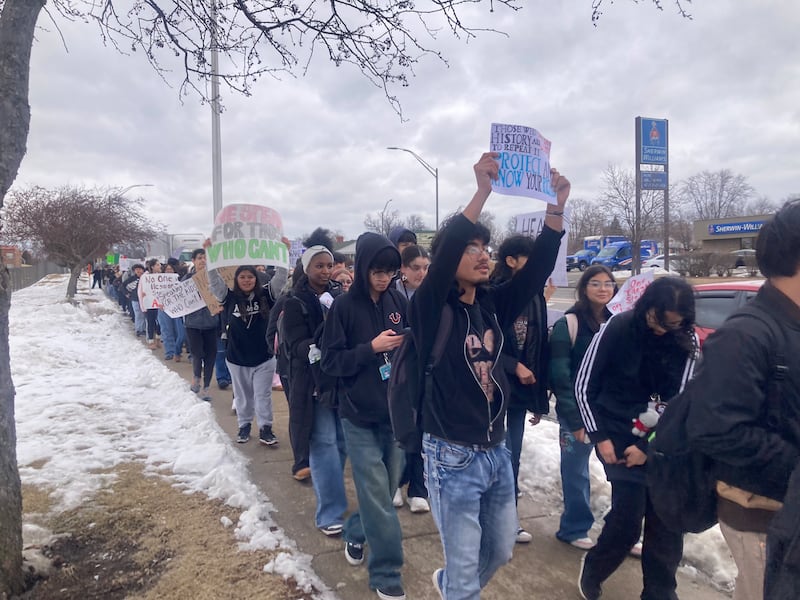
Students in Joliet, Oswego, Bolingbrook and Huntley staged walkouts to protest ICE arrests this winter, including one in a police station in January. Student protesters, a large number of whom were non-Hispanic, said they were motivated to speak out on behalf of their Hispanic friends, some of whom they said had missed days or weeks of school in the last year.
Guseman said District 204 is “lucky to have a lot of supports in place” for its Spanish-speaking families, including bilingual family engagement liaisons who can communicate with families. Those liaisons have been working with families at both of the district’s campuses to help them understand their rights and to connect them with community resources outside the district.
The Spanish Community Center, which provides services in both Joliet and Kankakee, is among the outside resource organizations families have been directed to.
For safety and privacy reasons, the organization declined to speak about individual cases or connect Shaw Local with its clients, but the organization confirmed the troubles facing families.
“We have seen a significant increase in fear and uncertainty among immigrant and Spanish-speaking families, particularly those with school-age children,” Spanish Community Center Executive Director Sylvia Acosta Chávez said. “Many families are hesitant to attend school events, access services, or even leave their homes due to confusion and anxiety surrounding recent immigration and anti-diversity policies.”
Acosta Chávez said the organization has been “coordinating closely with trusted partners to provide Know Your Rights trainings, family preparedness planning, and referrals to legal services,” much like many schools have.
All of the schools emphasized that they want families to see them as safe spaces for their students and that they would be making every effort possible to continue providing Spanish speakers and immigrant students with services, despite the ongoing uncertainties.
“What we’ve realized is important is for families to have connections with the district and to focus on building those connections,” District 204 Director of Multilingual Services Edgar Palacios said. “We want to ensure that they feel safe and know this is a welcoming environment, and many families have shared what a relief that is.”