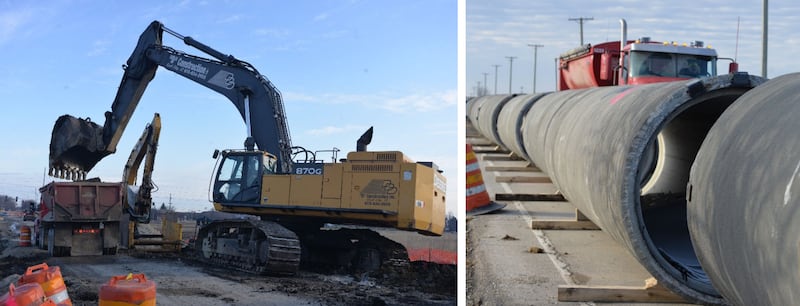
With a project as massive as the almost $400 million Lake Michigan water sourcing project, stretching about 30 miles across Naperville, Oswego, Montgomery, out to Yorkville, it can be difficult to scope the work’s full extent.
Yorkville city staff provided a closer look at the project, including what construction already has been started and what work residents of Kendall County can soon expect.
The first water down the pipeline is expected in the Yorkville area by the summer of 2028. Montgomery should receive water by 2030.
The project is a joint venture between Yorkville, Oswego and Montgomery, hooking up to existing water mains near Naperville, owned by the DuPage Water Commission. The three Kendall County communities are sharing costs.
As the region’s population continues to grow, the cities supported the project because the long-used underground aquifer was being depleted at an unsustainable rate.
Yorkville currently is eying a tab of $224.4 million for their contribution to the project.
Shovels already in the ground
Staff associated with the “Waterlink” project provided construction and bidding updates through the end of March. The updates provide a glimpse into the direction of the multi-year project.
:quality(70)/cloudfront-us-east-1.images.arcpublishing.com/shawmedia/ETJZG46DEJGD7JWDCN4GWJ3JSA.png)
The total project is divided into 12 different segments, each involving its own engineering and construction work bids. The first segment begins on Book Road in Naperville extending south and then east toward Kendall County.
Construction has already begun on this first segment with excavating tractors removing older water mains and crews replacing them with wider pipes to accommodate the larger water capacity flow.
By the end of March, crews had replaced 1,850 feet of water main. The total segment beneath Book Road needs 16,300 feet of pipe installation. This segment is expected to be completed by the end of the year.
Elsewhere along the project, tree clearing has begun at two other segments, including the Main Line – West segment which is in Kendall County, running parallel between Oswego and Montgomery.
No heavy construction has begun on any segments primarily located in Kendall County.
Out of the 12 segments, contracts still need to be awarded on four of them. A contract has been awarded for the South Branch – West segment, which connects Oswego to Yorkville. The final leg connecting Yorkville to the rest of the project, the Illinois Route 71 segment, currently has a bid package under development.
Work along Collins Road and Route 71 will fully connect Yorkville to the Oswego water mains.
According to Waterlink staff, “the program schedule remains on-track to achieve the targeted community water delivery dates.”
:quality(70)/cloudfront-us-east-1.images.arcpublishing.com/shawmedia/GBLDUJ2H5REQVLJFYVEU3MGH5A.png)
The Illinois Department of Natural Resources requires cities receiving the water to reduce non-revenue water loss below 10%.
To receive the water by 2028, Yorkville has been “aggressively” replacing older water mains across town and installing more accurate water meters in homes and businesses throughout the city. The city’s older water mains have been prone to breaks and leaks.
The city most recently approved another $5.67 million in water main replacements and accompanying road work in early March.
Yorkville staff said they expect all water main work, new water receiving stations, and installation of storage tanks to be completed by 2027.
Construction already is underway on the North Receiving Station, the northwest water tank, the South Receiving Station, the Illinois Route 126 water main, and the bluestem water main.
How is Yorkville paying for it?
The waterworks began when bids for the first leg of the project came in around about $100 million higher than expected. The sticker shock had city officials concerned about contracts for the rest of the project.
To cover the rising costs, the city re-applied for a $170 million loan from the U.S. Environmental Protection Agency, $30 million higher than the city’s initial Water Infrastructure Finance and Innovation Act loan.
The remaining costs of the project are to be financed through the city’s bond issuance and loan proceeds.
To help offset the costs, the city recently approved higher water rates for users. Residents will face about 20% annual increases for at least five years.
City Administrator Bart Olson previously said if contracts are continuously higher than expected, the city might need to revisit approving even higher water rate increases. However, after the first sticker shock, the subsequent contracts came in under or around estimates.
The second segment came in at $23 million, less than original estimates of $40 million. Another bid came in around $55 million with initial estimates $83 million. Yorkville Mayor John Purcell said the subsequent legs are easier construction, and engineering complexities and scheduling issues likely drove up the first bid.
Olson said once the final bids open, the city should know around 99% of the project’s official total costs.
The WIFIA loan has a 35-year payback from the time of substantial completion, which will take it through 2065. Yorkville must cover 145% of the WIFIA loan debt and the 3.5% interest rate to meet the obligations of the loan.
:quality(70)/s3.amazonaws.com/arc-authors/shawmedia/0cef0bf9-a04e-4bb4-aea0-03d8ced01c00.jpg)