Editor’s note: This story contains topics surrounding sexual violence, assault and abuse. If you are in need of help, DeKalb-based Safe Passage Inc. offers free and confidential services for people in crisis, regardless of race, ethnicity, sexuality, gender, ability, religion or immigration status. For Safe Passage, call 815-756-5228 or text 815-393-1995 available 24/7. For the National Domestic Violence Crisis Hotline, call 800-799-7233 or text START to 88788. If you are in immediate danger, call 911.
“We are here because we decided ‘No more,’ ” said a survivor of sexual assault in DeKalb on Monday who testified she’s been helped by “goddess-level” Safe Passage staff for about a decade.
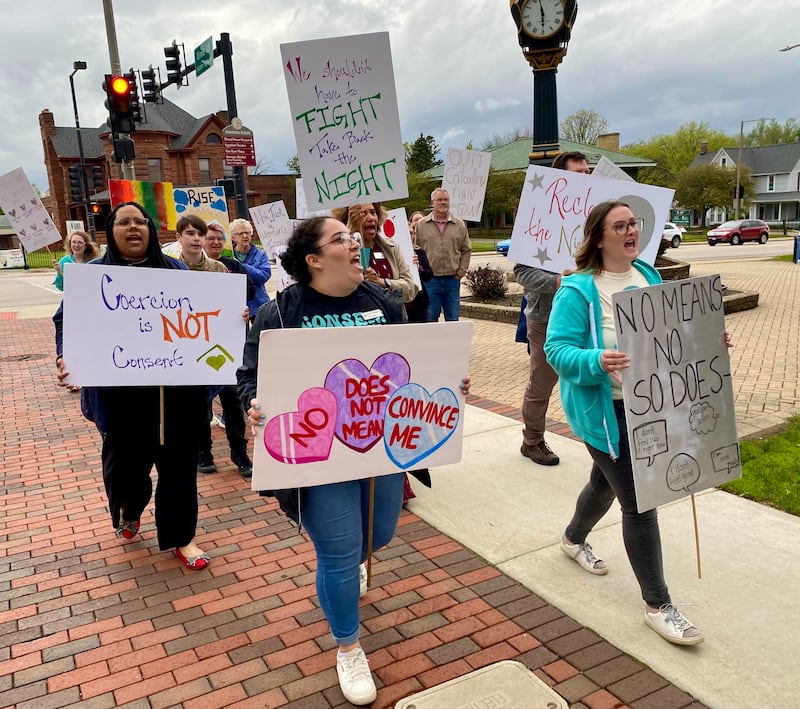
The weather held out Monday evening for participants and local advocates who marched in downtown DeKalb for Take Back the Night. Safe Passage marked Sexual Assault Awareness Month, in its 25th year, with the event, which survivors said brought them hope.
“Join together, free our lives, we will not be victimized,” marchers chanted as they walked through downtown carrying signs that declared “Hands off our bodies,” “No means no,” “Coercion is not consent,” “Not just a women’s issue” and “I believe you.”
Rebecca Versluys, executive director of Safe Passage, said Sexual Assault Awareness Month calls communities to honor survivors “whose courage broke silence,” and advocates who helped bring lasting change.
“It is both a milestone and a moment of reflection, an opportunity to acknowledge the progress we have made while recognizing that there’s still work that needs to be done,” Versluys said to a crowd of about 30 gathered inside the Egyptian Theatre, 135 N. Second St.
Since 2002, Safe Passage’s sexual assault response program has helped 1,388 adult survivors and 482 child survivors, staff said. In 2025, Safe Passage provided 4,417 nights of shelter for adults and 1,982 nights for children.
The event’s main speaker was Carrie Ward, CEO of the Illinois Coalition Against Sexual Assault, a statewide network of 31 crisis shelters offering 24/7 support, counseling and advocacy.
While Sexual Assault Awareness Month was first observed nationally in 2001, the beginnings of women-led Take Back the Night gatherings date back farther.
“At its origin, the Take Back the Night movement began as a direct, literal effort for women and girls to walk safely at night anywhere,” Ward said.
:quality(70)/cloudfront-us-east-1.images.arcpublishing.com/shawmedia/FRUPUQNO4VFULKNSZHOETRBBFQ.jpg)
In the 1970s, sexual violence reported in Pennsylvania, San Francisco and Los Angeles gained wide media attention, prompting the first marked Take Back the Night event in Philadelphia.
A similar event, dubbed “Reclaim the Night,” was born in Rome after 16,000 rapes were reported in the city in 1976, Ward said. In Leeds, England that same year, authorities told women to stay indoors while a predator targeting, assaulting and murdering women was at large. Organizers staged a Reclaim the Night there, too, outraged, Ward said.
“And I get it. Because why is the solution for women to always stay inside?” Ward said.
Take Back the Night came after hard-fought progress labored over during other movements like fights for women’s suffrage, the civil rights era and pushes for reproductive freedoms.
Why is it important to know the history of these movements? To know where to go next.
“Especially at a time where we have seen setbacks to hard-fought battles for equality, where we have seen victims’ voices silenced, when we have seen accountability for offenders grind to a halt,” Ward said. “And when we have seen survivors fall through the cracks.”
According to the National Intimate Partner and Sexual Violence Survey from the U.S. Centers for Disease Control and Prevention, 45.1% of women will experience sexual violence in their lifetime.
:quality(70)/cloudfront-us-east-1.images.arcpublishing.com/shawmedia/LAAGDCKODVA77BDDFBDTKIURIU.jpg)
Data shows that 21% of women are survivors of completed or attempted rape, and 16% of men experience sexual violence. At work, 1 in 3 women experience sexual harassment, the data shows. And 1 in 4 women experience technology-facilitated sexual violence.
That’s why shelters like Safe Passage – which broke ground in December on a forthcoming new, expanded shelter at 217 Franklin St. in DeKalb – are so important, Ward said.
The agency offers shelter and temporary housing for those seeking to leave a violent situation, including for children. Those in need of help at Safe Passage will find counseling sessions, safety planning and aid in filing an order of protection in DeKalb County court if they need it.
“While we know that the circumstances that bring someone into shelter are often traumatic, your provision of a safe, welcoming environment goes a long way toward helping them heal,” Ward said of Safe Passage.
Sexual violence can, and does, happen to anyone, statistics show. Advocates said programs like crisis centers push for awareness and greater reporting, and a system that lifts up survivors.
“We want to see a society that believes and supports survivors, that holds offenders accountable for their behavior, that prevents future sexual violence,” Ward said.
This story was updated on April 29, 2026, to correct an earlier version that misstated the year that Safe Passage began. Since 2002, Safe Passage’s sexual assault response program has helped 1,388 adult survivors and 482 child survivors, staff said.
:quality(70)/author-service-images-prod-us-east-1.publishing.aws.arc.pub/shawmedia/afeba7c5-6912-4fdf-967f-edcf9aadb18e.jpg)