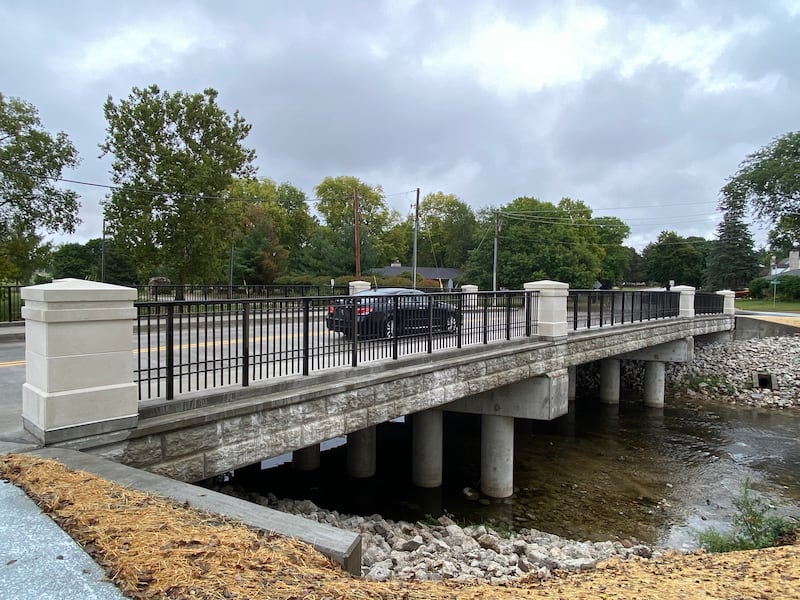
The city of DeKalb could be looking to establish a long-range plan to help guide improvements to bridges and culverts.
It all comes to a head as city staff work to index street conditions, a process meant to help better plan for what streets to prioritize in another street maintenance program, expected to be considered by officials this fall.
The city’s current street maintenance plan is in its fifth and final program year and was established in 2022, city documents show.
City Engineer John Laskowski said the city’s bridges and culverts are in a good state overall, in his view.
“They’re safe for the public to be traveling over, and that’s the main concern that I have is just making sure that we have safe bridges,” Laskowski said.
There are 10 bridges and culverts in DeKalb city limits requiring regular federal inspections. They include those at Bethany Road over the Kishwaukee River, Fairview Road over the Kishwaukee River, North First Street over the Kishwaukee River, Hillcrest Drive over the Kishwaukee River, Lucinda Avenue over the Kishwaukee River, Peace Road over the Union Pacific Railroad, Taylor Street over the Kishwaukee River, Annie Glidden Road over an unnamed tributary, Annie Glidden Road over Watson Creek, and Devonaire Parkway over a detention pond.
Laskowski pointed to how DeKalb’s bridges and culverts differentiate themselves from the infrastructure noted in other municipalities where he’s worked in the past.
He previously had stints working for the city of Sycamore and the villages of North Aurora and Hinsdale. He was reintroduced by the city of DeKalb as a new hire in October 2025.
None of these communities had bridges big enough to be regulated by National Bridge Inspection Standards, he said.
“Having to because these requirements are in place, I think the city’s well-positioned to continue to maintain their bridges at a high standard because we do get these reports every two years,” Laskowski said.
Of the city’s bridges and culverts, there was only one structure reported in poor condition as part of its most recent inspection, a report shows. That is the culvert at Annie Glidden Road over Watson Creek.
The rest of the city’s bridges and culverts were reported in excellent, very good, good, or satisfactory conditions, according to documents released by the city in a public records request.
The city has a plan in place for the culvert at Annie Glidden Road over Watson Creek to help address the issues noted in a 2024 inspection report, officials said.
Laskowski said the city is eying a project to resurface Annie Glidden Road, from Lincoln Highway north past Dresser Road to the DeKalb County health complex, in 2028.
“At that time, when they’re resurfacing that roadway, that’s going to help improve the condition of that bridge because they’re going to eliminate all those potholes and prevent the water from continuing to get in there,” he said. “And that’s also going to give us a chance to evaluate that bridge when we’re doing that project.”
That project could carry a $2.9 million price tag, officials said.
The improvements are expected to be paid out of federal funding allocated toward the metropolitan planning organization, DeKalb-Sycamore Area Transportation Study. Dollars would be matched at 80%/20% by the city of DeKalb.
Laskowski said he believes good maintenance practices will be key to any bridge or culvert, regardless of the topography and any challenges it may pose.
“I think of it as the bridge always being at the low points of the topography because usually where you have a bridge is when you’re crossing a river,” Laskowski said. “I think topography contributes to the placement of where the bridges are located, but I’m not necessarily sure that it has a huge impact on the condition of the bridges.”
Bridges tend to let water collect on the surface of roadways, which Laskowski said is important to watch out for.
When water settles along a roadway, for example, it can lead to the creation of potholes, he said.
“It’s really important to try to drain the roads properly,” Laskowski said. “...There’s a natural crown in the road, or a slope, so that when the rainwater hits the center of the pavement, it slopes off into the gutter. And it’s collected there on bridges. So, it’s really important that there’s some topography to the bridge to get that water to drain off the bridge, so it’s not just settling there.”
City staff said they anticipate new inspection data in December, assessing the condition of the bridges and culverts in city limits.
Typically, the city’s bridges and culverts require inspection every two or four years, depending on how they fare in their lifetime.
Laskowski said he looks forward to seeing how they test.
“We could see if there’s any severe or really big decrease in condition,” he said. “...We’ll be able to repair it immediately. But those reports are helpful because they direct us when we need to plan ahead for future replacements of bridges.”
:quality(70)/author-service-images-prod-us-east-1.publishing.aws.arc.pub/shawmedia/670e1b81-921a-4140-9c50-69b66cad217c.jpg)