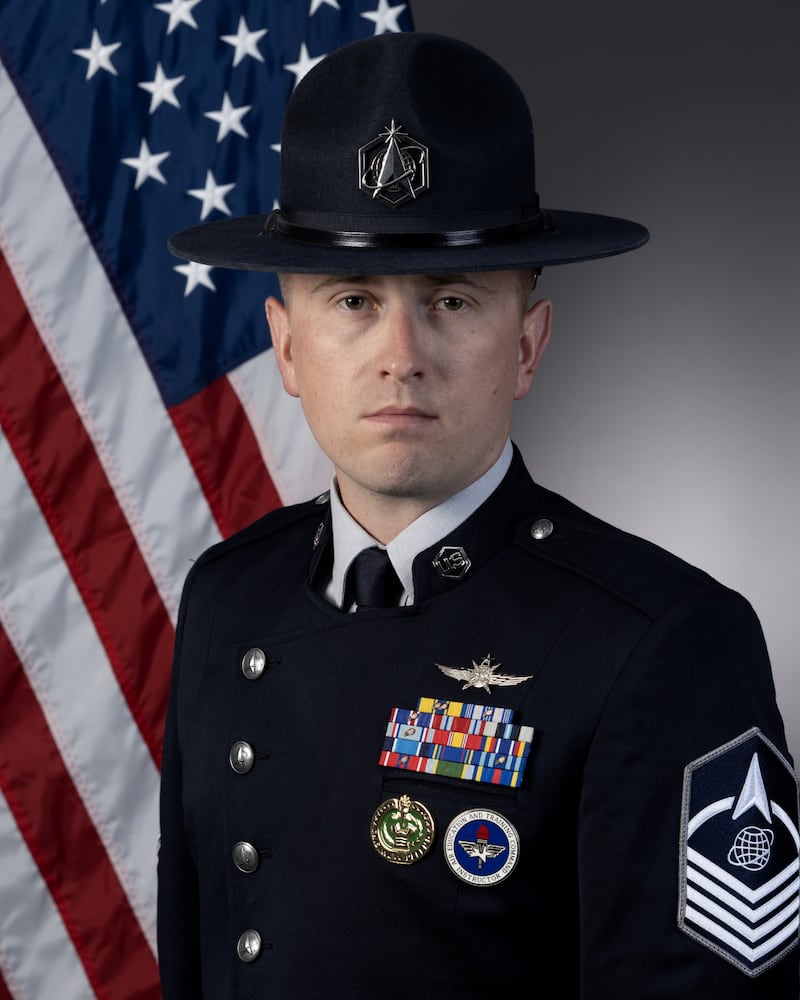
David Gudgeon didn’t know what he wanted to do with his life back when he graduated from McHenry High School’s West Campus in 2013.
He tried taking classes at Harper College in Palatine. But then a friend talked to him about enlisting in the Air Force.
Today, Sgt. Gudgeon is on his third six-year reenlistment with the U.S. military, working towards a planned retirement once he hits 20 years in.
“Harper was great, but the joke is I failed out of college and ended up here,” Gudgeon said. He also found himself back in class. His U.S. Air Force enlistment led to specializing in satellites, used across the military for the past 20 or 30 years to coordinate what was happening closer to the ground, he said.
Gudgeon, currently stationed in San Antonio, Texas, now is part of the Space Force. He’s been in Texas since late 2023, part of Space Delta 1 Detachment 3.
He is a drill sergeant – one of only two in the Space Force – preparing young recruits for what their lives will be in the newest branch of the military.
Gudgeon said he sometimes spends time in online comment sections, explaining what it is the Space Force does.
“You have to become an ambassador for what we are,” Gudgeon said of the effort he puts in to try to educate and dispel myths.
When the branch was created in the first administration of President Donald Trump in 2019, the idea was bringing all of the satellite and low-orbit operations handled by the separate branches under one, unified command.
By being under one house “it helps to secure the funding that we need to remain technically relevant,” Gudgeon said.
There were satellite systems “that were way outdated,” put into space in the early 1990s and even late 1980s, he said. The Space Force was able to get barriers removed and those systems updated, he said.
It also puts the U.S. on the same footing as other countries – primarily Russia and China – which also have created their own space forces, he said.
Moving from those technical roles to that of drill sergeant came at the suggestion of another superior.
“Essentially, my boss called me and asked if I was interested in going to a joint schoolhouse,” he said.
He graduated from the nine-week training course on April 4, 2025.
“Tech. Sgt. David Gudgeon and Sgt. Yuji Moore became the first #Guardians to graduate from the U.S. Army’s prestigious Drill Sergeant Academy,” according to a news release.
The Eagle Scout from McHenry’s Boy Scout Troop 131 also recently was named USO Guardian of the Year for 2026 – guardian being the name used for those enlisted in the Space Force.
“As a Space Force Military Training Instructor at JBSA-Lackland, Master Sgt. Gudgeon demonstrated exceptional composure and lifesaving skill during two separate medical emergencies,” according to a USO news release.
In one instance, Gudgeon performed the Heimlich maneuver on a recruit choking in the mess hall. In the other, he triaged two trainees who had passed out in brutal Texas heat.
His superior officers submitted his name for the reward.
“They keep telling me I am doing a good job,” Gudgeon said.
In the choking incident, another recruit alerted to what was going on.
“He was being a good teammate and called it out,” Gudgeon said. “I was able to go help him out.”
In the other incident, two recently arrived recruits had passed out from heat stress.
“It is so dang hot here,” Gudgeon said. He was able to get the two to cooling treatment quickly.
Recruits come from all over to the Texas base – from U.S. territories and all over the world.
“They have travelled upwards of 12 hours to get there, and get minimal sleep in the first 48 hours. Their bodies are in stress,” he said.
While drill instructors preach over and over again to hydrate, not all of them understand the importance, he said.
“In the first week, we see a lot of these issues” with the potential for heat stroke, Gudgeon said.
:quality(70)/s3.amazonaws.com/arc-authors/shawmedia/185fbfd8-8216-43d7-8beb-cd8992be6fe5.png)