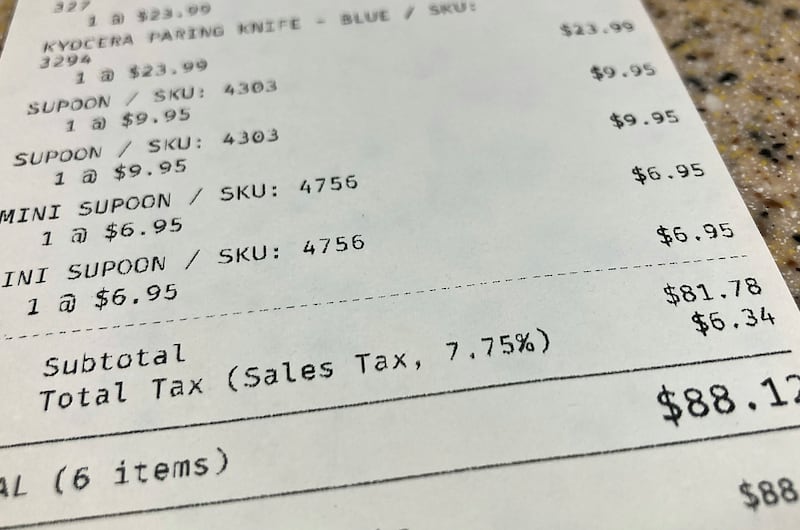
About a year and a half after McHenry County shoppers began paying a sales tax to fund the McHenry County Mental Health Board, officials say it brought in more revenues than what the board got from property taxes.
County voters approved an additional 0.25% sales tax in March 2024. It kicked in July 1, 2024.
In exchange for that yes vote, county leaders removed almost $11 million of the county property tax levy that funded the Mental Health Board.
County Administrator Scott Hartman had told the board late last year, before the holiday shopping receipts were known, that the sales tax was on track to give mental health services more money than the property tax revenue. County leaders recently confirmed that was the case.
The sales tax generated $11,156,562 in fiscal 2025, county leaders said, more than the $10.975 million the Mental Health Board got in fiscal 2024.
Hartman said the sales tax is a better tool because it gives property owners property tax relief, while anyone who buys anything in the county is contributing to the funding. County leaders have said another perk of sales tax is it tends to grow over time.
“It is, truly, actually an example of property tax relief,” Hartman said.
He touted it as “a huge victory” for the County Board and voters to have that property tax relief.
That was a turnaround from Fall 2024, when the sales tax numbers started coming in and the totals lagged well behind the $1 million per month projection.
Hartman acknowledged that the totals coming in short made people concerned and he noted sales tax can be unpredictable. He said agreed not to take drastic action based on a couple of months of data.
County officials said at the time that some retailers might have been lagging in collecting the tax and getting it to the Illinois Department of Revenue because it was new, and pointed out spending varies month to month.
Hartman said the state keeps a portion of the sales tax, which is about $12,000 to 13,000 a month.
There was also an overlap of several months in which shoppers were paying the sales tax, but the property tax levy hadn’t been finalized. Hartman said the first five months of sales tax revenue was $4 million in addition to the property tax revenues, which he said was a “windfall.”
County officials said Friday that the property tax revenue during the overlap was more than $4 million and the sales tax has raised just more than $15.2 million since it started.
The early shortfall had prompted discussion about whether to go back to the voters for another sales tax increase, among other remedies.
And it brought on “a greater crisis state” for the board, former Mental Health Board Executive Director Leonetta Rizzi had written in a board report.
Rizzi left the board in March 2025. She had clashed with county leaders about the sales tax miscalculations, but it’s not clear how much of a role that played in her departure.
Mental Health Board leaders earlier in 2025 had projected the sales tax might not exceed the property tax revenue until 2028.
Hartman also nodded to the County Board’s tight recent budget and levy process, which concluded when the board opted in November to take all of the inflationary increase allowed by law. That followed several votes on that and a so-called “lookback” that would have reset the levy to pre-referendum levels.
“I can’t help but think” how the Mental Health Board would have fared if it was still property tax-funded, Hartman said, adding the sales tax allowed the County Board to focus on other priorities.
“That funding stream was taken care of. You did not have to consider that,” Hartman told the county board.
While some on the board felt going for the lookback was the fiscally responsible thing to do, others felt like doing that would have been going back on the promise to voters. Though that was rejected, some of the property tax relief that was offered in exchange for the voter-approved sales tax hike was clawed back.
The levy in fiscal 2024 was about $73.8 million, and almost $11 million went to the Mental Health Board.
The county property tax levy dropped to about $65 million in fiscal 2025. Most of the drop was because of the sales tax switch, although the County Board chose to take some, but not all, of the inflationary increase allowed that year.
With the fiscal 2026 levy that was just passed, the levy increased to $67.7 million.
County officials said they have reduced property taxes over the past decade, with the levy being about $79.4 million in 2017. The county’s share is 6.5% of residential tax bills, officials said.
“The budget numbers for 2025 prove decisively that voters approved a win-win when they passed the referendum – they eliminated a property tax levy and replaced it with a fairer, more sustainable sales tax,” County Board Chair Mike Buehler, R-Crystal Lake, said in a county news release. “What’s more, as McHenry County’s sales tax revenues continue to increase, the Mental Health Board is in a much better position now to address mental health needs and challenges.”