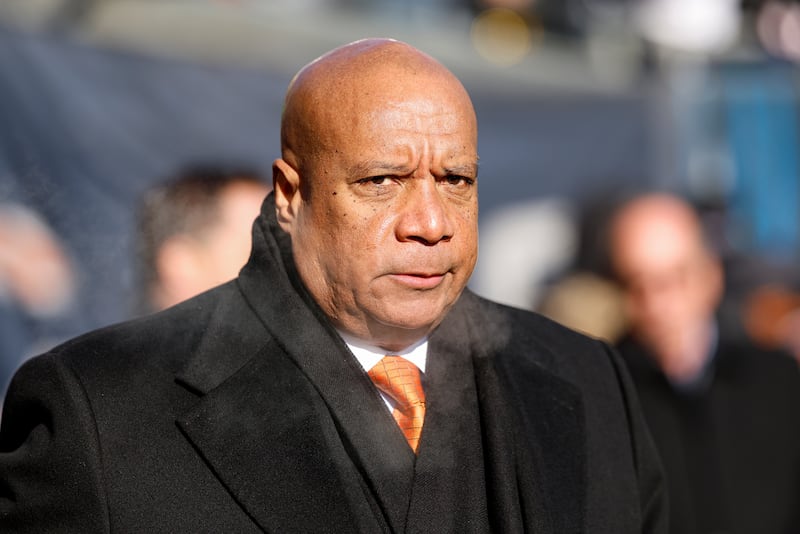
The Chicago Bears’ search for a new stadium took another unexpected, dramatic turn early morning Monday in Springfield.
Illinois lawmakers thought they had come up with a last-minute alternative plan to the Bears-backed megaprojects bill when the Illinois Senate approved a bill that would allow cities to create stadium authorities. Instead, the Illinois House decided not to vote on the Senate Bill for adjourning the spring legislative session.
Now the Bears are left with an interesting choice. Will they wait to see if Illinois lawmakers can pass a bill later in the year that would allow them to build a stadium in Arlington Heights? Or will they decide to take up Indiana’s offer and move to Hammond?
“We will finalize our evaluation of both Arlington Heights and Hammond, and remain on the late spring/early summer timeline that we have previously communicated,” the team said in a statement Monday morning. “We will provide an update when we have a decision to share.”
Monday was the latest shocker in a five-year search that’s had plenty since it started in 2021 when the team agreed to purchase the Arlington Heights property on the site of the former Arlington Park racecourse. There have been twists and turns throughout the process, including pivots back to Chicago before going back to Arlington Heights and now Northwest Indiana.
As of Tuesday, the Bears only have one offer to build a new stadium.
Indiana lawmakers moved quickly when Bears President and CEO Kevin Warren expanded the team’s search for a new stadium in December to include Northwest Indiana. They put together a bill to lure the Bears to jump over state lines and signed it into law at the end of February.
Lawmakers put together an enticing proposal. It set up the Northwest Indiana Stadium Authority, which would own a potential Bears stadium after the team puts in $2 billion toward its construction. That would allow the Bears to not pay property taxes while also garnering all the revenue generated from it. The state will also allow the Bears to buy the stadium for $1 after 40-year bonds are paid off.
Indiana also offered $1 billion in public funding backed by state revenue on top of investments in roads and other infrastructure surrounding the stadium district.
Warren didn’t give a yes or no answer at the beginning of April when he was asked whether the team would go to Indiana if Illinois failed to pass legislation by the end of its session. Instead, he voiced why the team would be comfortable with either stadium location.
“There’s plenty of space to make sure that we do have a mixed-use development in both locations,” Warren said in April. “We’ve made it very clear. You’ve heard the NFL, you’ve heard the commissioner specifically say it: These projects, they’re challenging. And when you get to a point when you actually can see them coming to fruition, you need to make sure we capitalize on it. Just because [of] the positive economic energy it brings.”
:quality(70)/cloudfront-us-east-1.images.arcpublishing.com/shawmedia/UQI7XBK4YJB2ZO4XBR6VAXTV6I.jpg)
If the Bears stick to the later part of their late spring/early summer deadline, that could give Illinois lawmakers a chance to pass something before the Bears decide to move to Indiana.
Illinois state leaders didn’t feel like they had enough time to pass the stadium authority bill given how late it came into fruition. By Monday morning, Illinois Gov. JB Pritzker himself said he hadn’t had time to read the full bill since it came in around 11 p.m. Sunday night, an hour before the spring session ended.
Lawmakers aren’t expected to be back in Springfield until November’s veto session. Pritzker was open to the possibility of a special summer session to get a Bears bill across the finish line. But House Speaker Chris Welch told Capital News Illinois that lawmakers would tackle the issue sooner rather than later, just not in a special session.
“I know that the House has said that they’re going to continue to work on this over the summer,” Pritzker told reporters Monday morning. “I think the question of a special session is a question really for the legislators and not for the governor, here. They’ve got to come to an agreement about something or other, and then either one can call a special legislative session. I can as well.”
It won’t be easy to pass legislation with or without a special session, regardless of which Bears bill lawmakers decide to tackle. Each bill has faced strong opposition from key lawmakers across the state.
Illinois lawmakers decided to move off of the megaprojects bill on Saturday night after years of working on it since they felt it didn’t have support in the Senate to pass. The bill would allow the Bears, and other major companies, to negotiate a Payment in Lieu of Taxes (PILOT) instead of regular property taxes with local government bodies.
But the bill received opposition once it passed the House in April. Some state lawmakers were concerned about how such a deal would impact surrounding property taxes. Other lawmakers from Chicago had a hard time supporting a bill that would give the Bears a tax credit to leave Soldier Field.
The megaprojects bill could take some time to pass, longer than just the next month. But it remains on the table and is something Pritzker wants for the state beyond the Bears.
“We still need that, by the way,” Pritzker said. “Thirty-eight states have a PILOT megaprojects law. Thirty-eight states. We are literally behind the curve. All we’re doing is organizing the way that they negotiate. They’ve always been negotiating about property taxes all across the country. It’s just in Illinois where we have a disorganized, dysfunctional endeavor forever, and now we’re trying to organize it and make it work so that businesses will want to come here.”
:quality(70)/cloudfront-us-east-1.images.arcpublishing.com/shawmedia/JSYCNYQ45BAQZLURBJ4RYIGCUQ.jpg)
The other Bears bill will face some headwinds too.
Illinois’ stadium authority bill follows a similar blueprint as Indiana’s and others that have been used for NFL teams. The bill allows any city with 70,000 residents or more in Cook County to create an authority. The Bears would build a stadium and give it to the authority, which would allow the Bears to not pay property taxes.
Arlington Heights Mayor Jim Tinaglia was disappointed Monday when the megaprojects bill didn’t pass. He said that not passing the megaprojects bill was “clearly a fumble for the state of Illinois.” But he didn’t voice opposition to the stadium authority bill.
The biggest obstacle once again will be state lawmakers from Chicago. Democrats have supermajorities in both sides chambers in Springfield. But without Chicago lawmakers, it might be hard to pass a bill. State leaders could work across the aisle and try to gain Republican lawmakers’ support for either bill.
“Now we have to continue to listen, you know,” Welch said. “I’ve already had meetings already on my schedule that is going to continue those conversations. I’m looking forward to hearing what folks have to say. I want to hear what the Bears have to say about the proposal that came over to the House, share that information with our caucus, work with our leaders that are actively involved in this process.”
The Bears will now need to decide how much more time they want to let pass in their five-year search. And if they’re willing to move across state lines if Illinois lawmakers don’t work quickly enough.
Bears owner and chairman George McCaskey was comfortable with the idea of moving to Indiana when he talked about it at the beginning of April. He pointed out numerous NFL teams that crossed state lines and felt comfortable that Bears fans would adjust regardless if they choose Arlington Heights or Hammond.
After five years, McCaskey and the Bears’ board of directors will have to make the best choice for the franchise.
“It’s an important decision,” McCaskey said in April. “It’s going to impact the Bears for decades to come. But the Bears board is empowered and entrusted by the shareholders to make this decision. We’re fully informed. Kevin’s been doing a great job keeping us up to date, and both sites are in the Bears’ home territory, as defined by the NFL, so I think we’ll be good either way.”
:quality(70)/author-service-images-prod-us-east-1.publishing.aws.arc.pub/shawmedia/eb89d2f0-2de7-4151-81f5-2c7ea0de9d1d.jpg)