Illinois lawmakers worked into the early hours Monday morning in Springfield but couldn’t fully pass a bill before the end of their spring legislative session that would stop the Chicago Bears from leaving the state for Indiana.
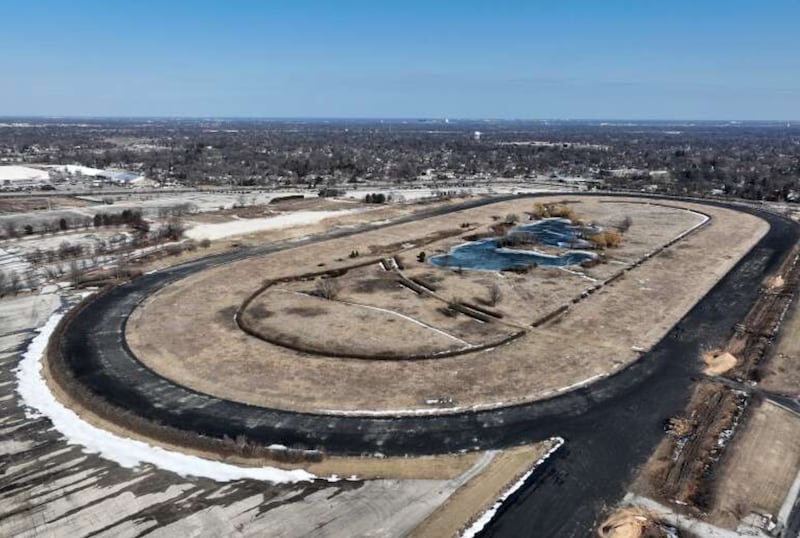
The Illinois Senate passed a bill 37-17 that would help the Bears build a stadium in Arlington Heights on a 326-acre property they own on the site of the former Arlington Park Racetrack. But the House adjourned the spring session at about 4:40 a.m. before voting on the bill.
The legislation still needs to be approved by the Illinois House and then be signed by Illinois Gov. JB Pritzker. Unless there is a special session over the summer, lawmakers won’t return to Springfield until November.
“There’s a lot of work still ahead of us,” Illinois House Speaker Chris Welch said before he adjourned the session. “We’ll continue discussions on a number of issues, including our approach to the Bears stadium question, this summer.”
The lack of action leaves where the Bears will build a new stadium up in the air.
The franchise has said over the past couple months that it was only considering sites at Arlington Heights and Hammond, Indiana. It announced that it would like to make a decision about where it will build its next stadium by the late spring or early summer and reemphasized that point in a statement Monday morning.
“We will finalize our evaluation of both Arlington Heights and Hammond, and remain on the late spring/early summer timeline that we have previously communicated,” the team said in a statement. “We will provide an update when we have a decision to share.”
Illinois lawmakers seemed on pace to pass a bill in the early morning after a complete change on the final day of the spring legislative session.
The bill the Senate passed Monday would allow municipalities in Cook County with a population of at least 70,000 residents to create their own municipal stadium authority. The franchise, which has previously dedicated $2 billion toward building a new stadium, would build the stadium but turn it over to the stadium authority to lease. It would require the Bears to agree to use the stadium for a term of at least 35 years.
This would allow the Bears to not pay property taxes on a new stadium since it will be a public building. The team would, however, have to pay property taxes on building within a potential stadium district. The bill would also permit a stadium authority to issue bonds to finance the construction of a stadium.
It also opens up an avenue, in the eyes of Chicago lawmakers, to keep the Bears in the city. Monday’s bill would theoretically help city officials come up with a plan for a stadium in Chicago, whether that’s on the lakefront next to Soldier Field or somewhere else.
The bill also created a solution for how infrastructure would be paid for surrounding a stadium district, wherever the Bears choose to build within the state.
The stadium authority will be allowed to issue revenue bonds that can be paid back solely using “pledged stadium revenues.” STAR bond district or NOVA district placed within a mile of the stadium could also pay for infrastructure, as well as other stadium district project costs.
“This, as I’ve said, would give the Bears what they want,” Illinois State Senator Bill Cunningham told reporters in Springfield on Sunday night. “They have said that they can build and will build their own stadium with private finances. They can do that. What they can also do is enter into an agreement with a municipality, with the stadium district, which would make the building publicly owned. As we know, publicly owned buildings don’t pay property taxes. So that is exactly what the Bears have asked for.”
:quality(70)/cloudfront-us-east-1.images.arcpublishing.com/shawmedia/UQI7XBK4YJB2ZO4XBR6VAXTV6I.jpg)
Monday’s Senate passage was part of a last-minute effort by lawmakers to help persuade the Bears to stay in Illinois. The state’s spring legislative session ended Sunday night but the Senate passed the bill in overtime after midnight with a supermajority.
It was the latest development in what’s been a long legislative process for Illinois lawmakers.
Lawmakers went away from a Bears-backed megaprojects bill on the final day of the spring session. That bill would’ve allowed the Bears and any major company to make a Payment in Lieu of Taxes (PILOT) instead of a regular property tax.
They originally advanced the megaprojects bill out of the House Revenue and Finance Committee at the end of February. The House didn’t pass a revised version of it until late April.
But the bill received heavy skepticism from lawmakers in the Senate for various reasons. Most were concerned about how such a bill would affect property taxes in neighboring communities. Chicago lawmakers were also not interested in providing a tax credit that would allow the Bears to leave the city for the suburbs.
The Illinois Senate has been working through the bill since then, trying to determine how to amend it so that it would garner enough support in the Senate but also in the House and from the Bears.
Illinois lawmakers have been under heightened pressure to get a deal done that’s earned national attention since December.
That’s when Bears president and CEO Kevin Warren opened up the team’s stadium search to include Northwest Indiana. Indiana lawmakers quickly jumped at the opportunity and passed and signed a bill into law in February to incentivize the Bears to move to Hammond, Indiana, just over the Illinois-Indiana border.
Both the Bears and the NFL have pushed for a quick resolution to the matter as well.
Bears brass and NFL commissioner Roger Goodell initially said at the NFL’s annual meetings during the spring that they’d like to have a decision during the late spring or early summer between the two spots. They reiterated that point and that they’re only considering two locations recently when Chicago Mayor Brandon Johnson made an effort to keep the team on the city’s lakefront.
“This, as I’ve said, would give the Bears what they want. They have said that they can build and will build their own stadium with private finances. They can do that. What they can also do is enter into an agreement with a municipality, with the stadium district, which would make the building publicly owned. As we know, publicly owned buildings don’t pay property taxes. So that is exactly what the Bears have asked for.”
— Bill Cunningham, Illinois State Senator
The bill would help the Bears finally end a five-year search that started in 2021 when the team agreed to purchase the Arlington Heights property on the site of the former Arlington Park racecourse. There have been twists and turns throughout the process, including pivots back to Chicago before going back to Arlington Heights and now Northwest Indiana.
The Bears have waited for years to evaluate what their options are for building a new stadium.
They have played in Chicago since 1921 when they first played at Wrigley Field after moving from Decatur, Illinois. The team has played at Soldier Field since 1971 with a one year-stay in Champaign in 2003 during stadium renovations. It has a lease at Soldier Field that lasts until 2033, which can be broken earlier by paying a termination payment.
Now the Bears will need to decide how longer they want to wait. If it’s not much longer, it could mean they could leave Illinois and soon call Indiana home.
:quality(70)/author-service-images-prod-us-east-1.publishing.aws.arc.pub/shawmedia/eb89d2f0-2de7-4151-81f5-2c7ea0de9d1d.jpg)