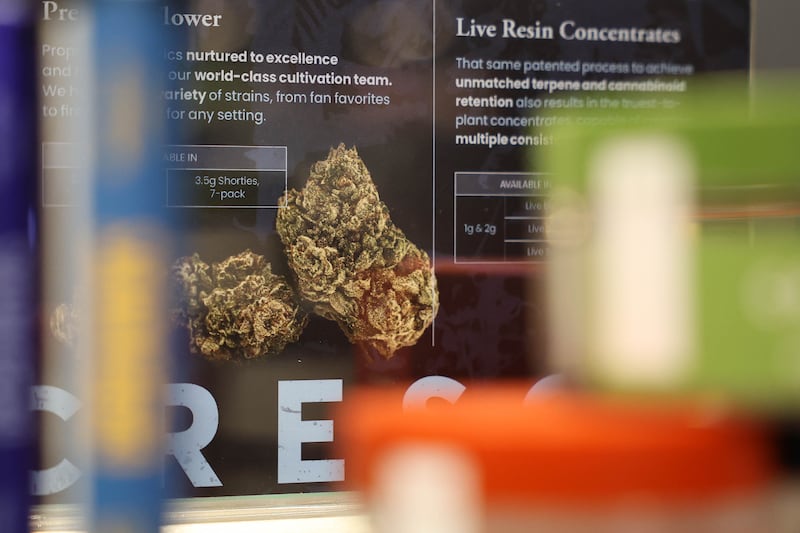
A new class action lawsuit filed in Illinois and Connecticut is raising old questions about whether the marijuana industry has oversold the plant’s medical benefits while downplaying research-based health risks.
The suit, filed May 4 by law firms including Texas-based Burke Law Group, seeks damages from cannabis sellers in 13 states where recreational marijuana is legal. Plaintiffs claim they overpaid for products marketed on medicinal claims that the lawsuit argues are not supported by science.
The case has drawn attention from local experts who study addiction, drug policy, and the science of cannabis itself. Their views reflect a complicated reality: marijuana can help some people, but the evidence is messy, contradictory and increasingly clouded by commercial interests.
“Whether you believe cannabis offers benefits to some users or is a dangerous substance, you can find a study to reinforce that belief,” said Dr. Richard Miller, a Northwestern University Feinberg School of Medicine professor emeritus of pharmacology who studies drug addiction and psychotropic drugs. He’s written books on the topic.
Miller acknowledged legitimate medical uses. Cannabis can work as a pain reliever and has shown promise for multiple sclerosis, seizures, and inflammation. “Many of these things seem to be true,” he said.
But he also noted that the scientific literature cuts both ways. Studies show marijuana can increase the risk of schizophrenia, depression, and anxiety – although the strength of that evidence depends on study design, control groups and the population studied.
“There are papers that say things like that. The scientific literature is vast,” Miller said. “It doesn’t mean that someone else hasn’t found the exact same opposite.”
Chris Reed, who runs the Woodstock-based New Directions Addiction and Recovery Services Northern Illinois Recovery Center, argues the debate has shifted since marijuana went from medical use to legal, recreational use.
“Legalized recreational marijuana rode in on the back of the medical support that it can provide people,” Reed said. But now, Reed said, dispensaries market cannabis like a cure-all, often with staff who lack medical credentials.
“Some of these places have a medical liaison inside the front door, without any medical certification or degree,” he said.
Reed also points to a generational shift in pot use. Today’s marijuana is far more potent than it was in the 1960s and ′70s, and he sees a direct link between adolescent use and serious mental health problems in the future.
Reed pointed to studies linking high-potency marijuana use among adolescents to later mental health risks.
“The rates of schizophrenia are increasing, particularly in younger people,” Reed said. “There is a direct correlation between adolescent marijuana use, potency, and severe mental health disorder.”
He is not arguing for prohibition. “I am not saying there shouldn’t be an ability to smoke marijuana,” Reed said. His concern is the marketing. “Positioning it as this medical miracle drug without acknowledging harm – that’s the problem.”
Luke Tomsha, founder and director of The Perfectly Flawed Foundation in La Salle, has studied drug policy for decades and sees in the lawsuit echoes of past public health failures.
“This is very similar to the tobacco lawsuits and opioid settlements,” Tomsha said, “when private business weren’t upfront about risks and it led to significant health issues and ultimately a public health crisis.”
Tomsha emphasizes that cannabis has real benefits for some people. But he worries about youth, whose brains are still developing.
“Their brains aren’t fully developed, and they don’t have a handle on their emotions,” he said. “Too much cannabis can be harmful in a variety of ways. You hear about psychosis, for example.”
He also noted a practical danger: dosing confusion. Edibles can range from 2 milligrams to 200 milligrams, and mistakes happen.
“A marijuana overdose isn’t necessarily lethal, but it is a very uncomfortable experience,” Tomsha said. “A friend may give them an edible and say it was 5 milligrams, and it ends up being 50 – that can put people in a state of panic or extreme anxiety.”
In Illinois, the suit was filed in Rockford’s Northern District of Illinois and Madison County by former Republican McHenry County state’s attorney, Pat Kenneally, and Jack Franks, a Democratic former Illinois lawmaker and one-term McHenry County Board chairman. Both are now in private practice, with Kenneally at the Burke Group.
As the state’s attorney in 2023, Kenneally required McHenry County dispensaries to display signage, warning customers of potential marijuana mental health risks and “the FDA has not approved cannabis for the treatment of any disease or medical condition.”
Humans have used marijuana “for tens of thousands of years ... because they found it beneficial,” Miller said. “It is a very ancient medication.”
Now that it is a business, “there is a lot of hokum that people claim” regarding its benefits, Miller added. Some, he said, are absolutely true, and others “are an advertising ploy.”
:quality(70)/s3.amazonaws.com/arc-authors/shawmedia/185fbfd8-8216-43d7-8beb-cd8992be6fe5.png)