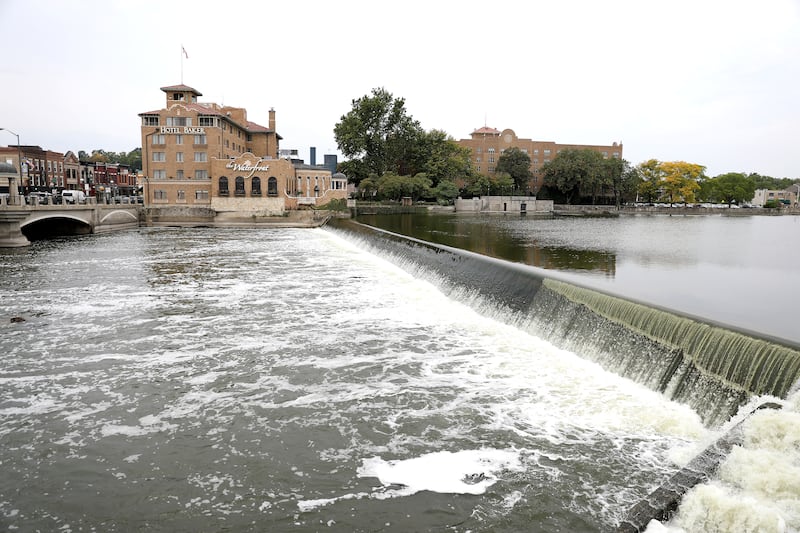
With a resolution passed to preserve the deep body of upstream water resulting from the Fox River dam in St. Charles, the question turns to funding.
The resolution approved by the City Council during its June 1 meeting keeps the city open to a potential modification of the dam in the future as long as the body of water upstream, the “impoundment,” remains.
While the city said the goal is to provide some clarity to the current predicament, the situation still contains several known knowns and known unknowns.
To restore ecological degradation from unnatural sediment buildup and decreased water oxygen levels that deplete biodiversity, the Illinois Department of Natural Resources, in partnership with the U.S. Army Corps of Engineers, initiated a study to examine 10 Fox River dams for potential removal, stretching from Algonquin to Montgomery.
The city has since said the U.S. Army Corps of Engineers announced it does not have the funding to continue the study right now and does not have a timeline for when it might reinstate the study.
City Administrator Heather McGuire said the passed resolution does not prevent the city from changing its mind in the future or from continuing to work with the IDNR.
“It allows for the flexibility, whether that is the dam staying as is, whether the dam gets rebuilt, whether it’s converted to some other system modification or tiered system,” McGuire said during a May 18 city meeting.
McGuire said the resolution just clarifies that maintaining the impoundment must be “crucial to whatever decision is made” because the boating and recreational activities enabled by the water depth is “integral” to the city.
This is where the water situation gets a little more murky.
Maintaining the impoundment without a dam structure is difficult to imagine considering the deeper water is a product of the dam.
Dam modifications, including safety features and fish steps, come with a hefty price tag. The modified dam in downtown Yorkville cost around $8.25 million and was completely funded by the state.
According to city officials, the IDNR told St. Charles that if the city decides to keep the dam, the city must take full ownership, maintenance and liability for the dam. For any modifications, the IDNR said it would only fund $780,000, or 60% of the $1.3 million it would have cost to remove the dam completely. The city would be on the hook for the rest of the project’s costs.
Without discussing where the future funding would come from, the City Council said it would like to explore ways to maintain the current impoundment water levels, including modifying the dam. No concrete solutions were discussed.
Alderperson Steve Weber said the historical landmark status of the Baker Hotel and the St. Charles Municipal Building, on either side of the dam, should be taken into consideration.
“I just don’t see a world where St. Charles does not have the impoundment of the river,” Weber said.
Alderperson Mark Foulkes said he approves of the resolution because it provides finality to the city’s direction while providing time to explore options heading into the future.
Dividing residents
During city meetings, some residents, especially those with property along the riverfront, have said the impoundment is essential to ensuring future generations can continue swimming, boating and fishing. The residents in favor of keeping the dam have said the fish populations are healthy – several residents involved with studying the ecosystem have disagreed.
Jeff Mengler, a resident and ecologist, said the resolution “does not even mention the ecological health of the river or the river quality.” He said it “focused solely on human recreation and economic gain in the short-term.”
Mengler said the river ecosystem resulting from the current dam is “impaired” and “unhealthy.” He said the Yorkville dam came with high cost overruns and its “functionality for fish passage is limited at best.”
With St. Charles taking on maintenance and liability for water rescues, drownings and improving the impaired water quality of the river, Mengler said “it’s economically foolish for the city to keep the dam.”
Steve Leffler, who serves on the board of directors of the River Corridor Foundation of St. Charles, said the Fox River Study Group’s 2022 analysis showed communities up and down the river will be burdened with around $150 million in water treatment upgrades over the next decade if the river remains impaired by dams.
He said with residents currently paying water rate increases, the decision to keep the dam could set them up for more cost hikes.
Leffler said dams are the “single largest physical stressor” on the river.
“In the impoundments, temperatures, nutrients, and algae levels are higher, resulting in lower dissolved oxygen and less biological activity,” Leffler said.
He said because so many fish and river organisms have a hard time surviving with dissolved oxygen levels, the problems will only compound by keeping the dam. He said the river is defined as legally impaired by the Illinois EPA under the Clean Water Act.
“That designation carries regulatory consequences that don’t go away just because we passed a resolution,” Leffler said.
:quality(70)/s3.amazonaws.com/arc-authors/shawmedia/0cef0bf9-a04e-4bb4-aea0-03d8ced01c00.jpg)