With utility rates hiking about 50% by 2029, the city of St. Charles is turning to state and federal lawmakers in hopes of easing the burden on residents.
While the increased bills are to cover $417 million in sewer and water infrastructure upgrades, which includes $84 million to replace lead pipes over the next decade, the city frustrated with the unfunded state mandate.
The remaining $333 million is for replacing aging water mains and upgrading sewer systems – work long put off by the city.
Taking aim at the unfunded lead pipe mandate, Mayor Clint Hull proposed a resolution that received City Council support to send a formal letter to state and federal legislators.
The city must replace lead service line connections for around 3,033 water customers. Drinking water from lead pipes has been shown to cause child development issues, neurological damages, kidney damage and reproductive issues, according to the Environmental Protection Agency.
In the letter, Hull asked lawmakers to consider extending the timeframe to remove the lead pipes and to provide St. Charles additional grant funding or zero-interest loan options to “reduce the impact on local residents and utility ratepayers.”
During the April 27 committee of the whole meeting, Hull said it was not fair the timeframe was recently reduced from 30 years to just a decade. While the city initially planned to spread costs over three decades, the Illinois Environmental Protection Agency shortened the mandate to 10 years in 2024.
“We have been faced with this unfunded mandate, ultimately throwing this in our laps,” Hull said during the meeting. “We’re going to do whatever we can to try to make sure that we try to reduce the impact on our city, and part of that is advocating with our legislators both federally and on the state side.”
He said the city is “by no way mitigating the harm that lead pipes do,” but stressed the urgency in opening up alternative funding options.
“We’ve applied for low-interest loans; we’ve been shut out of that process,” Hull said. “We want to advocate to our state and federal legislators that they open that and create more funding mechanisms so that towns like our can qualify.”
The letter says the city will comply with all regulations. The $84 million cost is being divided into annual phases of work each running $8.4 million. The work begins this year.
Approval for first batch of lead pipe replacement tabled
Approval for the bid containing the first year of construction was tabled until May 4 as city staff gathers information to provide to affected residents and businesses.
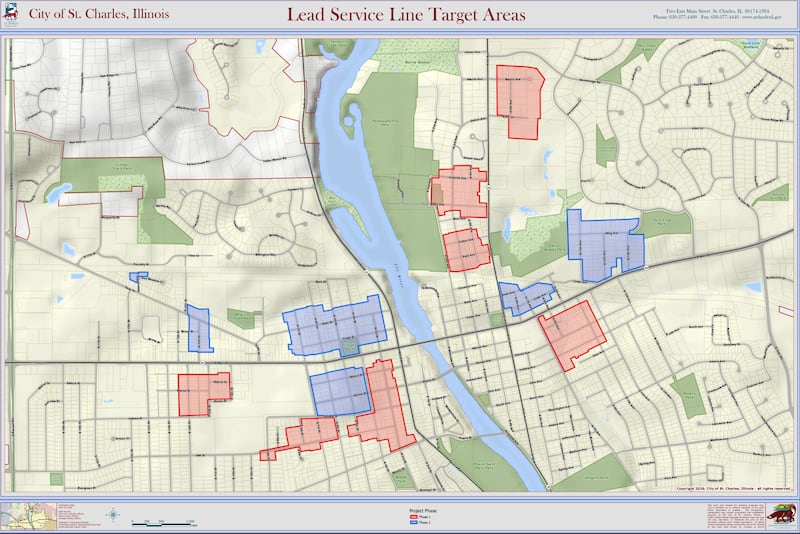
The city was originally getting ready to move forward a $7.65 million contract with Swallow Construction, from West Chicago, to replace lead service lines in high-priority areas across town.
According to city staff, the proposed replacement costs for individual homes will be different based on the site conditions at the residence. In general, each individual service line replacement will cost $21,000 to $25,000.
Several factors are taken into consideration regarding which areas will have their lead pipes removed first, with a priority being socioeconomically burdened areas.
Factors in each area include median household income, percentage of children under 6, rates of poverty and unemployment, and rates of people receiving social security and other types of assistance.
Also taken into consideration is the age of the pipes in the area, specifically pre-1990 construction, and the total percentage of lead pipes in the area.
Raised rates regardless
Even without the lead pipe replacement program, the city is facing another $333 million in costs to upgrade “aging water infrastructure.” Of the city’s 289 miles of water mains, the city said more than 80 miles are around 75 to 100 years old, increasing the chances for costly breaks.
:quality(70)/cloudfront-us-east-1.images.arcpublishing.com/shawmedia/ERHNZ6OB2NHGNHVJ3VOWV72EI4.png)
Electricity, sewer and water costs are combined into one monthly bill for St. Charles rate payers.
If your current monthly utility bill is $200, by 2029 it will be $298.31, according to the city. This includes a 17.3% spike in monthly bills starting this June, a 14.7% jump in year two, a 6.4% increase in year three and a 4.1% increase in June 2029.
City finance director Bill Hannah previously said the rate jumps will likely be readjusted in the future.
“A portion of this water rate increase is temporary,” Hannah said. “Once the city is finished with the lead service line unfunded mandate project, we will be able to roll back some of that increase.”
:quality(70)/s3.amazonaws.com/arc-authors/shawmedia/0cef0bf9-a04e-4bb4-aea0-03d8ced01c00.jpg)