Local activists in Joliet, Lockport and Shorewood took to the streets Friday afternoon to take part in a series of May Day protests.
The protests were among thousands taking place across the country in recognition of International Workers’ Day, and were centered around the theme “Workers Over Billionaires,” demanding better pay and benefits for workers and higher taxes on the ultra-wealthy.
In Lockport, about two dozen people gathered along Farrell Road outside Walmart with signs opposing President Donald Trump, the war in Iran and Gaza, high gas and healthcare prices, U.S. Customs and Immigration Enforcement and billionaires, as well as signs urging people to “vote blue.”
Senior citizens were gathering in Shorewood to hold a rally in the 1100 block of N. River Road.
“We hosted the No Kings Day protest in Lockport in March, so when we saw these happening we decided to create another event,” said co-organizer of the protest Jackie DeNardo. “We weren’t expecting a huge turnout because it’s Friday afternoon, but it’s always good to see support around you in the community. A big part of why we do this is to show people that they aren’t alone.”
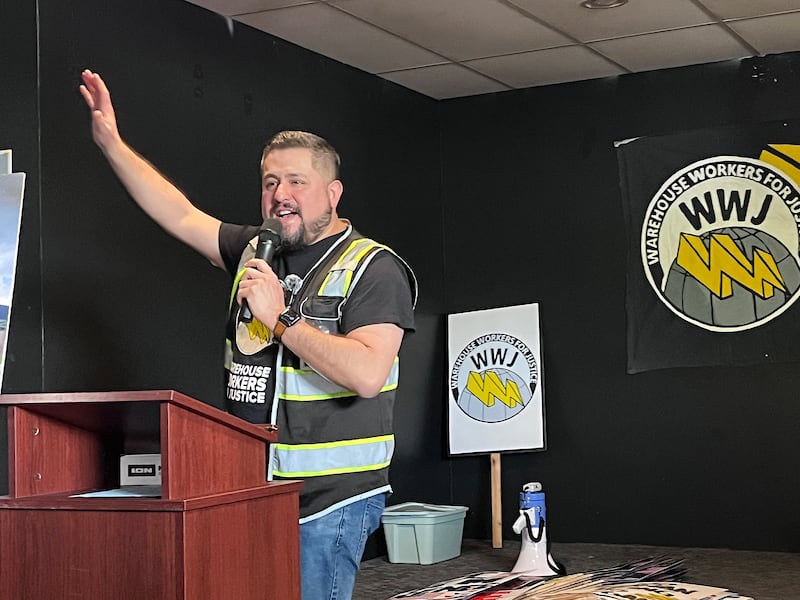
Warehouse Workers For Justice held an event in Joliet to recognize not just International Workers’ Day but also the victims of injustice at the hands of ICE.
:quality(70)/cloudfront-us-east-1.images.arcpublishing.com/shawmedia/IPZXCFTZTVB2FC2ZANNBEXADF4.jpeg)
Marcos Ceniceros, executive director of Warehouse Workers For Justice, told the crowd gathered at the Joliet office, “Nothing moves without us.”
“We’re here to tell the billionaires, we’re here to tell the company owners that mistreat us that nothing moves without us,” Ceniceros said.
DeNardo said she wanted to take part in the Lockport protest to draw attention to income inequality, particularly around billionaires and large corporations, and how they are taxed.
“I find it interesting to think of a billion dollars,” DeNardo said. “The average lifespan today is 79 years. To spend a billion dollars in 79 years, you’d have to spend about $35,000 per day, every day of your life. The average personal income in Illinois is around $70,000, so the average person’s whole income for the year is what a billionaire could spend in just two days. It’s such a disparity, it’s horrible.”
Several of the people protesting in Lockport were local members of the American Federation of Teachers who said they were protesting both the underfunding of public schools and ICE, which has caused distress for many Hispanic students.
:quality(70)/cloudfront-us-east-1.images.arcpublishing.com/shawmedia/PEVKPTUDDBBSDGKPZX234ACIHM.jpeg)
“Our union is here advocating for the full funding of public schools,” said Dan Mercer, the president of the American Federation of Teachers Local 604, which represents Lockport and Joliet’s high school districts.
“We’re seeing a squeeze of resources at the federal level, and there is not enough funding on the state level to reach the funding levels that the state promised, let alone to make up for the federal funding,” Mercer said.
Mercer said the union is supporting a tax on millionaires and billionaires at the state level, which would fund schools, though the proposed amendment is not likely to appear on a ballot until 2028.
“I think people who’ve benefited from the economy can afford to pay a little more to support our schools,” he said.
Meanwhile, his fellow teacher, Kyle Stern, the president of the West Suburban Teachers Union 571, said one of his chapter’s biggest concerns was immigration.
“We’re concerned about ICE,” he said. “We’ve had parents of our students detained who are citizens. We’ve had students afraid to come to school. We represent Franklin Park, where that man was shot after dropping his kids at school. It’s very scary. It’s an attack on democracy, and it’s an attack on human rights.”
One recent issue that seemed to be attracting a lot of the protesters’ ire was the proposed construction of a White House ballroom using taxpayer funds.
“People aren’t getting health insurance or going to the doctor because they can’t afford it, but we’re paying for a ballroom and a war?” asked nurse Maryanne Riley Jensen facetiously. “It’s just wrong.”
“I can’t believe the hypocrisy of these people,” said Micki Skrip. “We can’t save our kids from being shot at in schools, but we’re gonna save this one guy with a $200 million ballroom. That’s just great.”
While the small group of protesters received a lot of supportive honks from passing vehicles, they also were met with a handful of hecklers.
“You get a few of them no matter what you’re out marching for,” said Loretta Slavik, who said she’d been attending protests for decades. “It’s okay. There’s a lot more interest in these events recently. People who used to say ‘I never vote’ are even getting interested, and we need to get noticed more, because if you don’t speak up, nobody will know what you’re thinking.”
LaBryant Smith, worker leader for the organization, said International Workers’ Day was about the people who wake up early and work long hours to provide for their families and “keep a city moving.”
Smith said it’s about the people who perform “labor that often goes unseen” but keeps businesses running daily. And yet too often workers are “treated like they’re disposable,” he said.
:quality(70)/cloudfront-us-east-1.images.arcpublishing.com/shawmedia/4DXF2OUSJVECZMELRFMNX7RTS4.jpg)
Griselda Chavez, an environmental justice worker, said the celebration of May Day arrives about a week after Earth Day, which highlights an “overlooked connection” between organized labor and environmental justice.
Chavez said safe air quality and drinkable water align with the need for workers’ safety and dignity.
“Environmental justice is worker justice because our workers are the people most affected by pollution, unsafe conditions and a broken system that puts profit ahead of people,” Chavez said.
:quality(70)/s3.amazonaws.com/arc-authors/shawmedia/7a2e8311-fc10-4849-8481-ab8459fa3039.png)