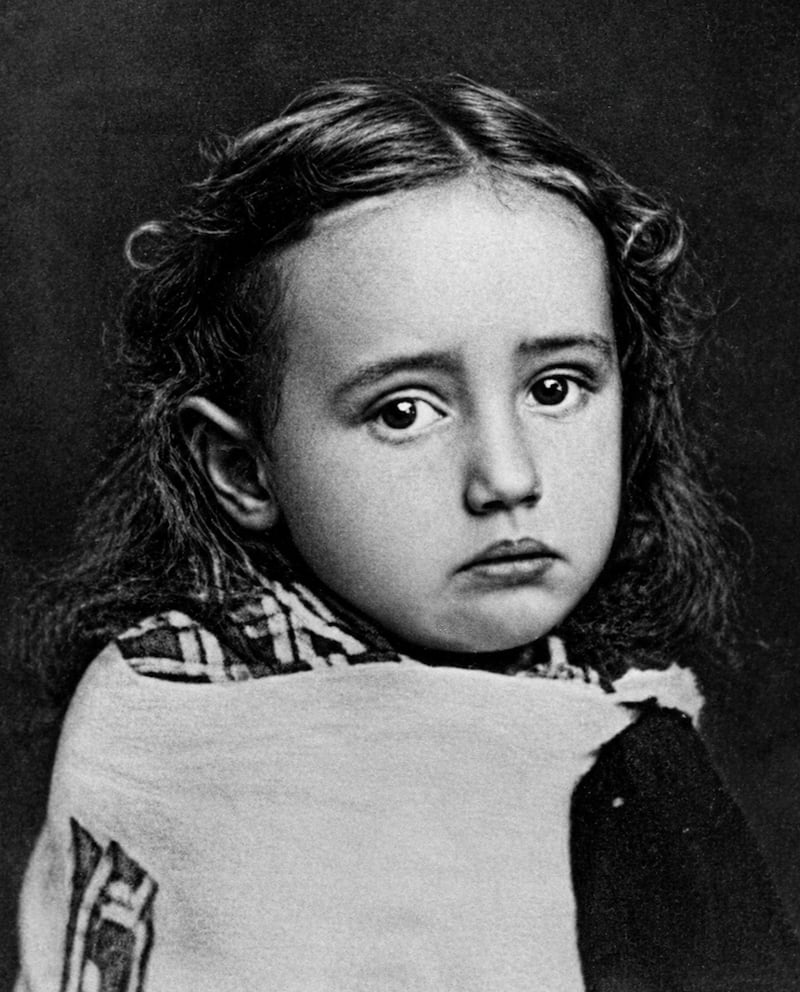
On May 4, 1873 – 153 years ago this weekend – a large crowd gathered on Dixon’s Truesdell Bridge to watch a baptism. Among them was 3½-year-old Gertie. She would be the littlest survivor of that terrible day.
Ironically, Gertie was born in Dixon in 1869, the same year the Truesdell Bridge was erected across the Rock River. Her parents, 25-year-old John and 19-year-old Josephine, had just married in 1868. Anna Gertrude was their firstborn child; they called her “Gertie.”
Gertie’s maternal grandparents were James and Christan Goble, longtime Dixonites who first came to Lee County in 1837. Five children were born of their union, but Josephine, Gertie’s mother, was their only surviving child.
The devoted grandmother
Grandmothers often pamper their grandchildren. In Christan’s case, Gertie was extra special. She was Christan’s first grandchild and her only hope for a future generation.
In 1871, the Illinois Central Railroad offered John a promotion to an important job in Bloomington. This job meant that 2-year-old Gertie and Josephine, pregnant again, would move away from Dixon. As devoted grandparents, James and Christan Goble moved with them to help their daughter, who then gave birth to a son that October.
By April of 1873, the homesick grandparents returned home. On April 30, 1873, the Dixon Sun newspaper welcomed the return of James and Christan Goble, noting that they planned to make Dixon their “final home.”
The Sun expressed a hope that the Gobles may “live long” to enjoy the city’s constant improvements. The paper had no idea of the awful tragedy that would descend on the town only four days later.
Dressed in their Sunday best
For their first Sunday back in Dixon, Christan was delighted to have little Gertie, then 3 years and 5 months old, staying with her, while her parents remained in Bloomington. As a longtime devoted member of the First Baptist Church, Christan proudly entered the church that Sunday, showing off her precious granddaughter.
The two were dressed in their Sunday best. At that time, ladies and girls wore full-length dresses with petticoats and layers of material.
May 4, 1873, was a special day at church; six people were to be baptized in the Rock River. So, after church on that bright spring day, Grandma Goble and little Gertie strolled for two blocks, hand-in-hand, down Galena Avenue to the Truesdell Bridge, built the same year Gertie was born.
The baptism of death
They stepped onto the bridge with a crowd of 150 to 200 others, stopping on the west sidewalk of the north end of the bridge, above where the baptisms were to take place. Since Gertie was no taller than the sidewalk’s 3-foot railing, Christan probably held Gertie in her arms so that Gertie could get a better view.
During the third baptism, the bridge emitted a loud crack and collapsed. In seconds, it tipped over and plunged into the river. The bridge’s 15-foot wall of iron latticework, which stood behind all those on the bridge’s sidewalk, came down on top of them.
It appears that Christan had the presence of mind to thrust little Gertie away from the iron cage that quickly trapped the grandmother and dozens of doomed victims under the water.
‘Sustained by her clothing’
Little Gertie’s fate was reported by at least a dozen newspapers, including the Chicago Daily Tribune and the New York Times. These news stories indicate that Gertie was unconscious as the cold current swept her downstream with dozens of frantic, flailing people.
The Tribune reported that she was “sustained by her clothing.” The same heavy garments that doomed so many others kept her afloat.
She drifted helplessly as far as the railroad bridge (today’s pedestrian bridge), about one-third of a mile downriver. There, a young man spotted her, dove in and swam out to her. He rescued her “almost miraculously,” grabbing her by the hair and paddling with one hand to shore.
The Dixon Telegraph said that Gertie was “nearly gone by strangulation.” Newspapers reported others with the same “strangulation” problem, which was common terminology for near-drowning victims.
The littlest survivor
When Gertie was revived on shore, the traumatized child realized that Grandma was gone. Gertie knew no one around her. But amid the chaos, caring Dixonites eventually placed her in a boat – now the only way to cross the river – and returned her to the south side, where she was reunited with Grandpa James Goble.
Of the 46 people who died in the disaster, 37 were females wearing heavy dresses, including 51-year-old Grandma Goble. Of all the female deaths, 14 were girls younger than 18, and three were younger than 10. But of all those on the bridge who survived the calamity, Gertie was the youngest.
Word finally reached Gertie’s parents back in Bloomington. Devastated by the news, they climbed into a horse-drawn carriage and hurried back to Dixon.
Coming back home
On May 15, the Telegraph reported the good news that Gertie had “entirely recovered.” But the traumatic event shook the family to its core. Gertie’s father, John, resigned his position in Bloomington, and the family soon moved back to Dixon. They never left their hometown again.
In the ensuing years, Gertie was raised in Dixon with five brothers and two sisters. At age 20, she married Henry Grant Lievan in 1889.
The two produced five children before moving away in 1910 to try farming in Kansas and Missouri. But like her parents, Grant and Gertie finally returned home to Dixon in 1925.
How the story ends
Gertie became a devoted and beloved member of the Grace Evangelical Church at Fellows Street and Ottawa Avenue. A strong woman, she lived into her seventies, outliving her husband and two of her younger brothers.
:quality(70)/cloudfront-us-east-1.images.arcpublishing.com/shawmedia/OUJJFGVFQND2TKBQGWSZD6UYNQ.png)
Finally, at age 74 on March 15, 1944, Gertie died at her home at 115 W. Everett St. in Dixon, only two blocks from the river where she had survived the bridge collapse 71 years before. To my knowledge, she was the longest-living survivor of “Dixon’s darkest day.”
Had she not survived, I would not be here to tell her story. Gertie was my great-grandmother, Anna Gertrude Wadsworth.
- Dixon native Tom Wadsworth, Ph.D., is an author, speaker and historian. His popular new book, “Distinctive Dixon: Fascinating Stories of Dixon’s Rich History,” is available at Books on First in Dixon.