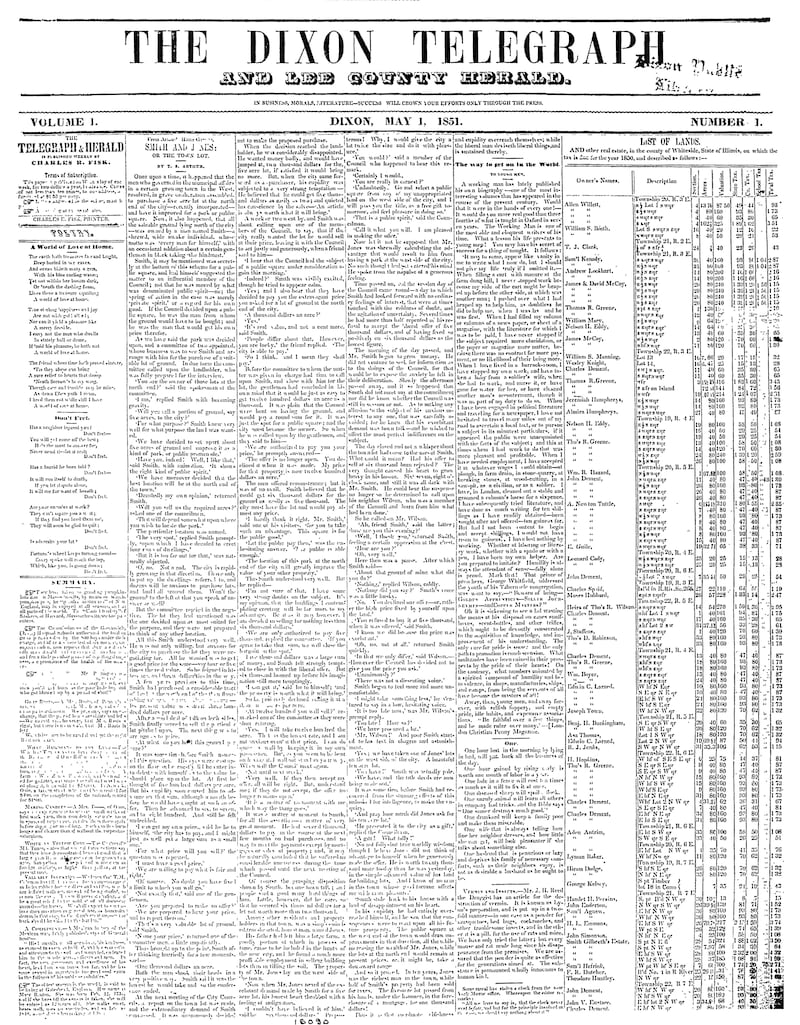
The year 2026 marks two major milestones: the 250th anniversary of our nation’s birth in 1776 and the 175th anniversary of the Dixon Telegraph.
Born on May 1, 1851, The Telegraph is one of the oldest institutions in the city and throughout northern Illinois.
As a local historian, I have relied heavily on Telegraph coverage of local events over those 175 years. Since the history of Dixon is so deeply intertwined with the history of The Telegraph, this article will reveal some enlightening details of the beginnings of The Telegraph itself.
Morse code and the telegraph
No newspapers served Lee or Whiteside counties in 1850. But Samuel Morse’s famous invention of the telegraph system had a role in bringing a newspaper to Dixon.
In 1843, Morse convinced Congress to fund the construction of the nation’s first telegraph line, running from Washington, D.C., to Baltimore. Transmitting messages by Morse code, the telegraph system could send news and information instantaneously over long distances.
By 1851, telegraph lines had recently connected Dixon with Peru, Illinois, as a part of a larger project to build a transcontinental network of telegraph lines. So, when the weekly Dixon Telegraph and Lee County Herald printed its first issue on May 1, 1851, the name “Telegraph” conveyed to readers its promise of using this revolutionary technology to deliver the latest national news.
Initially, the promise exceeded reality. During the paper’s first four weeks, the telegraph lines from Peru were down about half the time. Consequently, it appears that these early Telegraph issues gleaned their national news from the Chicago Democrat, a newspaper that came to Dixon via the stagecoach.
Primitive provisions
Transportation in 1851 was primitive and slow. It typically took two or three days for the Chicago newspaper to reach Dixon. All roads were little more than dirt paths for horse-drawn stagecoaches, carriages and wagons. Dixon had to wait until 1855 for the railroad to arrive.
Electric lighting and kerosene lamps did not exist at that time. In one of the Telegraph’s early issues, the editor posted a request for “a few pounds of lard to burn in lamps at this office.” These lamps were constructed of “tallow candles stuck into scooped out potatoes.”
Dixon then had no reliable bridge across the river, even though as many as 11 bridges had been attempted. The Telegraph’s first issue reported, “Measures are … being taken to construct a bridge over Rock River at this point, which is now crossed by a good rope ferry boat, which is in operation night and day.”
The 9-block village
In the census of 1850, Chicago’s population reached 30,000, becoming the state’s largest city. Dixon, the second-oldest city in northwestern Illinois, claimed 1,000 residents.
John H. Moore was “the paper boy” who delivered the first Telegraph to every home in Dixon. He later recalled the extent of the village on May 1, 1851. He said that if you stood on the north-side bluffs just west of today’s armory, “nearly every house in town could be seen at a single glance.”
Moore added that Dixon “reached but little beyond the 9 blocks bounded by Peoria and Ottawa avenues east and west, and River and Third streets north and south.” Outside of those boundaries, there were a few houses to the west and eight to 10 houses on the north side.
South of the courthouse was nothing but “a wilderness of brush.” The Nachusa House was only “a hole in the ground,” where construction had been halted ever since 1837.
Only the Baptists and Methodists had built meeting houses. The Telegraph editor bragged that Baptists even had a bell. But no other denominations had yet organized.
The business district was mostly on River Street, as was the newspaper office, above the general store of Ayres & Barnes. Dixon then boasted a land office where settlers could buy local land from the government, a courthouse, a telegraph office, three hotels, a livery stable, a market and eight to 10 stores.
The Johnny Appleseed of newspapers
I always assumed that the acclaimed B. F. Shaw was the first proprietor and editor of The Telegraph. He was not. That honor goes to Charles R. Fisk, an enterprising 48-year-old “Presbyterian clergyman of the old school,” who had arrived in Dixon only a month earlier with his wife and son.
Fisk might be called the Johnny Appleseed of northern Illinois newspapers, having established the first newspaper in several Illinois towns. But after planting the seed, he typically sold the newspaper and moved on to start another paper elsewhere.
In 1849, before coming to Dixon, Fisk launched the Knox Intelligencer, the first newspaper in the village of Galesburg. Dixon was probably Fisk’s next stop in 1851. But after only five months, he sold the Dixon paper to J. F. Hopper and M. T. Bull.
Fisk then drifted to several other small Illinois towns, pioneering or operating newspapers there and sometimes organizing a Presbyterian church. Specifically, Fisk started the Little Rock Press (Kendall County) in 1854, the Mendota Press (La Salle County) in 1855 and the Delavan Advertiser (Tazewell County) in 1868.
Southern sympathizer
Even though he ran the Telegraph as a politically independent paper, Fisk was later known to lean Democrat on the slavery question, the hot issue of the day. “Old school” Presbyterians like Fisk generally opposed abolishing slavery. When Fisk ran the Mendota newspaper, he was described as “a warm sympathizer with the South.”
When he died suddenly at age 66, a competing paper noted that Fisk had “published papers in several other parts of Illinois, but never made them profitable to himself – never having a genius in that direction.” Fisk was buried in 1869 in Delavan, Illinois, 20 miles south of Peoria.
If only he had stayed …
When Fisk launched the Telegraph in Dixon in 1851, the paper was “the only newspaper then existing between LaSalle and Galena and between Naperville and Rock Island.” Even though it became Fisk’s only newspaper that survived, it faced an uphill battle.
The Telegraph changed hands four times in its first nine months. But if Fisk had only stayed in Dixon a little longer, he would have seen the village experience rapid growth.
The Nachusa House rose out of its hole in 1853, and the railroad arrived amid much excitement in 1855. By the end of 1855, Dixon’s population had tripled to 3,000, and its dozen businesses exceeded 120, as The Telegraph’s subscribers and advertisers skyrocketed.
In our next issue, we’ll examine the early years of The Telegraph, young Ben Shaw, and why he came to town.
Hint: A girl was involved.
- Dixon native Tom Wadsworth, PhD, is a writer, speaker and occasional historian. His popular new book, “Distinctive Dixon: Fascinating Stories of Dixon’s Rich History”, is available at Books on First in Dixon.