Cary successfully passed a balanced budget Tuesday, but not without some major changes from the draft presented last month, including an updated spending plan for renovations for a downtown alley that increased by over $500,000.
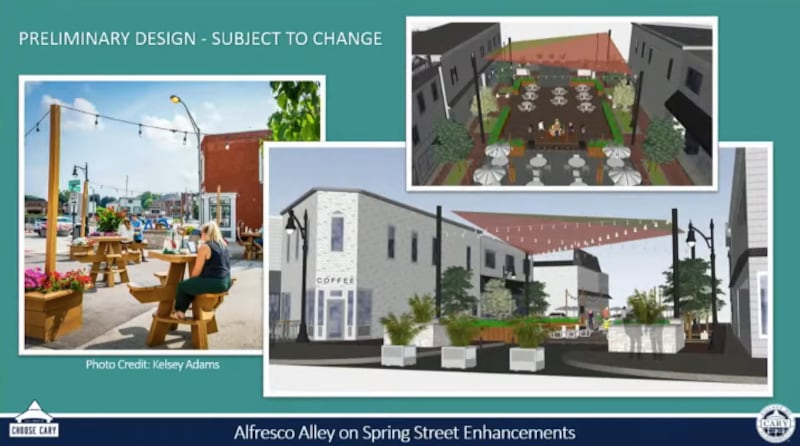
Every summer, vehicle access is shut off on the northern half of Spring Street in downtown Cary to turn it into an outdoor eating-friendly “Alfresco Alley.” The village is looking for ways to upgrade the experience to match its Main Street renovations.
:quality(70)/cloudfront-us-east-1.images.arcpublishing.com/shawmedia/OUHK2DNFWRENVHGXJHF53T2HM4.JPG)
In February, landscape architects MKSK Studios presented preliminary ideas to transform Spring Street. Some improvements include a seat wall, pedestrian paving that matches Main Street, overhead string lighting, bench seating and bike racks.
Originally, the village used a $850,000 grant it received from the U.S. Department of Housing and Urban Development for the project as a budget placeholder. Within the month, estimates for utilities, surveys and electrical costs came in, bringing the new total project estimated costs to about $1.36 million, Village Administrator Erik Morimoto said.
“These figures are estimations based on information gathered by the consultant as the design progressed from the conceptual to technical phase and remain subject to change until the design is finalized and construction bids are received,” Morimoto said in an email to Shaw Local.
Possible seasonal upgrades include a shade structure, shade pergolas, a wood deck and lawn tiles. These temporary additions would be used only during the warmer months when the street is closed off to pedestrian access.
Following about a $511,000 cost increase, the village will hold off on getting the seasonal deck this year.
“It’s not because of price creep or inflation,” Morimoto said during Tuesday’s meeting. “This refined design, we now know more of the details and the exact quantities and requirements needed for that design.”
Some good news for the village is that sales tax projections increased by $300,000 from what was originally predicted, Finance Director Kelly Brainerd said. To keep the budget balanced, that extra $300,000 will be transferred from the general fund into the capital fund.
:quality(70)/cloudfront-us-east-1.images.arcpublishing.com/shawmedia/PJR4BGYAJZAD7J3GD7MXXAMJJQ.png)
According to village documents, sales tax is the largest revenue source for the village, taking up 26.56% of total budgeted general fund revenue for 2027. The total sales tax, not including non-home-rule sales tax, is projected to top $3.36 million, Morimoto said.
The total projection for the 1% non-home-rule sales tax is $708,000, slightly less than the originally estimated $750,000 when the village first introduced the tax.
International affairs have also affected the village’s budget. Brainerd said the village fuel costs across all of the funds in departments increased by 10% “based on what’s going on right now with gas prices.”
Oil prices soared after Trump vowed the U.S. will continue to attack Iran last week. Although a two-week ceasefire was announced Tuesday, The Associated Press reports gas prices continue to climb.