Editor’s note: Shaw Local reporter Amanda Marrazzo’s dog Vinnie spent a free day at the Underdog Academy in Algonquin, an opportunity offered to anyone considering signing their dog up for a training program. She shares how it all went.
Vinnie, my loving, rambunctious 2-year-old ruby Cavalier King Charles Spaniel, had a special outing recently. The day began up and out the door early, and not for just his usual morning walk. He was off to the Underdog Academy in Algonquin to learn some manners.
The academy, which has trained almost 500 dogs since opening in January 2025, is owned by Zachary Holland, 28, of Island Lake. Holland began learning how to train dogs with his father when he was just 15. Henry Schnur, 24, of Hoffman Estates, who started at the academy with Holland last year, said he learned all he knows about dog training from Holland.
:quality(70)/cloudfront-us-east-1.images.arcpublishing.com/shawmedia/26UVDE5W7RBGJL537MXHV4PO2Q.jpeg)
The business is operated like a true academy, Holland said. Those interested in signing up their dog for a course are first given one full free day.
Vinnie, who lives with my husband and me along with our daughter and her two cats, arrived at the academy about 10 a.m. on a recent Friday.
Same as the days I took my daughters to preschool for the first time, we walked in and I looked on anxiously as Vinnie cautiously headed into a room already occupied by about 15 other dogs. But if I didn’t see the other dogs, I wouldn’t have known they were there.
The dogs, of all breeds, sizes and ages, sat or laid quietly on cots. Not one barked or became excited when Vinnie entered.
Vinnie, who is still in the reactive, excitable puppy phase, and who is working through what behaviors are acceptable, walked right in. He surprisingly seemed pretty much to conform to “the pack,” as Holland describes a grouping of dogs. Then I left. Throughout the day, same as anyone else who signs up for the free day of training, I received photos and videos of Vinnie in training.
:quality(70)/cloudfront-us-east-1.images.arcpublishing.com/shawmedia/PNXIQWSYOBFNDC2SG4SEDQOFX4.jpeg)
The dogs’ calm demeanors, Holland and Schnur said, are the result of the “philosophy we lean into.” They likened the scene to high school. When a student goes to high school, they want to “fit in.” So, they instinctually conform to the status quo.
“Dogs are pack animals,” Holland said. “When you have one or two dogs at your house, they tend to do what they want, because they think they can get away with it. But very similar to when we go to high school and we want to fit in, dogs are the same way. As a pack, they look around the room their mind shift changes and they think what do I have to do to be apart of this pack.”
Therefore if an untrained, easily excitable dog – take Vinnie, for example – walks into a room filled with calm, obedient dogs, he will, and Vinnie apparently did, behave the same.
Vinnie looked around the training room and saw all the other dogs and he wanted to be in sync with them. When not going through training sessions he was calm and sat on his cot like the others, the trainers said.
Holland called those dogs in the academy that day his “blueprint dogs.” They help train the new dogs. And, in Vinnie’s case, like most, it worked.
Schnur and Holland said when dogs are fearful, skittish or aggressive, it can be hard for a human to communicate with them or change their behavior. This is because, as dogs, those behaviors are naturally inherent.
“But when we allow them to hang out with our blueprint dogs, the new dogs change to be like the trained dogs,” Schnur said. “If a new, scared dog comes in and is sitting next to a trained, confident dog, he will take on the confidence of that other dog.”
Both trainers said they have seen this positive transition “many times.” Each trained dog naturally helps train new dogs.
“We let the dogs repack other dogs,” Holland said. “They learn through the pack and we lean into that.”
Once the new dog’s demeanor has aligned with the calm presence of the “blueprint dogs” training can begin.
:quality(70)/cloudfront-us-east-1.images.arcpublishing.com/shawmedia/KZOIAO2DOBFNPG3CWEG7TIKUGQ.jpeg)
The trainers recalled one of the more extreme cases, an interaction between Lola, Holland’s German shepherd who was one of the academy’s blueprint dogs ,and Ember, a smaller and skittish mixed-breed dog.
Ember was extremely fearful and scared of everything around her and would behave aggressively. At the academy, when someone walked by her on one of the cots, she would growl and show her teeth.
Holland said Ember would bite or bark out of fear. That was her way of protecting herself and making those things that scared her move away from her, he said.
“Dogs become aggressive out of fear because they don’t know what else to do to protect themselves,” Holland said. He took Ember home with him and Lola for a few days, and Ember began to learn from Lola. Ember learned, “Oh, I don’t have to be afraid when the doorbell rings or the neighbors are out because Lola isn’t, and I trust her. She is modeling good behaviors,” Holland said, adding Ember learned ”she doesn’t have to be afraid of everything."
The trainers say dog training and redefining “the pack order” in the home requires the same principles as teaching children manners and acceptable behaviors.
It involves:
- Setting clear boundaries, standards and expectations for what is acceptable.
- Having a clear level of communication.
- Consistency and follow through.
- Discipline and affection.
Before attempting to train a dog, Holland and Schnur recommend exercising and playing with the animal first to burn off excess energy. And, only give treats after a dog listens to a command, not as a way to entice a dog to listen to a command.
At 5 p.m. that Friday, when my husband, daughter and I returned to the academy, located at 220 Eastgate Court, Vinnie was sitting on his cot in the middle of the room.
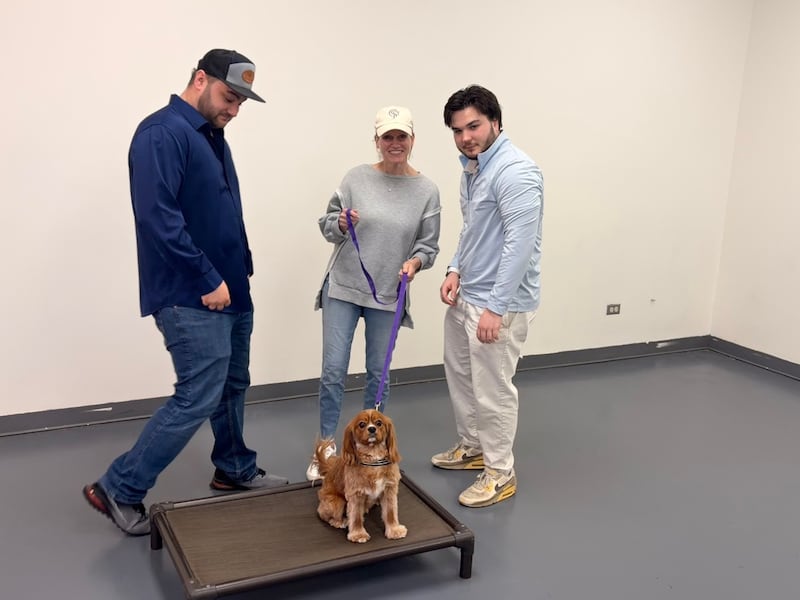
Typically, Vinnie would run and jump up on us. But after his seven hours at the academy, although he whined for us, Vinnie remained on his cot with the command of “place” until he was told “OK.”
Holland and Schnur brought us into the space one at a time. We then gave the commands, and same as with his trainers, Vinnie stayed on his cot until we said “OK.”
Vinnie showed us he’d learned to “heel,” or walk nice next to me, at my pace, as opposed to his own and dragging me down the street.
Vinnie’s day at the academy concluded with a written psychological breakdown with the trainers’ observations and tips.
“Vinnie has excellent potential to become a well-mannered, confident companion,” his said. “... His adaptability, intelligence, sweetness and quick learning today make him highly trainable.”
Way to go, Vinnie. The rest is up to us.
Learn more about Underdog Academy at underdoginstitute.com, 224-253-6335 or via email at zach@underdoginstitute.com.