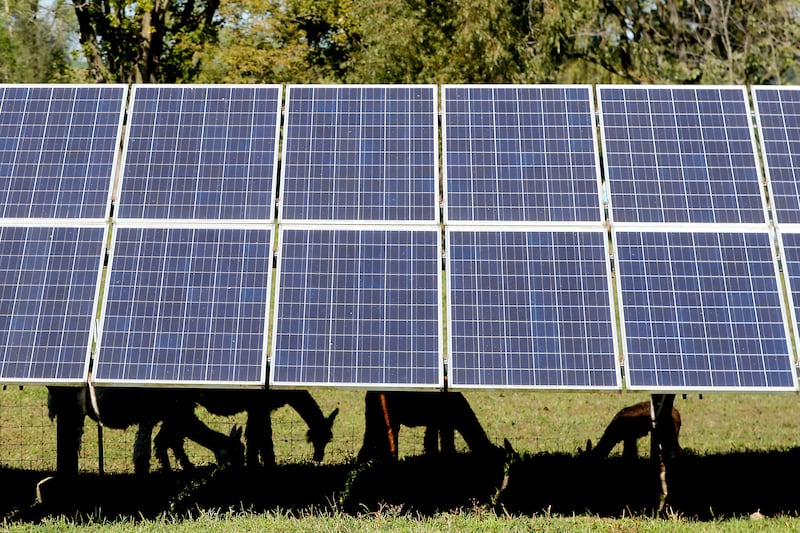
Johnsburg-area residents who oppose a proposed solar farm near the Ringwood and Spring Grove roads intersection made their final push to the McHenry County Board before it’s due to vote on the project Tuesday evening.
The County Board delayed final action on that farm last month, but is set to take it up Dec. 16.
Before members of the public weighed in Thursday, County Board Chair Mike Buehler addressed those coming to speak on the Johnsburg-area farm.
Buehler mentioned Illinois law restricts the county’s ability to regulate solar farms. The chair said he sent electronic copies of residents’ petitions against the solar farm to the lawmakers who represent McHenry County in the Illinois General Assembly.
“I explained that the state laws on solar facilities have precluded us from acting on your concerns. Nearly 400 neighbors and community members have taken the time to reach out to the McHenry County Board, and I made sure that the people who vote in the Illinois General Assembly have seen your petitions and can show their fellow senators and representatives the real people impacted by the laws they pass,” Buehler said.
Dylan Haber, a developer with Water Locust, the company behind the Johnsburg-area solar farm proposal, said he believed the company has done a “sufficient amount” of community outreach over the past couple of months.
Haber said he appreciates “change in the community can be hard and residents can be justifiably skeptical about this change” but the company feels it’s been transparent and has gone “above and beyond” to engage with the community.
Haber said he has spent a day out in the community, has knocked on doors and has had an open house for community members. He said about 15 neighbors attended and there was some “pretty good dialogue exchange” getting comments and addressing concerns.
He said he talked to the village of Johnsburg and went to a board meeting and answered questions, adding he’s been in touch with the McHenry Township Fire Protection District and the Environmental Defenders.
But a few residents have disputed the company’s outreach efforts and said the company hasn’t reached out to them.
Resident Ken Calhoun, who sits on the Johnsburg Planning and Zoning Commission, said he didn’t go to the Village Board meeting, but the company hasn’t approached his commission. Calhoun said he recognized the farm was outside the village limits, “but we’re neighbors,” and the company should have come to the commission.
Calhoun also made comments on behalf of his aunt and uncle who couldn’t be there. He said his family farms next door to the proposed solar farm.
“Why are we trading food for fuel? We’re giving up productive farmland,” Calhoun said.
Calhoun questioned why solar farms are not going in downtown Chicago and producing electricity “where they need the electricity more” than out in the rural area.
Neighbors have raised opposition for a number of reasons, including perceived health risks, contamination and environmental issues, among other things.
Resident Julie Remke, who said she lived downhill from the property, said she didn’t know about the plans. Remke mentioned panel disposal and her issues with the proposed farm included water contamination of her well and the Fox River.
“I’m furious that this is even a consideration, that we don’t think about, you know, the effects,” Remke said of the solar farm.
The Johnsburg-area proposal is one of several projects before the board.
Other solar farms include one off Route 176 near Crystal Lake, one off Gracy Road near McHenry, one off Crystal Lake Road near McHenry and one off Bull Valley Road near McHenry.
The Bull Valley Road farm, proposed by Pebble Solar LLC, also has raised opposition, with the McHenry County Zoning Board of Appeals giving it a negative recommendation. City of McHenry officials have also planned to send a letter to the county expressing their opposition to that farm.
Mark Gershon, an attorney for Water Locust and Pebble, said about both, “we truly respect the concerns noted” by residents. But he said the concerns had been addressed by expert testimony.
Gershon said about Pebble that the project must and will meet U.S. EPA, Illinois EPA and county requirements on issues such as groundwater.
“The science, the EPA, your stormwater requirements all confirm that this is safe and clean renewable energy, which we do believe is beneficial for all of humanity,” Gershon said.
He said “the elephant in the room” is state law, but “we’re required to follow the law.” He added “we’ve not only followed your law but we’ve gone way beyond that” to work with the community to meet standards.
A few County Board members on Thursday expressed they would be voting against the solar farms.
Board member Tracie Von Bergen said she was speaking about all solar farms and while solar might have a place in the county, “large-scale solar projects should not come at the cost of our most productive farmland or the future of our farming communities.” Von Bergen said converting “some of the best soil in the world” into solar farms “diminishes” future generations’ opportunities.
Board member Joe Gottemoller, R-Crystal Lake, said he was worried about lumping all of the solar farms together, and they don’t all have the same issues. “I don’t think that we should treat them as if they’re all equal.”
Board member Carl Kamienski, R-Johnsburg, whose district includes the Water Locust project, said he would vote against it.
He said as an elected official, he works for the people who live in the community, and the board is elected to do the residents’ bidding.
“The residents have all spoken and said, ‘Do your job. We don’t want this in our town.’ And I think it’s time that we stand up and listen to our employers that are telling us what to do,” Kamienski said.
The County Board is set to take up the solar farms at its voting meeting Tuesday evening, starting at 7 p.m. at the county building, 667 Ware Road in Woodstock.