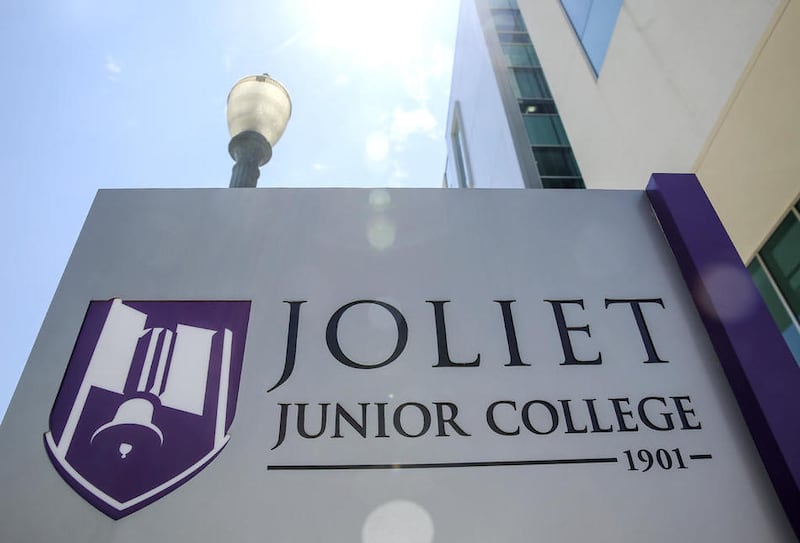
The Joliet Junior College Board of Trustees may consider whether to approve a tuition increase at next Wednesday’s meeting that would take effect in the fall semester.
The agenda for next week’s meeting has an item for the board to consider the approval of tuition rates and fees for next fall. It’s not yet publicly clear what the college administration has proposed for the board.
“The tuition and fee item listed on the upcoming Board of Trustees agenda will be formally presented and discussed at the public meeting, and the board will have the opportunity to consider and act on it at that time,” said JJC Spokeswoman Kelly Rohder-Tonelli.
At the Jan. 28 workshop meeting, college officials had initially proposed a $3 tuition increase. JJC officials had first projected the possible need for a $3 tuition increase at a board workshop meeting a year ago.
Under the Jan. 28 proposal, the tuition and fees would increase from $151 per credit hour to $154.
Full-time students enroll with a minimum of 12 credits per semester. The fall and spring tuition cost for such students under the Jan. 28 proposal would increase from $3,624 to $3,696.
A few board trustees, including Student Trustee Brenton Bishop, expressed either wariness or opposition to a tuition increase at the Jan. 28 meeting.
Bishop said he wanted to see “every reasonable effort is made” before the implementation of a tuition increase.
“Students are already struggling systemically,” Bishop said.
Trustee Alicia Morales said she is uncomfortable with raising tuition “even just by a small amount.”
:quality(70)/cloudfront-us-east-1.images.arcpublishing.com/shawmedia/3GHBTOMAZNDFJGYL3NN2NTSNOI.JPG)
At the Jan. 28 meeting, JJC President Clyne Namuo spoke about the “uncertainty at both the federal and state level.” JJC executive vice president Yolanda Farmer said colleges are navigating challenges “related to state funding, enrollment cliff and other external pressures.”
During the meeting, the board was shown a presentation that cited “constrained operating environment,” a budget driven by “personnel and fixed costs” that limit discretionary spending, and “new initiatives” that need to be funded either by “new revenue sources or expense reductions.”
Namuo said the college is exploring every option to control costs but the administration wanted to hear from the board whether the tuition increase should be the “lever that we want to pull this time around.”
College officials proposed the tuition increase at a time when they are planning the construction of the Grundy County campus in Morris and the creation of the Public Safety Institute.
Although financial projections presented to the board on Jan. 28 did not reflect those two initiatives because the operating budgets were still in development.
Last year, a majority of the college board approved a $2.55 million land purchase for the Grundy County campus. It’s not clear how many students will attend the new campus but the college has based the need for it on the growing job market and rising population in the county.
A $1.9 million employee retention credit will go toward the land purchase and the difference will come from the college’s reserves.
The Jan. 28 proposal for a $3 tuition increase, along with a projected 1% enrollment increase, would provide the college an additional $1 million to help balance the budget for the next fiscal year, which begins on July 1.
The presentation to the board factored the $3 tuition increase under revenue and expense assumptions for Fiscal 2027 to 2029.
:quality(70)/cloudfront-us-east-1.images.arcpublishing.com/shawmedia/UTC3V445VFCZNMZML5MV36Y454.jpg)
Most colleges in the state are increasing their tuition and fee rates, according to Karen Kissel, JJC vice president of finance and administrative services. She said many of those schools are increasing their tuition between $3 to $10 per credit hour.
The current tuition and fees JJC is at $151 per credit hour, which is the ninth lowest of 39 schools in the state, according to the Jan. 28 presentation. The $3 increase would make JJC’s the tuition and fees the 11th lowest in the state.
JJC Trustee Elaine Bottomley said she doesn’t think she could be a “yes” vote to a tuition increase “as well as taking the full property tax rate.”
“I could be a ‘yes’ on a tuition rate increase but it has to make sense,” Bottomley said.
The board was shown a slide where the projections for Fiscal 2027 shows no budget deficit while factoring in the $3 tuition increase.
The slide also showed projections of a $880,041 deficit in Fiscal 2028 followed by a $1.8 million deficit in Fiscal 2029. Those projections also factored in the $3 tuition increase.
“I think the concern is planning three more years of tuition increases versus looking at a number of $880,000, knowing we have 18 months we can fix that or address that first,” said James Budzinski, chairman of the JJC board.
:quality(70)/cloudfront-us-east-1.images.arcpublishing.com/shawmedia/NUFU4NHVYBBZ5KXJBWJYOXRYZE.jpg)
JJC Trustee Maureen Broderick said she wanted to see a five-year financial forecast for the incoming Grundy County campus.
“If we don’t see something of a financial five-year forecast on that, how are we going to even adjust to what we could for the next five years running that? I don’t want to see us keep increasing, increasing, increasing tuition,” she said.
She said she did not want JJC to run into the same problem as Lincoln-Way High School District 210 when they closed North high school in 2016 because of projected student enrollment that never materialized.
Broderick and JJC Trustee Michelle Lee were the only votes against the land purchase for the Grundy County campus. Broderick was the sole vote against the $318 million budget for the current fiscal year while Lee abstained.
Regarding the budget vote, Broderick said she was concerned about what she estimated was a $73 million increase in the college’s budget since 2023.
In 2024, Broderick and Lee were the sole two votes against Namuo receiving a base salary increase from $275,000 to $325,000. Broderick cited concerns with “overspending” during “inflationary times.”
During the Jan. 28 presentation, Morales said she is seeing “expenditures are going to outpace our revenues within the next three years.”
“So we need to get a better control on our expenditures somehow,” Morales said.
Morales said the college needs to intensify its enrollment and recruitment goals.
She also inquired about salary freezes.
“I wouldn’t want to impose that on anybody making less than $110,000 a year but I would consider it for anybody making over $110,000 year,” Morales said.
:quality(70)/s3.amazonaws.com/arc-authors/shawmedia/7a2e8311-fc10-4849-8481-ab8459fa3039.png)