This is the third of a three-part series examining housing affordability and access in Will County. Read all the articles here.
Will County desperately needs more housing, including more diverse housing and housing that’s affordable.
But Will County also is exploring solutions to the growing problem.
Cost considerations in multifamily housing
Martha Sojka, community development administrator at the Will County Land Use Department, said it’s “pretty cost prohibitive to construct a unit and still make it affordable,” adding that the cost of labor and materials are some contributing factors.
That’s why “federal dollars” and development subsidies are really important, she said. Many times it costs more to construct the unit than the developer would ever see in rental income, she added.
But development subsidies are highly complicated and “require a lot of layers of funding,” Sojka said.
[ We want to hear from you. Share your experiences about housing in Will County. ]
“And we have supported projects like that,” she said. “The most recent one was a project in New Lenox.”
That project was Prairie Trail at the Landings, a housing community for adults with disabilities that opened in 2022. The community offers 22 one-bedroom and three-bedroom units, with Trinity Services offices on the first floor.
:quality(70)/cloudfront-us-east-1.images.arcpublishing.com/shawmedia/TBXNIT7URFCQJEO4OIP4RQOT7I.jpg)
Will County supported that project with $200,000 of HOME funds, Sojka said.
Cost isn’t the only barrier, however. Many times, municipalities don’t want multifamily homes in their community and get some pushback when it comes to the permitting, Sojka said.
Oftentimes, obtaining approval for any type of related housing is “cumbersome,” she said.
Mismatch between earnings and costs
It’s no surprise that incomes haven’t kept pace with the rising costs of just about everything.
But that gap keeps widening, Sojka said.
A $37,000 annual salary – or $18-an-hour wages – qualifies as low income by the U.S. Department of Housing and Urban Development, she said.
According to the website United for ALICE – an acronym for asset limited, income constrained and employed that represents the growing number of families who are unable to afford the basics – the income needed for survival in Will County for a single person is $38,256; for a family of four (two adults and two children), that number is $96,108.
:quality(70)/cloudfront-us-east-1.images.arcpublishing.com/shawmedia/EVU47HYL6JE2DJ4GYKZVRE6FDA.jpg)
According to United for ALICE data, rent on a survival budget should be no higher than $1,292 for a single person or $1,612 for a family of four.
That data aligns with HUD, which says a moderate income for a family of four is $95,900 – and that’s still not within market rates, Sojka said.
For an individual or household annual income of $59,950, Will County has 11,664 available rental units at that price point and 19,245 households at that income level, Sojka said.
That leaves a gap of 7,581, which is pretty significant, she said.
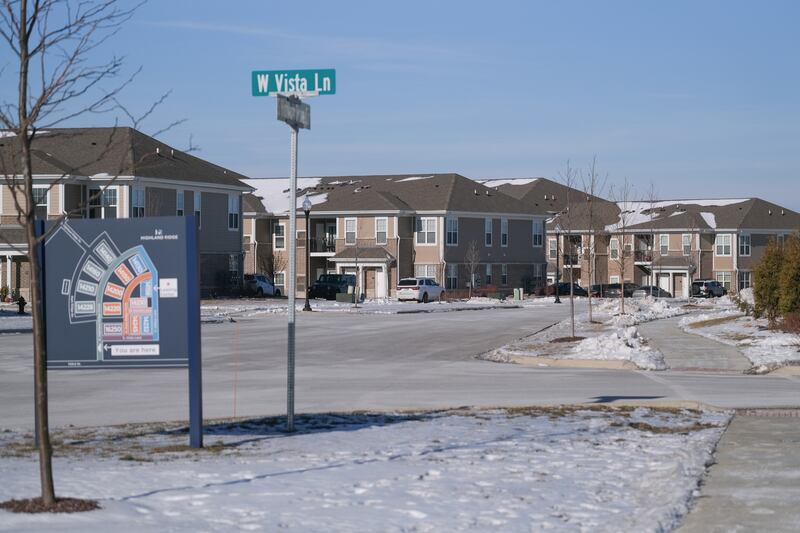
On the bright side, Sojka said, 550 permits were issued in 2024 for multifamily property, which is much higher than 29 in 2023 and 125 in 2022 for housing with five or more units.
:quality(70)/cloudfront-us-east-1.images.arcpublishing.com/shawmedia/2TCKQEHHKRCSJG52TW4NYT34XA.jpg)
Exploring solutions
The Will County Center for Economic Development is currently working on a housing study that will look at the entire spectrum of housing in Will County, said Doug Pryor, president and CEO of the organization.
“The key goal is to determine where the demand is for growth and, ultimately, what are best practices to make sure we’re targeting that,” Pryor said.
Main objectives include creating affordable housing, making existing housing affordable, improving the condition of available housing, reducing homelessness, improving neighborhood infrastructure and facilities, and improving public services.
Federal funding helps with housing supply, affordability, stabilization and improvements, Sojka said.
Eligible funds are available for developers, down payment assistance for income-eligible homebuyers, homeowner assistance to those facing eviction, and low-income homeowners who don’t have resources to replace windows or roofs, she said.
:quality(70)/cloudfront-us-east-1.images.arcpublishing.com/shawmedia/3KI2Y4OM6RGKDFJMHPF55LXGKM.jpg)
Such surveys and plans are useful in several ways.
“We definitely want to make sure our solutions are grounded in some data,” Sojka said, noting that data also supports economic development strategies by “providing options for people to stay in your community.”
“And spend the dollars they earn in your community, rather than having to travel somewhere else,” she added.
But in the meantime, people still need to live somewhere, and “there’s just not enough resources to help everyone,” said Antoinette Walker, 54, of Lockport.
Walker returned to work in November after double knee surgery from a work injury. She is now working two jobs, one in home health and the other in security, “and I’m still struggling,” she said.
People often need to be “almost homeless” to get help, she said, and they get further behind while waiting for approval.
Even then, no one is taking a closer look at the high and still-rising cost of life’s other necessities, Walker said, including “the lights, the gas, the trash, the cellphone – because you have to have some type of phone – and you need the internet just to watch TV."
“Everything is going up except your pay,” Walker said.
This article is part of a national initiative exploring how geography, policy and local conditions influence access to opportunity. Find more stories at economicopportunitylab.com.
:quality(70)/s3.amazonaws.com/arc-authors/shawmedia/59304215-cb18-46db-bced-9941d9413236.jpg)