After four months of work to ensure Whiteside County’s jury selection process is a fair one, the county’s state’s attorney, a defense attorney, and the judge presiding over a criminal case set to go to trial Tuesday have delayed the county’s first criminal trial in months.
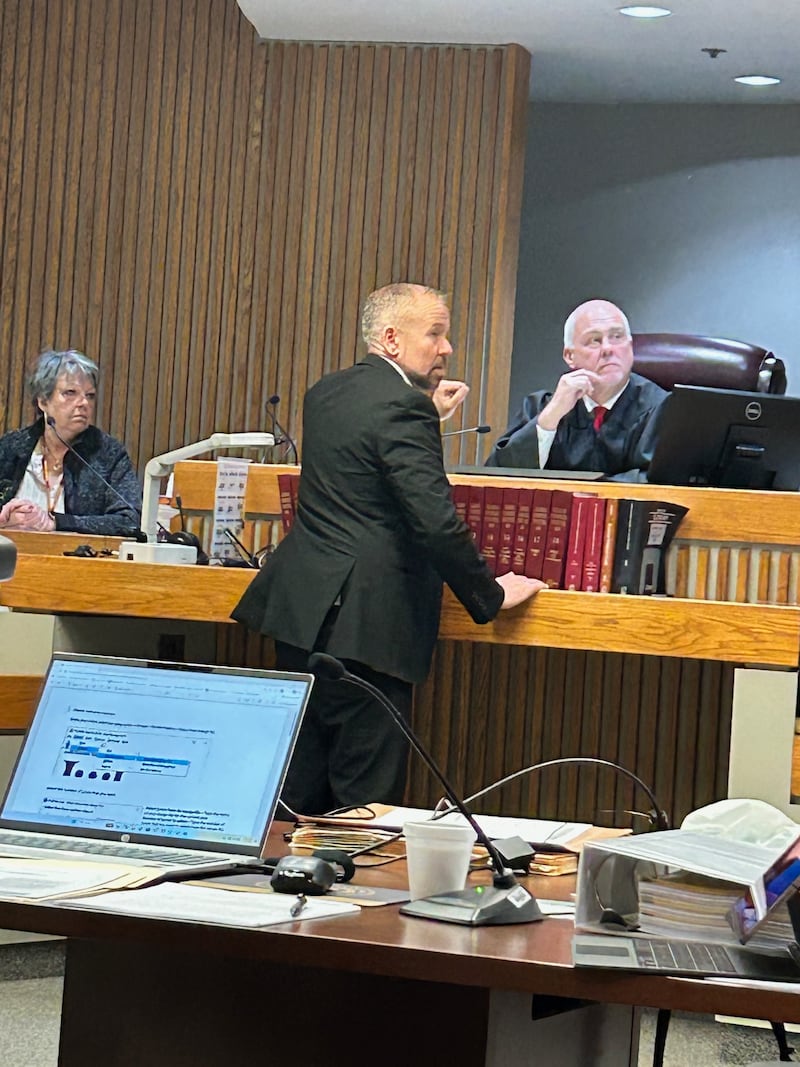
Whiteside County Circuit Court Judge James Heuerman, State’s Attorney Colleen Buckwalter, and Sterling attorney James Mertes agreed Monday morning to delay by one day the trial of Michael Cover, a Rockford man accused of aggravated battery and obstructing a police officer in connection with a Sept. 11 fight in the Whiteside County Jail.
Cover, 33, was first set to go to trial Feb. 10. Since then, the trial has been rescheduled four times throughout the course of 20 court hearings about the jury selection process and how it is taking place at the state and county levels.
Cover was set to go to trial Tuesday, June 9, but on Monday morning, the start date was moved to Wednesday as the trio waits for a report from a team of University of Chicago mathematicians. That team worked over the weekend to determine if names selected to create jury panels in Whiteside County are being chosen at random.
To do that, they have been reviewing Whiteside County’s state-provided master jury list of 48,300 names that was then run through a computer program to get it down to a list of 12,500 selected names, from which a 100-name jury pool was selected.
The results of their work were expected to begin arriving in report form later Monday, according to court discussion Monday morning.
However, Mertes told the court Monday that the initial information he has heard points to a selection that is not randomized, as five of the 100 had also appeared on previous jury pool lists over the past four months.
“It’s not possible it’s randomized,” he said.
Cover’s trial still set to begin at 8:30 a.m. Wednesday, but a pretrial hearing is scheduled for 1 p.m. Tuesday to discuss what happens next.
Jury selection problems
Whiteside County’s jury selection woes first surfaced in February, when in the days leading up to Cover’s Feb. 10 trial date, Mertes discovered the Whiteside County Circuit Clerk’s Office – which is the office responsible for creating the jury panel – had been systematically excluding qualified jurors for more than three decades based on age, economic status, pending civil cases, money owed in court cases and criminal history.
Mertes then began arguing against that jury selection process, saying it failed to gather a jury panel that represents a fair cross-section of the community and therefore would deprive his client of being tried fairly.
Since that time, continued court hearings have led Whiteside County judges to dismiss three jury panels based on arguments that the process used to select them was flawed.
Those hearings have included testimony from the leadership at the Administrative Office of the Illinois Courts, as well as the owner of the company that makes the software used in the Whiteside County Circuit Clerk’s Office.
The AOIC is the statewide agency responsible for compiling jury lists from voter registration, driver’s license, and unemployment insurance data, and Illinois identification and Illinois Person with a Disability Identification Card holders. Questions arose about how that agency gathers the master list of potential jurors since Whiteside County’s list had more than 48,000 names on it, a number that is 4,500 greater than the entire adult population of Whiteside County, according to Mertes.
Jury panel dismissals
The first and second jury panels, for February and March, respectively, were dismissed based on Mertes’s arguments that the jury selection process could not guarantee that Cover would have a jury representing a fair cross-section of the community; a judge’s dismissal order for the March panel went so far as to state that the Circuit Clerk’s Office’s earlier exclusions violated state and federal law.
Alongside those hearings, to rectify another issue in their circuit, the 14th Judicial Circuit’s judges appointed a functioning three-member jury commission in Whiteside County, something the county had not had for several years.
The most recent jury panel was dismissed May 14, when Heuerman agreed with Mertes that the data used to select the county’s jury panels remained flawed.
[ Judge says Whiteside County wrongly excluded jurors for years ]
The Whiteside County Circuit Clerk’s Office was tasked with gathering April’s jury panel. The agreed-upon process would use the master list of names supplied by the AOIC, ChatGPT, and the Whiteside County Circuit’s Clerk’s jury management software to randomly select 200 jurors.
What happened next was the creation of a jury panel that contained at least 60 dead people – including one person who died 35 years ago; no jurors younger than 42; a jury pool with a median age of 72; 52 people who are 90 years or older; and 27 people who would be 100 years or older, including at least one potential juror who would be 135, if they were still living.
:quality(70)/cloudfront-us-east-1.images.arcpublishing.com/shawmedia/IED6RMYXYBDRRHHD7ESIJEMKIM.png)
During a day-long hearing in May, Mertes said the April jury panel list revealed another problem: As the Circuit Clerk’s software system was selecting potential jurors for the panel, it wasn’t pulling from just the 2024 AOIC list. It was pulling in jurors who served as far back as 1991. That’s because, unknown to users, the software does not purge older lists that have been input into it.
He said the significance of that means those who died several years ago were not purged out of the system and are continuing to appear on the potential juror list, as are a disproportionate number of older jurors. Mertes argued the issue disproportionately favors older jurors and effectively excludes younger residents.
:quality(70)/s3.amazonaws.com/arc-authors/shawmedia/9bb5f897-be4a-42b8-9507-9193a7f43c2d.png)