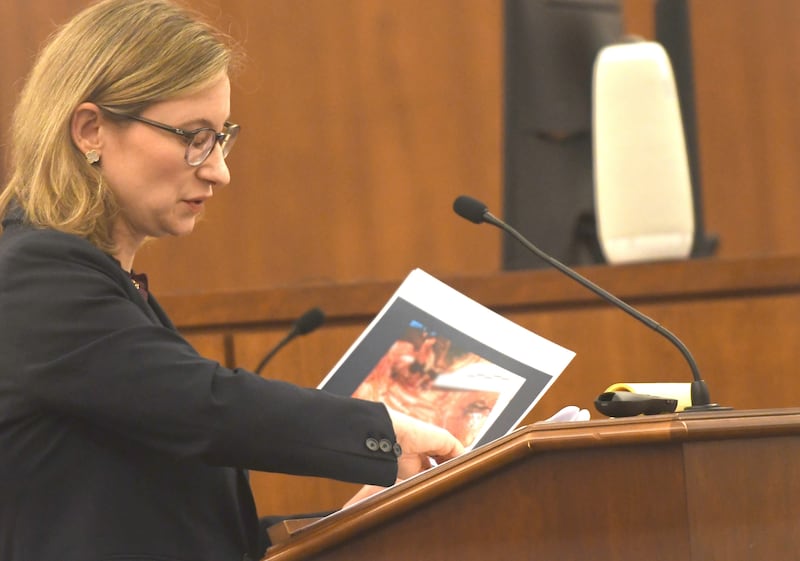
Two forensic pathologists testified Thursday that Margaret “Maggie” (Rosko) Meyer was dead before her body was found burned beyond recognition in her Byron home, but they could not give a definitive cause of death.
Meyer’s ex-husband, Duane “DC” Meyer, 43, of Stillman Valley, is charged with killing her and then setting her home on fire with their 3-year-old son inside.
Meyer, referred to as DC during the trial, is charged with four counts of first-degree murder, two counts of aggravated arson and one count of concealment of a homicidal death in connection with an Oct. 19, 2016, Byron house fire in which Maggie, 31, was found dead.
:quality(70)/cloudfront-us-east-1.images.arcpublishing.com/shawmedia/C3AXFEEZTZDGVGREJILSW327P4.jpg)
The couple’s 3-year-old son, Amos Meyer, who was in an upstairs bedroom in the home at the time of the fire, was later pronounced dead at a Rockford hospital.
DC Meyer has pleaded not guilty to all of the charges and has been held in the Ogle County Jail since his arrest Oct. 9, 2019.
On Thursday, Dr. Mark Peters, the forensic pathologist for 11 counties in northwestern Illinois, and Dr. Hilary McElligott of the DuPage County Coroner’s Office both testified they found “ante-mortem” injuries on Maggie’s body that occurred before her death.
Peters said he conducted autopsies on Maggie and Amos on Oct. 19, 2016, at the Ogle County Coroner’s office in Oregon.
Peters said Maggie’s body was burned “100 percent.” He said some of the injuries she suffered were from the heat of the fire, which caused limbs to be distorted and one femur to break.
Jurors were shown photos of Maggie’s body on a large video screen. Her body had no identifying features, causing some people present at the trial to cry softly or avert their eyes from the images.
Peters said no soot was found in her throat or lungs, indicating that she was dead when the fire occurred. He said an examination of her internal organs found fluid in her lung, which was indicative of a prolonged death, possibly by strangulation.
Peters said he could not determine a direct cause of death, but noted she had “suspicious” neck injuries.
Peters said he also found hemorrhaging on the lower part of her scalp and on her back, posterior shoulder, and neck. He said an examination of her skin for other areas of pre-death injuries was made impossible by the severe charring from the fire.
Defense attorney Patrick Moore asked Peters under cross-examination if any tests were completed to determine if she had been sexually assaulted.
“Nothing for sexual assault?” asked Moore.
“No,” replied Peters.
Under redirect questioning by Assistant Ogle County State’s Attorney Matthew Leisten, Peters said those tests were not done because he did not observe any signs that a sexual assault had occurred.
McElligott testified she performed a second autopsy on Oct. 25, 2016, at the DuPage County Coroner’s Office.
“The charring was extensive,” McElligott said. “The thermal burning was 100 percent, charred to various degrees. The charring itself is noted as possibly masking other injuries.”
:quality(70)/cloudfront-us-east-1.images.arcpublishing.com/shawmedia/G5RFC5BRDBG3XEGA5BMIDSHMSI.jpg)
She said the body’s condition made it “definitely challenging” to determine other possible injuries.
However, she said an internal examination under the skin showed hemorrhaging and clotted blood on the skull beneath the scalp, which indicated some type of blunt trauma.
“This was a reaction to trauma before death,” testified McElligott, who said she discovered more signs of hemorrhaging on the neck, back and shoulder. “There was deep bleeding on the neck … mainly in the middle of the neck.”
McElligott’s examination of Maggie’s airway also showed no evidence of soot, but a damaged hyoid bone, found in the neck.
“She didn’t inhale any particles while she was alive. This indicated she was dead before the thermal injuries. She didn’t inhale any particles while she was alive,” McElligott testified.
McElligott said the injuries on the back were “a significant impact site”, but she, too, could not determine an exact cause of death.
“I could not reach a definitive conclusion,” McElligott said. “In my opinion, this is highly suspicious for homicide.”
Under cross-examination, McElligott said DNA samples were unable to be taken from the body due to the “significant disruption of tissue” because of extensive thermal injuries.
Peters said Amos died from acute asphyxia from carbon monoxide from the fire as indicated by soot in his larynx. In photos presented as evidence by prosecutors, Amos was shown lying on his side and back.
Cellphone records argued
The state’s case in chief continued in the afternoon, with Timothy Gray, a senior analyst with Verizon, called to testify about cellphone records requested in 2016 by investigators.
Gray started to testify about spreadsheets that prosecutors say listed calls, texts, and cell tower locations taken from DC’s phone, but Moore raised many objections as to the accuracy of the data, and the foundation for how it was provided on a spreadsheet.
That issue was argued for 90 minutes outside the presence of the jury. Moore and co-counsel Christopher DeRango argued that the state had not proven the authenticity of the data and argued Gray could not testify to the data because he did not gather it or have proof that it was original data provided by Verizon.
Gray testified that data was not kept for years, but said it appeared to be data provided to investigators when they requested it in 2016.
“He [Gray] can say ‘yeah, it looks like records we would have kept’, but he didn’t work there at that time,” DeRango argued. “We have no idea if these are original. Someone could have cut and pasted anything in these spreadsheets.”
DeRango argued that prosecutors should have requested and provided detailed proof from Verizon that the data was original.
“Verizon should have the records. The idea that because this happened 10 years ago does not excuse them [prosecutors]”, DeRango said.
Gray said Verizon only maintained records for 2 years in 2016.
Leisten argued that the date on the spreadsheets was compiled from data secured from a 2016 search warrant faxed to Verizon from the Ogle County Sheriff’s Office.
After reviewing arguments and case law, Ogle County Judge John “Ben” Roe allowed Leisten to continue questioning Gray over DeRango’s objections.
Prosecutors have argued that their evidence, which includes cellphone data, will show DC planned to end Maggie’s life.
But the defense has argued that text messages sent by DC before the deaths were only part of a “contentious” divorce and not indicative of anything nefarious. They have also argued that cellphone tower locaters in 2016 did not provide exact locations of where calls were made or received.
More state witnesses are scheduled to testify this week and next week, with the trial expected to take up to three weeks.
In her opening statement to jurors on Tuesday, Assistant Ogle County State’s Attorney Allison Huntley said prosecutors would prove that DC “attacked and murdered” Maggie while Amos was sleeping in his upstairs bedroom.
DeRango told jurors that while the deaths were a “heartbreaking tragedy”, his client was not responsible and the state’s case was based solely on circumstantial evidence.
Maggie was a teacher at the Chana Education Center at the time of her death. She filed for divorce in 2014, and court records show the divorce was finalized in September 2016.
:quality(70)/author-service-images-prod-us-east-1.publishing.aws.arc.pub/shawmedia/c70d24f0-1332-4244-8446-e91288029474.jpg)