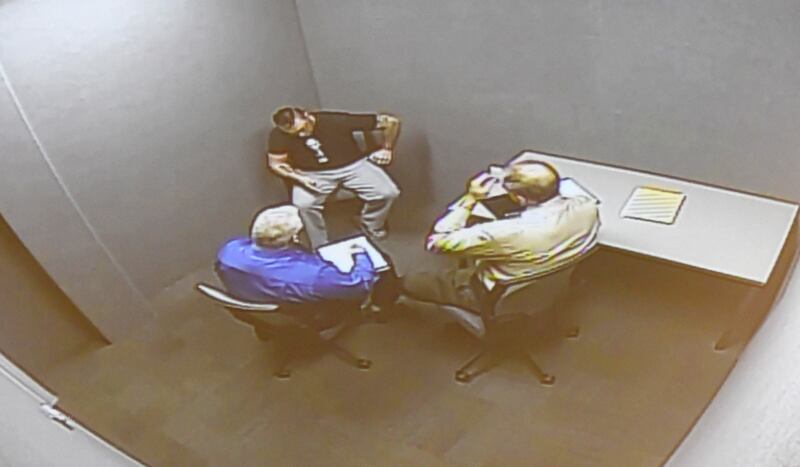
A Stillman Valley man told police nine days after the 2016 death of his ex-wife, Margaret “Maggie” (Rosko) Meyer, that he was not in Byron the night before she was found dead inside a home they once shared.
Ogle County jurors on Tuesday, Jan. 20, heard the recorded interview in which Duane “DC” Meyer vehemently denied claims from two investigators Oct. 28, 2016, that he was in Byron on Tuesday, Oct. 18, 2016.
Meyer, 43, is charged with killing Maggie, 31, and setting her home on fire with their 3-year-old son inside. He is charged with four counts of first-degree murder, two counts of aggravated arson and one count of concealment of a homicidal death in connection with the Oct. 19, 2016, house fire in which Maggie was found dead.
The couple’s 3-year-old son, Amos Meyer, who was in an upstairs bedroom in the home at the time of the fire, was later pronounced dead at the former Rockford Memorial Hospital.
Meyer has pleaded not guilty to all the charges and has been held in the Ogle County Jail since his arrest Oct. 9, 2019.
:quality(70)/cloudfront-us-east-1.images.arcpublishing.com/shawmedia/TXUTURLEVFGPLGN5FLIXEW4G6E.jpg)
Maggie, a teacher at the Chana Education Center at the time of her death, filed for divorce in 2014. Court records show the divorce was finalized in September 2016.
On Tuesday, Ogle County State’s Attorney Mike Rock called Chuck Davidson, a former investigator and master sergeant with the Illinois State Police, to testify about a four-hour video recording that Davidson and Ogle County Detective Doug Lockard made when Meyer was interviewed Oct. 28, 2016 – nine days after Maggie’s charred body was found on a couch inside the home.
:quality(70)/cloudfront-us-east-1.images.arcpublishing.com/shawmedia/3UNZV2IL3FGJDGUOM47DI6K4VU.jpg)
Davidson asked DC if “things just got out of control” on that Tuesday night and an “accident” happened. DC replied: “No, I was not there.”
“We know you were in Byron on Tuesday night,” Davidson replied. “We work with the FBI, we have cellphone information that we can track.”
“There’s no way,” replied DC. “This is ridiculous.”
Earlier in the recording, DC said he had been hunting Tuesday on his family’s farm near Chana and had left his phone in his truck.
After questioning DC in subdued voices for most of the recording, investigators became more aggressive in the final minutes.
Davidson accused DC of not telling the truth about his whereabouts Tuesday evening. He said everything DC had told investigators about his movements prior to Tuesday synchronized with cellphone data recovered from his cellphone, with the exception of Tuesday evening.
“Everything except Tuesday night is a match,” Davidson told DC.
“I wasn’t in Byron,” replied DC, raising his voice. “I was deer hunting. I can’t say I was somewhere I wasn’t.”
Davidson countered that cellphone locations from data tracked by tower “pings” indicated otherwise.
“I don’t care how it works. I wasn’t there,” DC replied.
“This is an exact science,” Davidson said. “It’s nonnegotiable stuff.”
During cross-examination Tuesday, Meyer’s defense attorney, Christopher DeRango, accused Davidson of lying to DC about the “hard” evidence of the cellphone tying him to the scene, arguing that cellphone data can be interpreted differently.
“Overstating the evidence did not get DC to incriminate himself,” DeRango said to Davidson. “The impression you wanted to give to DC was that the technology ‘has you.’”
Davidson said he had experienced “hard denials” from defendants in other interviews during his career.
:quality(70)/cloudfront-us-east-1.images.arcpublishing.com/shawmedia/VBEHXFB76VAZ7HB37HTKCFUZWE.jpg)
“It is not easy to get someone to admit to committing a crime,” Davidson said. “We wanted to glean all the information we could from him because we thought we’d never get another shot at him.”
“You had already made up your mind he was the one,” DeRango.
Davidson said Meyer was fingerprinted and had DNA taken before being released after the interview. Meyer was not arrested until three years later, Oct. 9, 2019.
Earlier in the interview, DC told investigators he arrived at Maggie and Amos’ home about 6:30 a.m. Oct. 19, 2016, after texting Maggie at 5:15 a.m. that he wanted to pick up Amos so he could spend the day on the farm with his grandparents – DC’s mom and dad.
He said when he arrived at the home, in a rural subdivision just north of Byron, he saw the home was on fire, called out to Amos and tried twice to run up the stairs to Amos’s bedroom, but was turned back by heavy smoke. He said he called 911 and was able to get to the toddler on his third attempt. DC said he carried Amos out of the home to the front yard, where another first responder began CPR.
DC said he rode in the front seat of the ambulance as Amos was being transported to the hospital, where he was later declared dead.
When asked by Lockard if he looked for Maggie or yelled her name, DC replied: “My first thought was the home was on fire and to get my son out.”
Maggie’s severely burned body – with no recognizable features remaining – was found on the couch in the home’s first-floor living room.
DC told investigators his mom and dad arrived at the hospital and drove him to his home in Stillman Valley, where he showered and placed his clothes in the washer.
Earlier in the interview, DC said disagreements had arisen between him and Maggie over his visits with Amos. He said Maggie liked to keep Amos on a scheduled routine and often criticized him (DC) of not bathing him when he returned him home after a visit.
DC also said he had a strained relationship with Maggie’s mother because she made him feel he was “not good” enough and that he could never change that opinion. He said those ongoing disagreements with Maggie’s mother, Luann Rosko, fueled the couple’s separation.
“I tried to get along with [Luann]. I always felt like I wasn’t good enough for Maggie,” DC told the investigators. “I felt I was never going to be good enough.”
DC said he and Maggie had been separated for some time before the divorce was finalized.
Investigators also quizzed DC on his relationship with Catherine Mearns, whom he said he met in November 2014 before they started living together in 2015. He said their relationship worsened relations with Maggie’s family because of Mearns’s connection with another family member.
“Obviously, our relationship didn’t help that out at all,” DC said.
“It had its ups and downs, for sure,” DC added when asked about his relationship with Mearns, adding they both were focused on Mearns’s son following her divorce.
He said he and Mearns felt that “every single thing” they did with Amos was “being criticized,” and Mearns believed he was “giving up more than I should.”
“It was kind of part of the plan to get married,” DC said about his relationship with Mearns, adding he had no interest in Maggie’s life after the divorce, and if it hadn’t been for Amos, he would have “never seen her again.”
:quality(70)/cloudfront-us-east-1.images.arcpublishing.com/shawmedia/2PFOUGGAUJGY7JHE5GNGQX2GQY.jpg)
On Friday, Special Agent Nate Macklin testified to messages and other data extracted from cellphones used by DC and Mearns.
Assistant Ogle County State’s Attorney Matthew Leisten displayed a selection of text messages on the courtroom’s video screen, with Macklin reading the content from some of them. Most of the messages read were text conversations between DC and Mearns days, and sometimes months, before the fire.
Some of those texts included derogatory comments about Maggie from DC. One dated Aug. 15, 2016, read: “I [expletive] hate this [expletive]. I hate a lot right now. Idk what’s going to happen today. I hate that you hate me. Since meeting you all I’ve wanted was to be that man that got to spend his life next to you. I love you to no end. Your (sic) good bad and ugly. I hope I won’t need bail. See you on the other side.”
Mearns, who was listed in DC’s phone as “My Hopes and Dreams”, responded: “Yep. Have fun in court. Go ahead and kill the [expletive]. I’ll visit you in prison.”
On Aug. 22, 2016, Meyers texted Mearns: “If I did go to jail would you be there for me when I got out?”
Another message, dated July 30, 2016, from DC to Mearns said: “Hate is not a strong enough word for her. That piece of [expletive] will be gone or I’ll die trying,” to which Mearns replied: “Yeah, you’ll die trying.”
In other messages, DC and Mearns complained how the relationship with Maggie and Amos was impacting their relationship. They also complained about other family members.
Maggie, who was listed in DC’s phone as “Saggy,” sent DC a message on Sept. 27, 2016, in what appeared to be coordinating visitation with Amos. That message concluded with: “Lastly, you are seven weeks behind on child support and half of his tuition is due on the 1st.”
DeRango objected to the text messages being entered as evidence, arguing that prosecutors had chosen just a few texts to show jurors and taken them out of context. And he criticized the extraction procedure used by state police to retrieve the messages as well as the state’s interpretation of those messages.
He argued that texts chosen by the state were selected for a “dramatic reading” by Macklin, and other texts not selected showed “perfectly normal” exchanges. He characterized some of the texts as DC’s exchanges with an “unstable girlfriend who upsets him.”
Leisten said the software used to recover data from cellphones was widely accepted, and the data recovered was then placed into a readable format and had not been manipulated.
Macklin testified that the process investigators used for extracting the data from the cellphones was “widely accepted in the forensic community” and had been used many times in court cases. And he said the software was designed to parse information accurately.
The state’s case in chief will resume at 9 a.m., Wednesday, Jan. 21.
Previous testimony highlights
Gregory Castronovo, an investigator for the State Fire Marshal’s Office, said the fire was extremely heavy on Maggie’s mid-torso, and the entire surface of her body was damaged beyond recognition.
He said the “V” burn pattern from the couch indicated to him that the origin of the fire was on the sofa in the first-floor living room, where Maggie’s charred body was found in the morning fire. He said damage to the ceiling of the basement – directly below where the sofa was located – also pointed to the fire starting on the sofa.
He said he found no evidence that the fire started because of electrical or mechanical issues or a cigarette or candle, with the greatest amount of damage found in the center of Maggie’s body. Smoke and carbon monoxide from the fire traveled upstairs to the bedroom where Amos was asleep.
The fire smoldered for some time, but Castronovo could not say when it started.
On Thursday, Jan. 15, two forensic pathologists testified they found ante-mortem injuries on Maggie’s body that occurred before her death. Both said she died before her body was found in the living room of the home, but could not give a definitive cause of death.
Dr. Mark Peters of Rockton said Maggie’s body was burned “100 percent,” with charring covering her entire body. He said some of the injuries she suffered were from the heat of the fire, which caused limbs to be distorted and one femur to break.
Jurors were shown graphic photos of Maggie’s body, which had no identifying features visible.
Peters and Dr. Hilary McElligott of the DuPage County Coroner’s Office said no soot was found in Maggie’s throat or lungs, indicating she was dead when the fire occurred. Examinations of her internal organs found fluid in her lung, which was indicative of a prolonged death, possibly by strangulation.
Peters and McElligott said they both found hemorrhaging on the lower part of her scalp and on her back, posterior shoulder and neck. Examinations of her skin for other areas of pre-death injuries were made impossible by the severe charring from the fire.
McElligott said the charring on Maggie’s body could have masked other injuries. However, she said an internal examination under the skin showed hemorrhaging and clotted blood on the skull, beneath the scalp, which indicated some type of blunt trauma before she died.
DNA samples were unable to be taken from the body due to the “significant disruption of tissue” because of the extensive thermal injuries, McElligott said.
Peters said Amos died by asphyxia from carbon monoxide from the fire, indicated by soot in his larynx. In photos presented as evidence by prosecutors, Amos was shown lying on his side, his features intact.
Also testifying on Jan. 15 was Timothy Gray, a senior analyst with Verizon, who was called to testify about cellphone records requested in 2016 by investigators.
Gray started to testify to spreadsheets that prosecutors said listed calls, texts and cell tower locations, but defense attorney Patrick Moore raised many objections as to the accuracy of the data and the foundation for how it was provided on a spreadsheet.
Leisten argued the date on the spreadsheets was compiled from data secured from a 2016 search warrant from the Ogle County Sheriff’s Office.
Prosecutors have argued that their evidence – which includes more cellphone data – will show DC planned to end Maggie’s life.
The defense has argued that text messages sent by DC before the deaths were only part of a “contentious” divorce and not indicative of anything nefarious.
Prosecutors said they will prove DC “attacked and murdered” Maggie while Amos was sleeping in his upstairs bedroom.
Defense attorneys told jurors that while the deaths were a “heartbreaking tragedy,” DC was not responsible, and the state’s case is based solely on circumstantial evidence.
:quality(70)/author-service-images-prod-us-east-1.publishing.aws.arc.pub/shawmedia/c70d24f0-1332-4244-8446-e91288029474.jpg)