A special agent for the FBI testified Wednesday, Jan. 21, that Duane “DC” Meyer’s cellphone was in the Byron area on the evening before his ex-wife was found dead in her burned home – contradicting a taped police recording played to jurors on Tuesday in which Meyer denied being there at that time.
DC Meyer, 43, is charged with killing Maggie (Rosko) Meyer, 31, on Oct. 19, 2016, and then setting her home on fire with their 3-year-old son, Amos, in an upstairs bedroom. Amos was later pronounced dead at the former Rockford Memorial Hospital.
DC is facing four counts of first-degree murder, two counts of aggravated arson and one count of concealment of a homicidal death in connection with the fire.
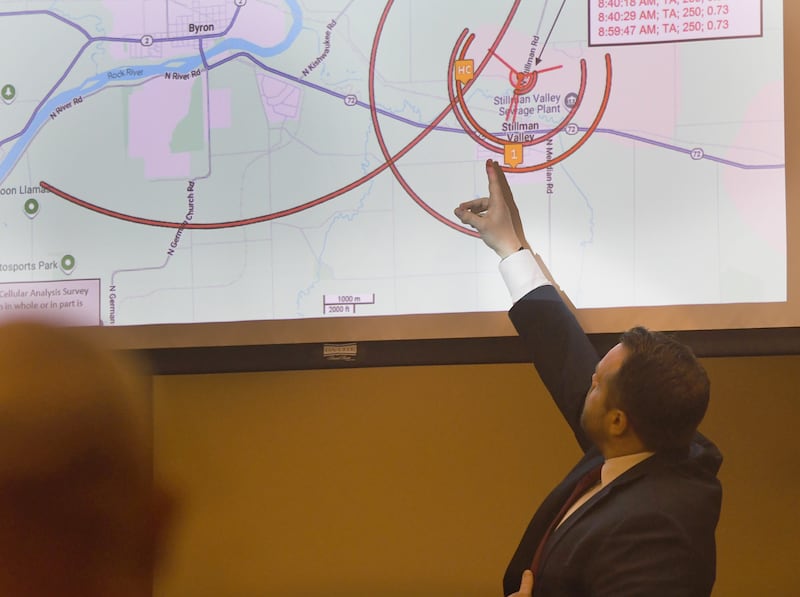
Under questioning by Assistant Ogle County State’s Attorney Matthew Leisten, FBI Special Agent Jeremy Bauer testified to maps he said the FBI generated based on Verizon cellphone data extracted by police from DC’s phone. He said that data indicated where DC’s phone was by tracking communications sent to and from cell towers in the area.
:quality(70)/cloudfront-us-east-1.images.arcpublishing.com/shawmedia/AH7ACE6RGRAVRCBKROYVCKUYGY.jpg)
He said a Historical Cell Site Analysis provided a general idea where the phone was located, at a certain time and place, based on radio transmissions between the phone and the tower. That information is kept by major phone companies for billing customers and monitoring reception and performance, Bauer said.
Data gathered does not provide an exact address or determine who is making the calls or writing the text messages, he told jurors.
Bauer said the maps shown to jurors were created in April 2025 after he received the original report – created in 2016 – from an FBI agent who retired in January 2025. He said the report was also updated in October 2025.
The maps showed times and towers where Bauer said DC’s cellphone was used the day before and the day when Maggie’s body was discovered. He said a Real Time Tool is used by Verizon to establish when calls are made and the measurements between the tower and phone.
“It gives approximate distances as to where the phone was from a tower,” Bauer said.
The data showcased timestamps when the phone communicated with cell towers near Byron, Stillman Valley and the Rockford area. The maps also showed locations of DC’s home in Stillman Valley, his parents’ home on Hales Corner Road, and Maggie’s house.
Leisten showed jurors 26 slides on a large screen while Bauer pointed out distances to each tower along with call times and durations. The slides shown included information from the day before and the day when Maggie was found in the home.
Leisten had Bauer explain the path and direction he believed the phone was traveling during those times. Several of the slides indicated that on the evening of Oct. 18, the phone had communicated with the cell tower located in Byron.
On Tuesday, prosecutors played a 4-hour video recording in which DC insisted he was not near the rural subdivision north of Byron the day before Maggie was found dead.
During his nearly 2-hour cross examination, defense attorney Christopher DeRango questioned Bauer’s training, the accuracy of antennas in 2016, how the cellphone data was gathered and compiled, and the accuracy of Bauer’s analysis.
:quality(70)/cloudfront-us-east-1.images.arcpublishing.com/shawmedia/MXZAQWGMGJDJFO4BH53DMNZCOM.jpg)
Last week, defense attorney Patrick Moore raised many objections as to the accuracy of the data and the foundation for how the data was provided on a spreadsheet.
On Wednesday, DeRango argued that additional data had been omitted in the state’s presentation and questioned Bauer’s expertise in deciphering the information and estimating distances from towers.
DeRango said the information Bauer received should have been verified further since DC was charged with “double murder”. He said a “drive test” should have been done to verify the data.
Bauer said he was confident the data obtained was accurate and had not been altered.
Late in the afternoon, Blake Aper, a forensic scientist for the Illinois State Police, testified that DNA taken from an earring found in DC’s truck on Oct. 19, 2016, matched Maggie’s DNA.
During cross examination, DeRango called into question why more samples from the home hadn’t been collected for testing, including “touch DNA”. Aper said investigators had asked him to test the handles of a wheelbarrow found in the backyard and a cellphone case, but neither provided an adequate amount to test.
:quality(70)/cloudfront-us-east-1.images.arcpublishing.com/shawmedia/I7RYWLFYIRCQHJ3KPEKE7T6P2Q.jpg)
DeRango then questioned Aper regarding investigators’s comments he said were made during a “Major Case Review” meeting with lab officials.
“They told you what they wanted to find,” DeRango said.
Aper said such reviews were common during major investigations and did not sway lab results.
“That can’t change the DNA that is on an item,” Aper said. “They can say that but it does not influence me and does not influence the DNA results.”
DeRango returned to questioning Aper about the lack of “touch DNA”.
“You don’t have the ability to test the things you weren’t given,” commented DeRango, to which Aper replied: “Correct”.
State witnesses testified last week that the interior of the home was covered in soot from the fire and Maggie’s body was so severely burned that additional samples were not taken.
:quality(70)/cloudfront-us-east-1.images.arcpublishing.com/shawmedia/77WFTQCUU5DFXJ5M3GRKXU3FTU.jpg)
Maggie was a teacher at the Chana Education Center at the time of her death. She filed for divorce in 2014 and court records show the divorce was finalized in September 2016.
Earlier this week, prosecutors displayed a selection of text messages between DC and his girlfriend, Catherine Mearns, sent days, and sometimes months, before the fire.
Some of those texts included derogatory comments about Maggie from DC. One dated Aug. 15, 2016, read: “I {expletive} hate this {expletive}. I hate a lot right now. Idk what’s going to happen today. I hate that you hate me. Since meeting you all I’ve wanted was to be that man that got to spend his life next to you. I love you to no end. Your (sic) good bad and ugly. I hope I won’t need bail. See you on the other side.”
Mearns, who was listed in DC’s phone as “My Hopes and Dreams”, responded: “Yep. Have fun in court. Go ahead and kill the (expletive). I’ll visit you in prison.”
On Aug. 22, 2016, Meyers texted Mearns: “If I did go to jail would you be there for me when I got out?”
Another message, dated July 30, 2016, from DC to Mearns said: “Hate is not a strong enough word for her. That piece of (expletive) will be gone or I’ll die trying” to which Mearns replied: “Yeah, you’ll die trying.”
The defense has argued that text messages sent by DC before the deaths were only part of a “contentious” divorce and not indicative of anything nefarious.
Prosecutors said they will prove DC “attacked and murdered” Maggie while Amos was sleeping in his upstairs bedroom.
Defense attorneys told jurors that while the deaths were a “heartbreaking tragedy,” DC was not responsible and the state’s case is based solely on circumstantial evidence.
Testimony recap
On Tuesday, under questioning by Chuck Davidson, a former investigator and master sergeant with the Illinois State Police, Meyer denied in a 4-hour video recording – taken on Oct. 28, 2016 – that he was at Maggie’s home before she was found dead.
He denied Davidson’s claim that “things just got out of control” on that Tuesday night and an “accident” happened.
DC said it was “ridiculous” when Davidson said cellphone records showed otherwise.
Earlier in the recording, DC said he had been hunting on his family’s farm near Chana on Tuesday and had left his phone in his truck.
After questioning DC in subdued voices for most of the recording, investigators became more aggressive in the final minutes.
Davidson accused DC of not telling the truth about his whereabouts Tuesday evening. He said everything DC had told investigators about his movements prior to Tuesday synchronized with cellphone data recovered from his cellphone, with the exception of Tuesday evening.
Davidson countered that cell locations and data tracked by tower “pings” showed otherwise.
“I don’t care how it works. I wasn’t there,” DC replied.
DeRango accused Davidson of lying to DC about the “hard” evidence of cellphone data tying him to the scene, arguing that cell phone data can be interpreted differently.
Earlier in the interview, DC told investigators he arrived at Maggie and Amos’ home around 6:30 a.m. after texting Maggie at 5:15 a.m. that he wanted to pick up Amos so he could spend the day on the farm with his grandparents – DC’s mom and dad. He said when he arrived he saw that the home was on fire, called out to Amos, and tried twice to run up the stairs to Amos’s bedroom, but was turned back by heavy smoke.
He said he reached the toddler on his third attempt and carried him out of the home to the front yard where another first responder began CPR. He rode in the front seat of the ambulance as Amos was being transported to the hospital where Amos was declared dead.
When asked by Lockard if he looked for Maggie or yelled her name, DC replied: “My first thought was the home was on fire and to get my son out.”
Maggie was found dead on the couch on the home’s first floor.
He told investigators his mom and dad arrived at the hospital and drove him to his home in Stillman Valley where he showered and placed his clothes in the washer.
Previous testimony highlights
Gregory Castronovo, an investigator for the State Fire Marshal’s Office, said the fire was extremely heavy on Maggie’s mid-torso and the entire surface of her body was damaged beyond recognition.
He said the “V” burn pattern from the couch indicated to him that the origin of the fire was on the sofa in the first-floor living room where Maggie’s body was found. He said damage to the ceiling of the basement – directly below where the sofa was located – also pointed to the fire starting on the sofa.
He said he found no evidence that the fire started from electrical or mechanical issues or a cigarette or candle, with the greatest amount of damage found in the center of Maggie’s body. Smoke and carbon monoxide from the fire traveled upstairs to the bedroom where Amos was asleep.
On Thursday, Jan. 15, two forensic pathologists testified they found ante-mortem injuries on Maggie’s body that occurred before her death. Both said she died before her body was found in the living room of the home, but could not give a definitive cause of death.
Dr. Mark Peters of Rockton said Maggie’s body was burned “100 percent”, with charring covering her entire body. He said some of the injuries she suffered were from the heat of the fire, which caused limbs to be distorted and one femur to break.
Jurors were shown graphic photos of Maggie’s body, which had no identifying features visible.
Peters and Dr. Hilary McElligott of the DuPage County Coroner’s Office said no soot was found in her throat or lungs, indicating she was dead when the fire occurred. Examinations of her internal organs found fluid in her lung, which was indicative of a prolonged death, possibly by strangulation.
Peters and McElligott said they both found hemorrhaging on the lower part of her scalp and on her back posterior shoulder and neck. Examinations of her skin for other areas of pre-death injuries were made impossible by the severe charring from the fire.
DNA samples were unable to be taken from the body due to the “significant disruption of tissue” because of the extensive thermal injuries, McElligott said.
Peters said Amos died by asphyxia from carbon monoxide from the fire, indicated by soot in his larynx. In photos presented as evidence by prosecutors, Amos was shown laying on his side, his features intact.
:quality(70)/author-service-images-prod-us-east-1.publishing.aws.arc.pub/shawmedia/c70d24f0-1332-4244-8446-e91288029474.jpg)