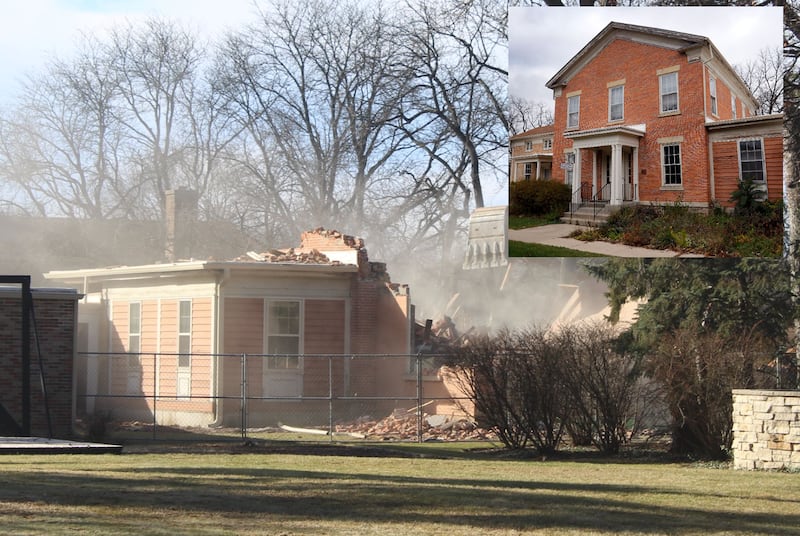
One of Crystal Lake’s oldest buildings, constructed in about 1853, was completely torn down Tuesday after a year-long effort to preserve it proved unsuccessful.
The Crystal Lake Academy Building, also known as the former Gates House and the Tarpley House, stood on the property of Trinity Episcopal Parish’s St. Mary’s Church along McHenry Avenue. But in 2024, the church applied for a demolition permit for the structure, which prompted the Crystal Lake Historic Preservation Commission to seek protections for the roughly 172-year-old building.
The Crystal Lake City Council revoked landmark status for the building last month after preservationists, who’d hoped to move the building off the church property, were unable to find a new location for it. Council members had unanimously agreed to landmark the building in October, with strict conditions that preservationists had to find a new location within 30 days, and then raise funds and move the building by April 30.
[ See more photos of the Academy Building before, during and after demolition ]
“We recognize this outcome is disappointing for many who care deeply about Crystal Lake’s history,” leaders of St. Mary’s said in a FAQ document about the building. “We share that disappointment. Every avenue was explore, and numerous individuals and organizations worked tirelessly to find a solution. The reality is that no financially feasible path emerged despite extraordinary efforts from all parties.”
The church secured a demolition permit last month and began the process on New Year’s Eve.
The bulk of the work was completed Tuesday as excavators hacked away at the structure until it collapsed, sending a large cloud of dust into the air. What remained was what Crystal Lake Historical Society President Diana Kenney warned historic commissioners and City Council could be the fate of the structure: “a bulldozed rubble pile filled with old bricks and cobblestones.”
A group of volunteer preservationists, calling themselves the Crystal Lake Academy Task Force, was able to document the building for historic purposes last month, Historic Preservation Commissioner Ana Freund said. Scans and drone images were captured with the goal to create 2D drawings and a 3D walkthrough. The group also plans to have a commemorative plaque placed on the property.
Bricks and stone sills were salvaged by the Crystal Lake Park District and Crystal Lake Public Works “for possible reuse” at the Colonel Palmer House Museum and Depot Park, Crystal Lake Park District Park Planning and Development Manager Amy Olson said.
The church cited multiple reasons for demolishing the building, including increased insurance costs, the concern that the structure in its deteriorated state posed a danger and that the costs of maintaining the building take away from the church’s primary mission to fund community-based programs. The church plans on turning the plot of land into an open grassy area, St. Mary’s pastor, the Rev. Scott Zaucha, said at previous meetings.
Built before the Civil War by stonemason Andrew Jackson Simons, the Crystal Lake Academy Building featured “rare” Greek revival and federalist architecture and cobblestones from Lake Michigan, Kenney has said.
It was constructed as the city’s first purpose-built school for education beyond eighth grade. The building also was the childhood home of William Day Gates, who created the American Terra Cotta & Ceramic Co. factory, where terra cotta tiles and TECO pottery were made.
The fight over the building inspired City Council member Denise Smith to propose a change at a meeting last week that would require property owners’ consent before a structure received landmark status from the city.
“I find it distasteful that government can dictate to a homeowner what they can and cannot do to their property. That really bothers me deeply,” Mayor Haig Haleblian said.
Council member Ellen Brady noted, “We do it all the time,” pointing to city codes that restrict things like how tall a fence can be, which Haleblian argued was “different.”
Some Council members voiced opposition to the proposal, saying that could allow historic buildings to apply for demolition without the city’s say.
“I think it’s a tool for transparency,” council member Natasha Teetsov said.
The next step is that city staff “will look into it” and put the matter on a future City Council agenda for discussion, City Manager Eric Helm said.