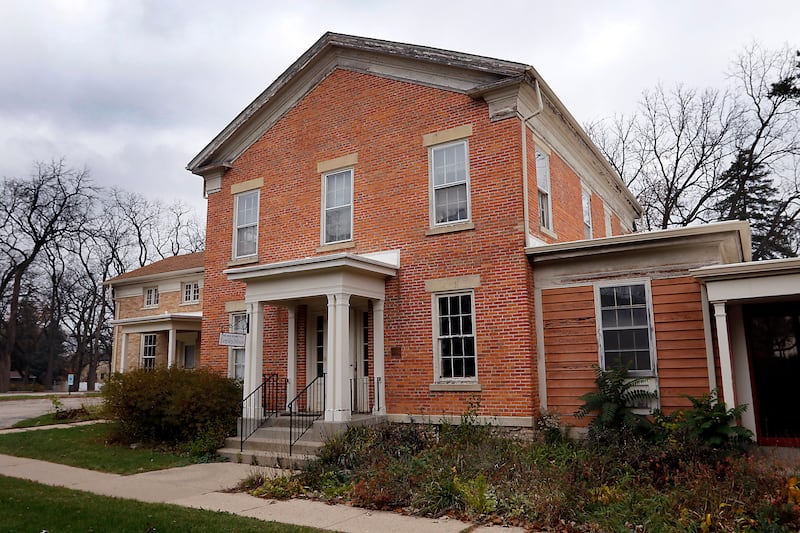
The Crystal Lake City Council has revoked landmark status for a Crystal Lake school building built in about 1853 after preservationists failed to find a new location for it.
That means the apparent demise and demolition of the building.
The Crystal Lake Academy Building, also known as the former Gates House and the Tarpley House, stands on the property of Trinity Episcopal Parish’s St. Mary’s Church at 210 McHenry Ave. The church last year applied for a demolition permit for the structure, which prompted the Crystal Lake Historic Preservation Commission to seek protections for the 172-year-old building.
For more than a year, the city held off on granting approval to demolish the structure as interested parties sought to find a way to save the building, potentially by moving it off the church property.
But Tuesday evening, the City Council revoked the landmark status in a 4-2 vote, giving a go-ahead for demolition. Council members had unanimously agreed to landmark the building in October, with strict conditions that preservationists must find a new location within 30 days, and raise funds and move the building by April 30.
The City Council reconsidered the decision after preservationists failed to meet the one-month deadline.
:quality(70)/cloudfront-us-east-1.images.arcpublishing.com/shawmedia/P4VFOHQBMJCRDCBWTFII7EB2VE.jpg)
Last year, the Historic Preservation Commission unanimously recommended landmark status for the structure, and the church agreed to hold off on demolition plans for six months while preservationists assessed whether the building could be restored and for how much. The council’s landmark vote was postposed multiple times to grant preservationists more time.
The church’s pastor, the Rev. Scott Zaucha, said the church now will move forward with securing a demolition permit. When the building will be torn down will depend on weather and when preservationists have completed documenting and archiving the building.
The church and preservationists explored every avenue possible, but none was shown to be financially feasible, Zaucha said.
“We recognize that this is disappointing for some people,” he said. “We believe that this is the final option that remains for us.”
The church cited multiple reasons for demolishing the building, including increased insurance costs, the concern that the structure poses a danger and that the costs of maintaining the building take away from the church’s primary mission to fund community-based programs.
The landmark status meant the responsibility of maintaining the building ultimately would land in the church’s hands, which City Council members agreed would be unfair.
In a last-ditch effort, council member Ian Philpot reached out to more than a dozen organizations to see if there was any interest in taking over a ground lease of the property. He said he only got one response, which was a rejection, leaving the city at the “end of a rope.”
:quality(70)/cloudfront-us-east-1.images.arcpublishing.com/shawmedia/DW3MFU4TIRGURI4MXYHGNDKGPQ.png)
“We can be frustrated, but we need to find a way to let it go,” he said. “We need to find a way to move on and work together as a community, because that’s what makes Crystal Lake a good place.”
Built in about 1853 by stonemason Andrew Jackson Simons, the Crystal Lake Academy Building features “rare” Greek revival and federalist architecture and cobblestones from Lake Michigan, Crystal Lake Historical Society President Diana Kenney has said.
It was constructed as the city’s first purpose-built school for education beyond eighth grade. The building also was the childhood home of William Day Gates, who created the American Terra Cotta & Ceramic Co. factory, where terra cotta tiles and TECO pottery were made.
A group of volunteer preservationists, who call themselves the Crystal Lake Academy Task Force, aim to document what they can of the building for historic purposes. Options they are looking into include 3D photography of the exterior and interior, and salvaging any materials possible such as brick, cobblestone and fixtures. Historic Preservation Commissioner Ana Freund also plans to have a commemorative plaque placed on the property.
The iron fence on the church property was unanimously approved for landmarking Tuesday, as the church doesn’t have concerns over it.
“I think everybody tried to do the right thing, and it didn’t quite turn out the way we wanted it to,” Mayor Haig Haleblian said.