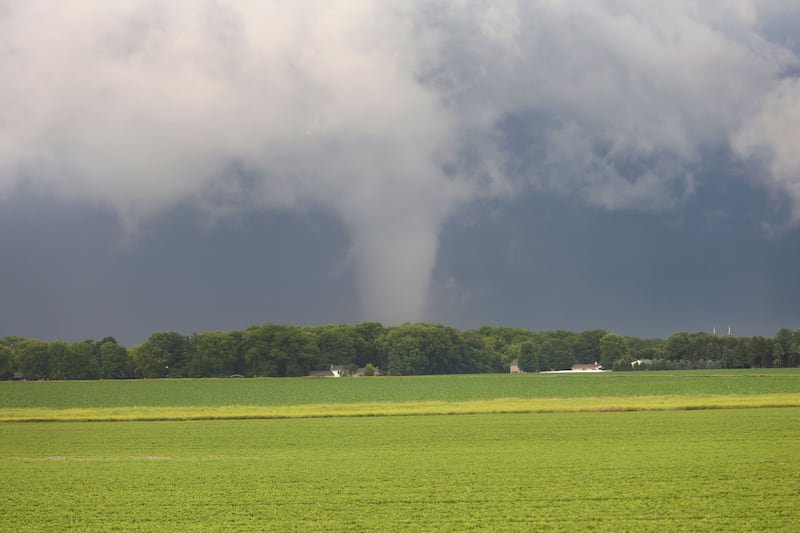
The National Weather Service said the storms that battered northern Illinois on Thursday produced 17 tornadoes, including an EF-3 in Streator that destroyed homes.
A tornado was recorded in Dwight and South Wilmington in Grundy and Livingston counties, and an EF-1 tornado caused property damage in Bartlett in DuPage County.
This is the second time in just three months that storms have caused major damage in northern Illinois communities, with a tornado destroying homes and damaging many buildings and vehicles in Kankakee County on March 10.
State climatologist Trent Ford said Illinois is closing in on the record set in 2024 with 142 tornadoes. If the state sees an additional three tornadoes, it will break the record number it has seen for the third time in the last four years, and “tornado season” isn’t even over yet.
Tornado season, as defined by the National Weather Service, typically runs from April to June.
“It has been a sort of unprecedented period of time with really active and frequent severe weather, particularly for tornadoes,” Ford said. “This year has been particularly odd because our neighboring states are above average for tornado frequency, but not nearly to the extent that we are.”
Ford said Illinois has recorded more than 130 tornadoes as of Monday, and, by comparison, neighboring states have half or fewer.
“We’re getting picked on,” Ford said.
:quality(70)/cloudfront-us-east-1.images.arcpublishing.com/shawmedia/3JU2OPDH7BAR5IS3D2IQSY3CBI.jpg)
There’s a rational explanation for this, he said. Illinois is getting an active subtropical jet stream bringing moisture and the right dynamics into the air.
“We think about dynamics being the way the air moves,” Ford said. “It’s not enough to have a bunch of humidity in the atmosphere, though sometimes that’s enough to spark an isolated severe weather event. When we have these big organized events like what we saw last week, we need not only the rampant humidity and intensity and instability, but also need the air to be moving in such a way that it can generate these multiple dozens of tornadoes instead of just one.”
Victor Gensini, a Northern Illinois University Professor and the Director of the Center for Interdisciplinary Research on Convective Storms, said one thing people need to keep in mind is that Illinois is a really big state from north to south. Like Texas, its large size means it is going to see higher numbers, statistically
“We’ve had our fair share of severe weather this year,” Gensini said. “There’s no question about that. A lot of it is just kind of where the ingredients have been favorable, where they’ve been setting up.”
Gensini said he thinks back to March 10 in Kankakee. That day, he said, had an extremely volatile setup in the Midwest. The storm that struck Streator on Thursday was similar. He referred to the forecast on Wednesday as the third “big day.”
Ford said he hasn’t seen any explainable factors as to why this is happening yet, but he said there has been a string of La Niña conditions in the Pacific Ocean in the last few years.
Three of the last four years have been La Niña winters, which typically lead to above-average severe weather events during the spring.
However, this year’s winter was not an El Niño year. It was a neutral year.
“Yet we’re still seeing this really active period of time,” Ford said. “It remains to be seen why we’ve seen this three-year period with a high frequency of tornadoes.”
Gensini said the Midwest is heading into a particularly strong El Niño pattern starting this winter.
Ford said the increase in tornadoes can’t quite be attributed to climate change. Illinois has seen an increase in tornado frequency over the past 30 or 40 years, but that can be attributed to improved observational methods by forecasters.
Ford said that, while the trend of increasing tornadoes goes beyond what improved observation methods would show, it is a difficult topic to address.
“However, when we look at our climate models, they do show better chances of more of those environments with higher numbers of tornadoes,” Ford said.
He said, looking back a few years ago, Illinois had three straight years with fewer tornadoes than average. Now the state has had three straight years of an unprecedented number of tornadoes.
“What climate change does is, it makes these high-frequency years a little bit more likely,” Ford said.
Ford said it will take a lot of research and a nuanced look at how climate change is affecting the numbers over the years to tell what is and isn’t climate change.
“I don’t want to say yes, absolutely, this is climate change,” Ford said. “That would be going too far. But I also don’t want to downplay the potential role of climate change in influencing the tornadoes we have here in Illinois.”
Gensini used an orchestra as an analogy for why these storms keep popping up the way they are.
“The atmosphere is a very, very complicated orchestra with lots and lots of ensemble members,” Gensini said. “Picking out exactly which instrument is causing the crescendo, so to speak, is incredibly difficult to do without going to lots and lots of concerts.”
:quality(70)/cloudfront-us-east-1.images.arcpublishing.com/shawmedia/IAUWVXNL5JHAXPVQW3CABEIZ24.jpg)
What’s become even more difficult, Genisni said, is that there are a lot of weather balloons missing. The National Weather Service isn’t launching morning weather balloons from stations across the Central US, which makes forecasting extremely difficult.
Gensini said he’s been doing this for almost two decades, and 2026 has been the hardest year for predicting when, where, and how intense weather will be.
“The recent staffing shortages and cuts at the National Weather Service have basically delayed, or in some locations, they’re not even performing weather balloon launches,” Gensini said. “That is an incredibly important, vital piece of data that goes into these weather models to make predictions.”
He said the National Weather Service lost a lot of institutional knowledge and talent when the Department of Government Efficiency offered the early retirement option to reduce the federal workforce. Now, there are staffing shortages all across the National Weather Service, and those who have retired aren’t being replaced.
:quality(70)/s3.amazonaws.com/arc-authors/shawmedia/744709d3-0d08-4f13-a8f2-47f3f8ea9de6.png)