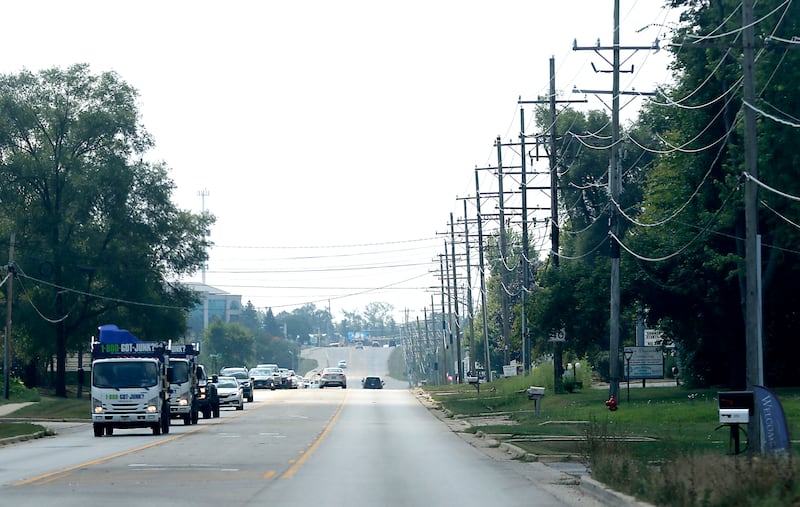
Beginning in 2027 and expected to run into 2030, the Route 31 reconstruction and widening project could hurt 60 McHenry businesses, Economic Development Director Doug Martin said.
On Monday, he provided the McHenry City Council with a proposal outlining the Route 31 Business Relief Fund and Program. If approved by the City Council, the program aims to help small businesses hit hardest by construction, including “restaurants, retail, people that rely on foot traffic,” Martin said.
Woodstock has adopted a relief program for the Route 47 reconstruction project, Martin said, and McHenry’s proposed program is based on Woostock’s.
Martin also suggests that, like Woodstock, McHenry should also work with The Community Foundation for McHenry County to administer the grant program.
“The reason for the partnership is to establish transparency,” Martin said, adding the foundation has “a lot of credibility” in the county.
The foundation can also accept donations towards the relief program, pooling it with $100,000 from McHenry’s Revolving Loan Fund in two $50,000 deposits. Eligible businesses could receive one-time reimbursement grants of $10,000.
The idea behind both Woodstock’s and McHenry’s proposed relief programs is to support the businesses most affected by the traffic disruption, said Amy Hernon, executive director of The Community Foundation for McHenry County.
“It is an opportunity for the community to support the businesses that are a part of the community,” Hernon said.
Before an application is made, program applicants will send letters of intent to the municipality. Once that step is done, Hernon’s staff would review a formal application “and makes sure those that are needing the support can get it,” she said.
Because the foundation’s grant reviewers are from all over the county, it also helps remove any suspicion of favoritism in who receives the grants, she said.
Any funds from the municipality or from donors that is not distributed would be returned to the town, Hernon added.
So far, there have not been many donations to the Woodstock program, she added, but neither has the grant cycle started yet. Fundraising for the program “is the job of the city ... to promote it to community residents” and ask them to help support local business, Hernon said.
The McHenry City Council, and Martin, had thoughts on the proposal. A vote was not held Monday, as it is still in early stages.
In his original proposal, Martin suggested businesses could apply if they saw a 30% decline in total gross revenue over 120 days.
However, “I talked to several businesses ... and 120 days is too long to let a business go while losing money,” Martin said, adding that a 30-day period gets aid to the businesses faster. He also suggested a trigger of a 20% decline in gross revenue, based on the same time frame the previous year.
“They will have to prove they are being affected by the construction,” Martin said.
Alderman Andy Glab, 2nd Ward, said he was not in favor of a relief program.
“Every time we turn around, we are giving out taxpayer money to businesses,” Glab said.
Those business owners have known for several years that the Route 31 expansion was coming.
“Businesses should be preparing themselves for that,” Glab said.
The funds Martin suggested McHenry use comes from the revolving loan fund, City Attorney David McArdle said. Decades ago, the state gave those funds to towns to help support local businesses, and McHenry continues to use it for that purpose, he said.
The revolving loan fund has a current balance of $256,000, Martin said.
By Council policy, those funds can only be used to help local businesses, 1st Ward Alderwoman Bobbi Baehne said.
“It is not just about taxpayer money. It is about a thriving community supporting small business and building our tax base,” Baehne said of the relief fund spending.
:quality(70)/s3.amazonaws.com/arc-authors/shawmedia/185fbfd8-8216-43d7-8beb-cd8992be6fe5.png)