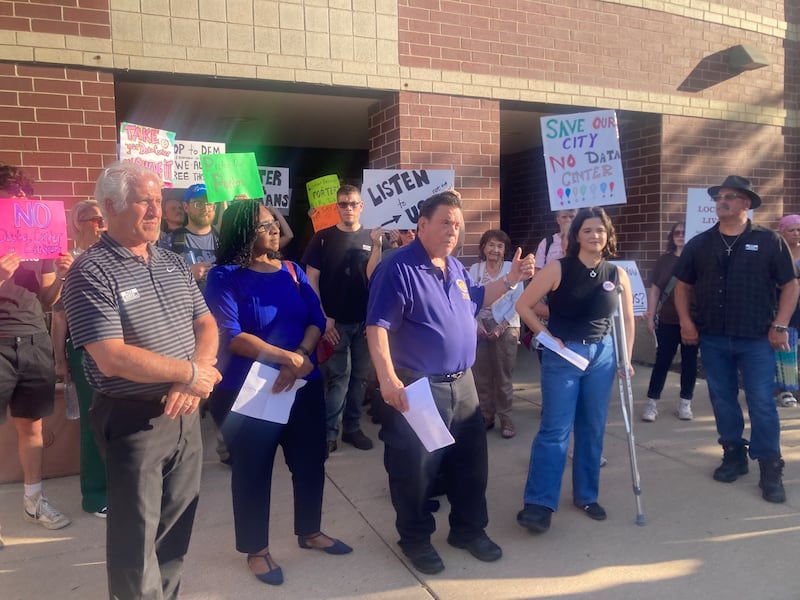
More than 100 Bourbonnais residents packed a city council meeting over the prospect of a data center. In Joliet, neighbors sued to stop one. In Lockport, residents said local officials couldn’t handle it alone. But when Illinois lawmakers adjourned last month, the state’s most ambitious effort to regulate the rapidly expanding industry died without a vote.
The legislation, known as the POWER Act, would have imposed new transparency requirements and limits on utility consumption by data centers. Its failure has left state and local officials searching for other ways to regulate an industry drawing increasing scrutiny across northern Illinois.
After the POWER Act expired without passage, Gov. JB Pritzker on Thursday called for a pause on processing agreements for the Data Center Investment Program starting July 1.
Pritzker is calling for comprehensive legislation that addresses several key data center issues, including accountability for energy and water usage by setting proficiency standards and a new rate class; protections against air and water pollution; and pausing state tax incentive packages.
“Illinoisans have a right to know what’s happening in their communities, including how much water, electricity and other resources data centers will use. We must ensure tech companies operate a transparent process with opportunities for community members to voice their concerns and opinions,” he said.
Meanwhile, state legislators and local leaders are taking up the matter in their own ways. State Sen. Darby Hills, R-Barrington Hills, has filed a new bill that would give counties and municipalities more control over regulating data centers, rather than broader state and federal oversight.
:quality(70)/cloudfront-us-east-1.images.arcpublishing.com/shawmedia/35M2WVMDEZCXPMCVHQU3OJMXAA.jpg)
“People are worried and they have every right to be,” said Hills in her announcement of the bill. “As data centers continue to grow across Illinois, we must ensure innovation and economic development do not come at the expense of local communities or our natural resources.”
Senate Bill 1050 would allow counties and municipalities to set standards related to the size, design and geographic concentration of data centers and strengthen local authority over where the facilities can be located.
The bill would prevent data centers from being built within three miles of a residential community or another municipality’s boundary without that municipality’s written consent.
The legislation also would give local governments the ability to adopt protections related to water usage and conservation, contamination prevention, water reuse and noise mitigation for data centers.
Municipalities also would be legally required to hold at least one public hearing before a vote can be taken on approving a data center, in order to give residents a chance to speak out, according to the language of the bill.
“Good policy starts with listening to the people directly affected,” Hills said.
Hills also has requested that the state impose a one-year moratorium on data center development to allow for more research on community impact and for “proper guardrails” to be put in place.
Can local control fill the void?
The lack of regulation currently at the state and federal level was a major point of contention at a May 26 meeting in Lockport, where residents spoke out vehemently against the possibility of using a specific parcel of city-owned land to build a data center.
Mayor Steven Streit argued that if the city were approached about a data center project, the city could use its ownership of the property, known as the Star Innovation District, to impose its own restrictions on the development. Residents were skeptical, however, that local efforts would be successful without regulation at the state or federal level.
When asked about Hills’ Senate Bill 1050, Lockport City Administrator Ben Benson said, “Any tools for local authorities are certainly helpful; however, the state and feds are missing the point; this industry needs to be regulated much like a utility.”
Benson noted that while he was not familiar with the entirety of the bill, he does not believe local regulation is enough.
“The concern is far too many resources and regional impacts are beyond one town’s reach. Until state or federal guidelines are increased, I don’t see how punting to the local municipalities is going to solve the issue,” he said. “You’re still allowing approvals of these individually without overall protections on the larger issues or their relationships to one another.”
Republican Will County Board member Steve Balich, who is a vocal opponent of data centers, said he plans to “continue fighting” the development of data centers in the area.
But he agreed with Hills’ proposed legislation saying, “we need to have local control” and asserting that the state “should not be allowed to do the job of local government.”
:quality(70)/cloudfront-us-east-1.images.arcpublishing.com/shawmedia/JRHNN54YX5GM5OTDMCN2NPL4D4.jpeg)
The mere appearance of the term data center on an April Planning and Zoning agenda in Bourbonnais sparked fear in the city, which resulted in more than 100 residents coming to a recent city council meeting to oppose such a development.
Bourbonnais officials said they are being proactive after someone approached them about the possibility of a data center, although it would first require electrical studies, which could take years.
The issues on the planning and zoning agenda were meant to require approval of a special use permit in order to build a data center in the city on property zoned for manufacturing, which would give the city more control on what could be built.
:quality(70)/cloudfront-us-east-1.images.arcpublishing.com/shawmedia/V4MFI4UZ3FNTVPOHA7XOQ3MSJE.jpg)
“We are evaluating,” Bourbonnais Administrator Mike Van Mill said. “The Planning and Zoning board wants to see more detailed legislation. We don’t want the state or anybody to dictate it to us.”
Streit said he hopes any state legislation also could lead to a new zoning designation that could potentially streamline data center regulation for many municipalities.
“If they created a new data center zoning, let’s call it D zoning with some classifications for different sizes, then everything would need to be rezoned to allow them,” Streit said. “Creating different zoning would empower every municipality to start from scratch and consider where they would want to allow this.”
Letting voters decide
State Rep. Jed Davis, R-Yorkville, has offered another solution – requiring data center proposals to be put to local referendums.
“I’ve always been a huge proponent of local control,” Davis said of his House Bill 5755. “We really want [voters] to have the final say because they have a better pulse on the community. The people I represent kind of felt like they didn’t have a voice anymore. They’ve been very vocal on the data center issue, strongly opposed in several ways. I am trying to return the power back to their hands.”
:quality(70)/cloudfront-us-east-1.images.arcpublishing.com/shawmedia/D2G65LZCGFBNFPO5RMKPO5VBVQ.jpeg)
“Opposition overwhelmingly outweighs support, both from the general public and targeted voters,” Davis said.
Yorkville residents were very outspoken against data center developments that were approved earlier this year.
Residents in Joliet have taken another approach to have their voice heard. After a large data center was approved in March, a group of residents from unincorporated Will County near the proposed site has filed a lawsuit, challenging the rezoning of the subject property in hopes of derailing the development.
Both Hills’ bill and the POWER Act are expected to return for consideration during the fall veto session.
• Shaw Local reporters Joey Weslo and Jeff Bonty contributed to this story.