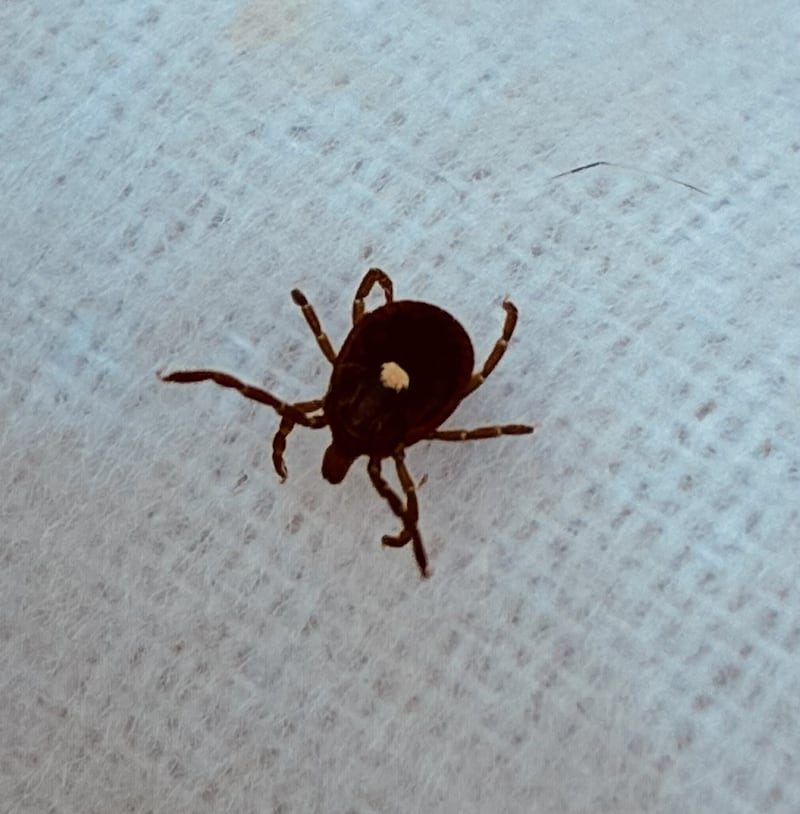
The Kendall County Health Department said an “unwelcome guest” has moved into the region.
Adult Lone Star ticks recently were discovered while teams were conducting a tick drag in Kendall County.
“We’ve been expecting this unwelcome guest as they’ve been discovered in other surrounding counties, and the climate is favorable for them to become established,” the Kendall County Health Department said in a social media post on April 24.
State criteria require one of the following to confirm an established population by the procedure of a tick drag:
• Six ticks of the same life stage, or
• Two ticks in different life stages (adult, nymph, larva)
• Two Lone Star Ticks have been found in Kendall County. Both have been adult ticks
“Given the number of Lone Star Ticks identified in surrounding counties, it is reasonable to assume the species is likely present regionally. However, scientific confirmation for Kendall County has not yet been met,” the Kendall health department said Tuesday.
Lone Star ticks have historically been found in the South and Eastern portion of the U.S., but have been rapidly migrating into the Midwest over the past few years, due to climate change and rising temperatures, health officials said.
:quality(70)/cloudfront-us-east-1.images.arcpublishing.com/shawmedia/7FX2XXFMBRBR7MP43ZV34RYMEI.jpg)
It is known as a “very aggressive tick” that bites humans, according to the Centers for Disease Prevention and Control.
Lone Star ticks are known to transmit several diseases: Ehrlichiosis, Tularemia, Heartland virus, Bourbon virus and the Alpha-gal syndrome, a severe allergy to red meat, as well as skin rashes, according to the Mayo Clinic.
Lone Star Ticks do not carry Lyme disease.
The CDC has issued an early advisory to the public to guard against ticks.
Tick bites typically spike in May, but “the data are telling us now is the time to take action,” Alison Hinckley, a CDC Lyme disease expert, told The Associated Press. “Ticks are out, and people are getting bitten.”
The CDC’s tracking system shows that weekly rates of ER visits for tick bites are the highest for this time of year since 2017.
About 85% of U.S. hospital emergency departments send data to the surveillance system, but it doesn’t capture people who didn’t go to a hospital, the Associated Press reported.
Lyme disease is a bacterial disease usually transmitted by infected deer ticks, also known as the black-legged tick, the CDC said.
How ticks can get on you
Ticks are found on grasses and shrubs; they do not live in trees.
When brushed by a moving animal or person, ticks will let go of the plant and climb onto the host. Ticks can only crawl; they do not fly or jump, the Illinois Department of Public Health said.
“Ticks found on the scalp have usually crawled there from lower parts of the body. Some species of ticks will crawl several feet toward a host,” the IDPH said.
Although at least 15 species of ticks occur in Illinois, only a few of these ticks are likely to be encountered by people: American dog tick, lone star tick, blacklegged (deer) tick, brown dog tick and winter tick.
:quality(70)/cloudfront-us-east-1.images.arcpublishing.com/shawmedia/7P7Z32OFJPBFWKU67MWX3W42NI.jpg)
Preventing tick bites
• Keep your grass mowed and keep weeds cut.
• Clean up items that attract rodents, which can carry ticks, like old wood piles.
• If ticks are present in vegetation along the edge of the property, insecticides labeled for control of ticks can be applied to small areas of high weeds that cannot be mowed, the IDPH said.
When hiking, biking, camping or visiting areas with tall grass and weeds, the IDPH encourages these precautions:
• Wear light-colored long-sleeved shirts and pants. Tuck pant cuffs into your socks.
• Apply insect repellent containing 10% to 30% DEET primarily to clothes. Always follow label directions for the appropriate use of repellents.
• Walk in the center of trails to avoid brushing against weeds.
• Check children and other family members for ticks. If pets spend time outdoors, regularly check them for ticks, too.
• Remove any tick promptly using tweezers to grasp it as close to the skin as possible and gently, but firmly, pull it straight out. To keep an intact tick identified, put it in a small vial of rubbing alcohol and contact your local health department for assistance.
:quality(70)/cloudfront-us-east-1.images.arcpublishing.com/shawmedia/GHTKIISDKOZHIFHEQKPEIQZUIU.jpg)
When to seek medical help
If you get a tick bite and experience a rash that looks like a bull’s-eye, or a rash anywhere on the body, or an unexplained illness accompanied by fever, the IDPH said to consult your physician and explain that you were bitten by a tick.
Diseases carried by ticks can be treated with antibiotics. However, the type of antibiotic can vary, and individuals should be treated early in the infection, the IDPH said.
Signs and symptoms of Lyme disease can vary from person to person and with the length of time a person has been infected, the IDPH said.
A ring-like red rash occurs in about 70% to 80% of cases and begins three days to 32 days after the bite of an infected tick. The red rash at the bite site is circular and grows larger over a few days or a few weeks.
Fact sheets about symptoms and treatment of tick-borne diseases may be obtained from local health departments by calling the IDPH’s central office at 217-782-2016 or from the department’s website at www.dph.illinois.gov.
:quality(70)/author-service-images-prod-us-east-1.publishing.aws.arc.pub/shawmedia/8832388b-fc0a-47f3-aa56-fba06c9d2015.jpg)