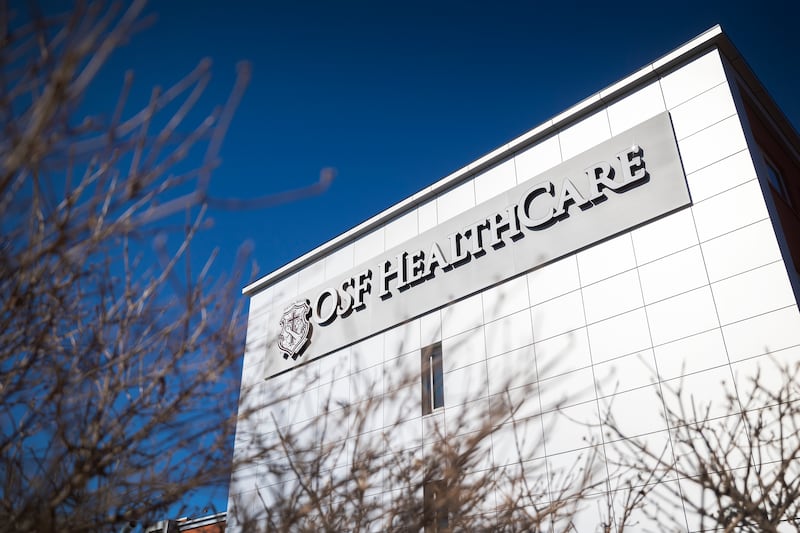
Two rural Illinois counties now largely depend on OSF HealthCare for reproductive services, but its policies limit the care it can provide.
After facility closures in 2025, Lee and La Salle counties lost access to contraception and fertility treatments, leaving residents dependent on OSF HealthCare, which operates under Ethical and Religious Directives for Catholic Health Care Services that limit reproductive services.
The closures left about 140,000 residents in two rural counties with a single major health care system. County health departments and one independent hospital are trying to fill the gaps, but their capacity is limited.
Medical birth control and contraceptive practices
OSF does not provide birth control to prevent pregnancy, including prescriptions, implants, vasectomies or tubal ligations, because of its Catholic directives.
Catholic health institutions “should provide, for married couples and the medical staff who counsel them, instruction both about the Church’s teaching on responsible parenthood and in the various fertility-awareness-based methods of natural family planning,” according to Directive No. 52.
Some hormonal medications can be prescribed for noncontraceptive medical reasons.
OSF “does not provide vasectomies or tubal ligations for the purpose of direct sterilization. We follow the Illinois Health Care Right of Conscience Act requirements if these requests arise,” the organization said.
OSF said it does not provide referrals for services it does not offer, but can share information about other providers.
Infertility treatment and alternatives
“When the marital act of sexual intercourse is not able to attain its procreative purpose, assistance that does not separate the unitive and procreative ends of the act, and does not substitute for the marital act itself, may be used to help married couples conceive,” according to directive No. 38.
The ERD states on page 16 that “reproductive technologies that substitute for the marriage act are not consistent with human dignity.”
That includes the use of a surrogate mother; heterologous fertilization, a method of assisted reproduction where genetic material from a third-party donor is used to achieve pregnancy; and any method that tries to achieve pregnancy through extracorporeal conception, which refers to the process of fertilization happening outside the body, including homologous artificial fertilization which uses the genetic material from the couple, according to directives 40, 41 and 42.
Instead, OSF offers fertility care through the Creighton Model, which involves tracking the menstrual cycle and Natural Procreative Technology, which involves medical treatments for gynecologic issues that can make it hard to get pregnant, the organization said.
“We offer medical and surgical options, all of which respect the life and dignity of those involved,” OSF said.
Terminating a pregnancy
“Abortion is never permitted,” according to directive No. 45.
In an email interview with OSF HealthCare, the organization said, “OSF does not carry out the directly intended termination of pregnancy before viability or the directly intended destruction of a viable fetus.”
However, there can be exceptions, such as for an extrauterine or ectopic pregnancy, a medical emergency where a fertilized egg grows outside the uterus.
In those cases, Directive No. 48 of the ERD says that “no intervention is morally licit which constitutes a direct abortion.”
OSF said the organization does offer “the medically indicated use of salpingectomy, salpingostomy and methotrexate.”
Those first two treatments are surgeries that remove either the affected fallopian tube(s) or the embryo and the third is a medication that stops the embryo from growing, according to the National Institutes of Health.
Directive 46 says that providers should offer “compassionate physical, psychological, moral and spiritual care to those persons who have suffered from the trauma of abortion.”
OSF reiterated that, saying, “we care for women who have experienced pregnancy loss with sensitivity and compassion.”
Prenatal care
The ERD also has policies for the treatments that can be done on a pregnant woman and when prenatal diagnosis is permitted.
“Operations, treatments and medications that have as their direct purpose the cure of a proportionately serious pathological condition of a pregnant woman are permitted when they cannot be safely postponed until the unborn child is viable, even if they will result in the death of the unborn child,” directive No. 47 says.
For OSF, in interpreting the directive, the organization said that “this is an example of an aspect of the ERDs where every word counts. It is an application of the principle of double effect. A clinical example is a medically indicated hysterectomy for a woman who has an aggressive uterine cancer and is also in the early stages of pregnancy.”
As for prenatal diagnosis, it is “permitted when the procedure does not threaten the life or physical integrity of the unborn child or the mother and does not subject them to disproportionate risks; when the diagnosis can provide information to guide preventive care for the mother or pre- or postnatal care for the child; and when the parents, or at least the mother, give free and informed consent,” according to directive No. 50.
It is “not permitted if undertaken with the intention of aborting an unborn child with a serious defect,” directive No. 50 says.
Other options for care
In Lee County, the health department has been a resource for residents offering various types of medical birth control and basic infertility services after the county’s primary health care facility became OSF Saint Katharine on Jan. 1, 2025.
Another possible option for Lee County residents is CGH Medical Center. The independent health care organization offers women’s health services at its Sterling hospital and Dixon clinic. Those services include prenatal care, labor and delivery services in Sterling, outpatient family planning services and long-acting reversible and irreversible contraception.
In La Salle County, OSF largely is the only option after Ottawa’s Planned Parenthood location closed in March 2025. The location did not provide procedural abortion care, but did offer birth control, emergency contraception and pregnancy testing, among other reproductive and sexual health services.
In response, the La Salle County Health Department launched its first STI clinic in March 2025, which served 62 clients that year. The department doesn’t offer comprehensive reproductive care, but does offer free condoms for men and women, according to the department.
In November 2025, the state public health board approved OSF’s plan to reduce its Ottawa hospital’s capacity. The plan eliminates the intensive care unit, labor and delivery services, and most medical-surgical beds, moving them to OSF’s Peru location.
“Contraception services are limited in La Salle County,” the health department said.
Under a new Illinois law effective Jan. 1, pharmacists now can evaluate and prescribe birth control without a doctor’s prescription.
This service is offered at the Walmart Pharmacy in La Salle County, and the pharmacy at Kroger is working toward offering it in the future, the department said.
:quality(70)/s3.amazonaws.com/arc-authors/shawmedia/0e4ec010-1273-46f1-8fc4-c5fe7fe40794.png)