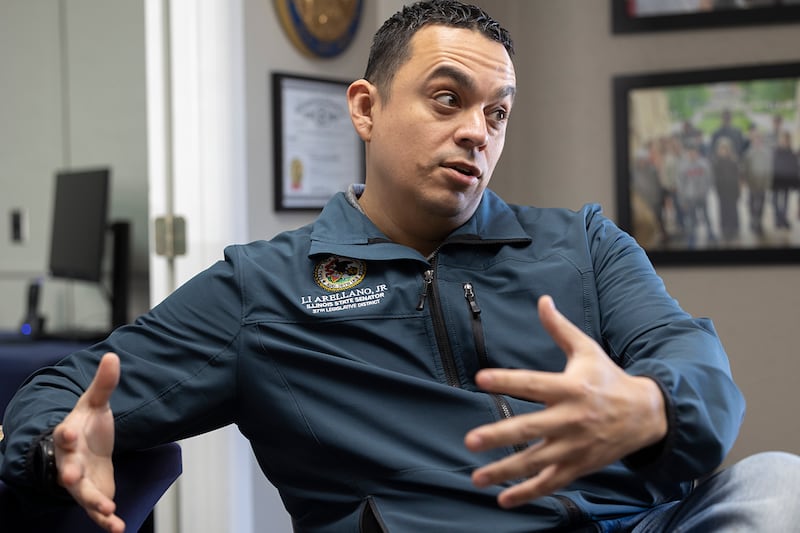
“Cockfighting, clearly across the line. Dog fighting, clearly across the line. Coleadero is, arguably, where the line is right now in modern society,” says state Sen. Li Arellano Jr., R-Dixon.
Coleadero, or steer tailing, is a Mexican-style rodeo event where a horseback rider chases a running steer, grabs onto its tail, and wraps the tail around the rider’s leg to slam the animal to the ground. The event is banned in Nebraska and in parts of California and Colorado, but not in Illinois.
“This bill has been kind of interesting, that I think there’s a very passionate core, how widespread that is is another question, and part of that is because most people don’t know what this is,” Arellano said.
The debate comes after animal cruelty charges were filed last year against participants in a McHenry County rodeo tied to steer-tailing events.
In the past few years, these events have popped up in several northern Illinois counties, such as Ogle, DeKalb, Will, Boone and McHenry. A Chicago-based advocacy group, SHowing Animals Respect and Kindness, provided authorities in each county with footage of the events, reviewed by Shaw Local, that appear to show horses and steers being hit in the face, tripped, prodded and used in events after suffering injuries such as severed tails and broken legs.
In all cases, county officials said they’ve struggled to regulate the events for a myriad of reasons, and local state’s attorneys conclude that the root of the problem is that Illinois law doesn’t specifically outlaw steer tailing.
[ DeKalb County administrator issued rodeo permit to man who pleaded guilty to animal abuse: Records ]
In Illinois, it’s illegal to “beat, cruelly treat, torment, starve, overwork or otherwise abuse any animal” under the Humane Care Act. It also says anybody with animals in their care must provide each animal with a sufficient amount of “good quality, wholesome food and water” and “veterinary care when needed to prevent suffering.”
A bill that would ban steer tailing in Illinois was introduced Jan. 13, 2025, by state Sen. Rachel Ventura, D-Joliet. It was referred to assignments that day and has not been voted on.
In the Senate, all proposed bills go to assignments. Friday was the deadline for bills to get assigned to any committee and have a hearing or for an extension to be filed, Arellano, a co-sponsor of the steer tailing bill, said.
“This week, I don’t foresee it moving,” Arellano said in the days leading up to the deadline, adding that an extension would likely be the next step.
State Sen. Kimberly A. Lightford, a Democrat representing the 4th District and who serves as the Senate’s majority leader, was added as a co-sponsor of the bill Feb. 25, according to ilga.gov. Lightford also is the chairperson of the assignments committee.
Arellano said he hadn’t yet talked to Lightford about why she took on the bill, but “that probably opens some doors.”
As of Friday morning, the bill still appeared to be in assignments, according to ilga.gov.
:quality(70)/cloudfront-us-east-1.images.arcpublishing.com/shawmedia/SIPJY472QFHX5AMMKCLJ4RS6SM.jpg)
Roadblocks to passing the bill
Some senators are struggling to support it due to the penalties imposed and concerns from the Latino community and the Department of Agriculture.
A second violation would be a felony under the current bill, Arellano said.
As it’s written, it would amend the Humane Care Act to add “that no person may intentionally drag or pull any bovine by its tail by any means for the purpose of entertainment, sport, practice, or contest,” according to the bill.
“A felony is a big conversation to have. To me, it shouldn’t be part of this particular conversation,” Arellano said.
Arellano said he would like to amend it to change the penalties into fines and revoke or ban future licenses. For example, the first offense could be a $250 fine, and a third offense might be $1,000, along with a ban from holding future events.
“This isn’t a situation where you’re going out and intentionally being cruel to animals. That can be a component, but generally speaking, this isn’t cockfighting. Unfortunately, the statutes currently don’t envision that. There’s kind of not a middle ground,” Arellano said.
That’s also, Arellano said, a reason why prosecutors are having a hard time under the state’s existing animal protection laws because they weren’t written for rodeo activities, which are seen as a local licensing concern.
One of the concerns of the state department of agriculture is that writing a state law for those activities would shift the responsibility to the state to enforce it. Across the state, the department only has about eight inspectors who would be qualified to take on that type of legal responsibility, Arellano said.
“You’re essentially not giving them enough funding to do their current jobs and then giving them this huge legal responsibility that we’ve never done before for additional jobs, no new money or staffing,” Arellano said.
That’s something Arellano said he would address in his amendments to the current bill by making it “very clear this is a local control issue. This isn’t a state issue.”
The department of ag’s role, if any, would be educational, Arellano said.
:quality(70)/cloudfront-us-east-1.images.arcpublishing.com/shawmedia/ONRYHFQYJFDDRG7IQ2MVTY3QP4.jpg)
The department’s other concern, along with the Illinois Farm Bureau, is making sure the bill can’t be misinterpreted to prosecute any genuine ag uses.
“It’s a non-concern as written. This is purely dealing with the entertainment side of things,” and the current bill very clearly defines that, Arellano said. “I’ve made very clear that we’re welcome to any of that language” to prevent misinterpretation.
As for the Latino community, this event has “a lot of cultural heritage to it. It’s a celebration of an agrarian lifestyle where these kinds of skills were very important,” Arellano said.
The Latino caucus holds significant power within the Democratic majority, Arellano said. “Until at least some of their concerns are alleviated, it would be hard to move this bill,” he said.
In general, Arellano said, they’re concerned the legislature is looking at a specifically Latino cultural event and not looking at any other rodeo activities.
”I personally think there’s a relatively easy counter to that, in terms of the level of damage caused to animals in coleadero versus, you know, calf roping or some of these other things they like to point to,” Arellano said. “We’ve got to try to find a way to honor that while also saying, ‘I think its time has passed.’”
“Because it’s so unregulated, it’s built into the culture, some of these looser interpretations of what’s OK to do to an animal,” Arellano said. “I feel like there’s a way to enforce better versions of it where the animals are treated a little better, and there’s vets on care, and you’re not shocking them all the time.”
The videos captured by SHARK show that damage.
“I’ve talked to senators who’ve watched the videos, and that’s part of why they co-sponsored. It’s having an impact,” Arellano said.
For example, footage of two rodeos held in 2024 on a property in DeKalb County and reviewed by Shaw Local appears to show participants hitting animals, injured animals still being used in events and steer-tailing events resulting in severed tails and broken legs or horns. One clip appears to show two men roughly biting a steer’s tail and shocking the steer with an electric prod while the animal tries to jump away in a closed chute.
SHARK footage of rodeos held on an Ogle County property in 2025 appears to show the same. In one clip, a participant appears to try to grab what was left of a steer’s tail after it had been severed during an earlier event.
“Whether people know it or not, they are always the most powerful political force in Illinois,” Arellano said. “Bills move when people get really agitated.”
:quality(70)/s3.amazonaws.com/arc-authors/shawmedia/0e4ec010-1273-46f1-8fc4-c5fe7fe40794.png)