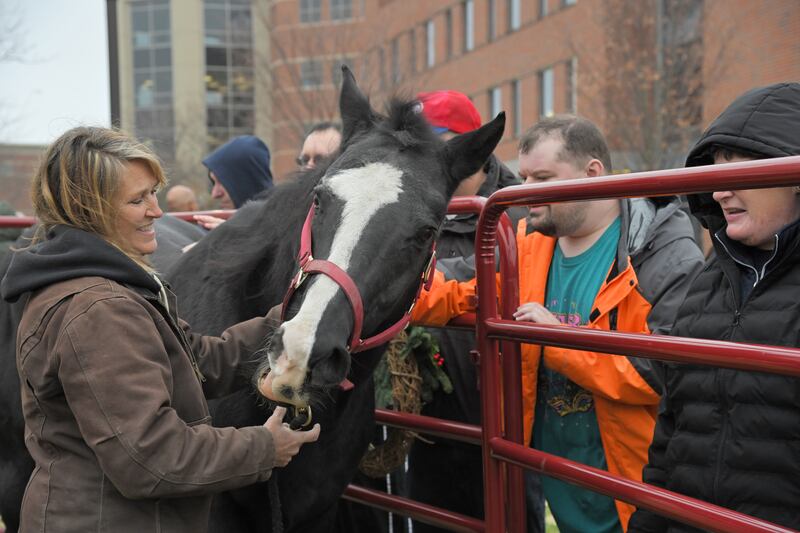
Margaret Gitter returns to her alma mater, Benedictine University in Lisle, six times a year with some visitors from her backyard barn.
Finn, a pony with an Appaloosa-like coat, and Ned, a steady 24-year-old horse, barely bat an eyelash when a small herd of students gathers at their corral on a recent afternoon. To be sure, they’re the center of campus activity. They’re also ambassadors of Mane Trail Stables, Gitter’s equine-assisted therapy and learning center near Winfield.
“Everyone sees some difference depending on what the goal is, whether it’s anxiety, depression, confidence issues, social awareness, communication, relationships. The horses can really teach a lot,” Gitter said. “They need to trust you. You need to trust them.”
Phil Hardy, Benedictine’s director of innovation and strategic partnerships, secured a grant through GreenState Credit Union to set up an equine-friendly environment in a school setting.
:quality(70)/cloudfront-us-east-1.images.arcpublishing.com/shawmedia/QVR6MVVPLZEN3NMM43PSX3FFZA.jpg)
“We really wanted to stress the idea that this was therapeutic, it was academic and wasn’t just a petting zoo,” he said.
The visits started last year and have turned into something bigger: a new undergraduate course about animal-assisted therapy to be taught by Dianne Moran, director of Benedictine’s Master of Science in Clinical Psychology program.
“They’ll learn about the research and the practice, but I want them to see it and feel it,” said Moran, who has her own horse sense.
Human-animal bond
Moran was raised in a typical Chicago neighborhood. And yet she was one of those “horse-crazy little girls” with pictures of horses taped to her walls.
Later, as a grad student in Indiana, Moran volunteered at a therapeutic riding program for kids with disabilities. She eventually bought her own — Kirby, a gypsy she affectionately calls her “heart horse” — and adopted rescues.
“For a long time, I’ve been wanting to integrate my love of horses and my own personal study of horses and how horses can be used therapeutically,” Moran said.
The GreenState Credit Union grant will fund the teaching of the new course next semester.
:quality(70)/cloudfront-us-east-1.images.arcpublishing.com/shawmedia/V6WNOT5HE5DENOXXWWUIGPCEOQ.jpg)
“I want students to understand our responsibility and our connection to these animals,” Moran said.
And, certainly, the science behind animal-assisted therapy. Moran said tons of research support the work of using horses therapeutically with people who have mental health problems. She also pointed to research on the physiology of horses and their electromagnetic fields.
“Heart rates will sync up between the human and the horse, and so that can go both ways,” she said. “If they’re calm, it’ll calm us down. But if we come in and we’re agitated, the horse will react to that.”
Healing, too, goes both ways. Moran adopted her rescue mare, Ruthie, from All Seated in a Barn, a California-based organization that saves horses from the slaughter pipeline.
“Her only problem — she’s sweet and healthy — but she’s blind in one eye,” she said.
:quality(70)/cloudfront-us-east-1.images.arcpublishing.com/shawmedia/NMEGTRRHE5D6FPJ5HGD4FKJLQI.jpg)
Moran also has received some training through the Equine Assisted Growth and Learning Association, or EAGALA. Her retirement plan, post-teaching, is to provide full-time equine-assisted therapy through her barn in Minooka.
“We certainly have the horses that will be wonderful therapy horses, I think. So now I just need the time to go back, finish the training and get certified so that I can start doing it in the most ethical and responsible and professional way,” she said.
Living in the moment
An equine specialist certified in the EAGALA model, Gitter has teamed up with mental health professionals since 2012. Instead of traditional talk therapy in an office, “we do activities with the horses,” she said.
“I wanted to share my passion and my horses to help other people,” Gitter said of the genesis of Mane Trail Stables.
Her horse and pony provide a mental health boost at Benedictine. Some students approach them tentatively.
“And then next thing you know, they’re grabbing a brush, and they’re grooming the horse and having a blast,” said psychology major Liam Law, who’s worked at Mane Trail on a behavior modification class project.
How does Gitter explain their healing power? Horses, she said, live in the moment.
“I think because of their energy and mirroring your energy, you can learn a lot. Horses don’t lie. You can’t lie to a horse,” she said. “They are very intuitive, very sensitive to emotions.”
There’s a give and take, a mutual trust.
“We’ve had a lot of grief counseling,” Gitter said, “and you can tell a horse anything.”
https://www.dailyherald.com/20251201/news/horses-can-really-teach-a-lot-benedictine-to-launch-animal-assisted-therapy-course/