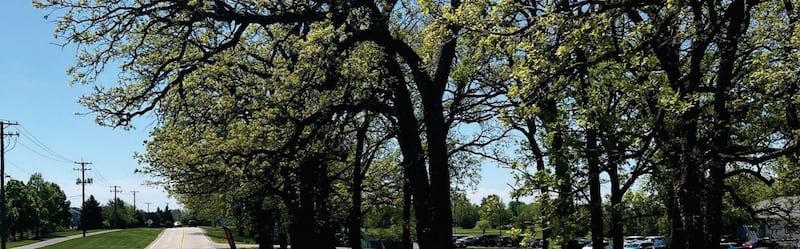
Thirteen “heritage oaks” along Kennedy Road, each around two-centuries old, have come to symbolize the Yorkville that was, while the city‘s rapid-growth could change the future for those trees.
There’s a chance each of the oaks along Blackberry Oaks Golf Course, that have provided shade far before the merger of Bristol and Yorkville in 1957, will face the chainsaw to make way for the city’s Kennedy Road expansion.
While several residents have spoken out against cutting down the trees, the city said their removal is imperative to the roadway construction.
The Kennedy Road expansion, which includes widening the pavement and adding turn lanes to improve the intersection at Freedom Trail, is designed to accommodate the area’s increasing traffic flow due to the growing Grande Reserve subdivision.
:quality(70)/cloudfront-us-east-1.images.arcpublishing.com/shawmedia/H2BUN7OC7JDLBJ4LMXBHKOLCKA.png)
The city said several factors are determining how many trees will be cut down, including a 24-foot wide “clear zone” required by the Illinois Department of Transportation. Mayor John Purcell said the trees pose a safety hazard as several vehicles have crashed into them over the years.
The size of the required clear zone is determined based on traffic volumes, speed limits, and engineering roadway features, according to city documents. City engineer Brad Sanderson said safe areas are established next to all roadways to minimize safety concerns if a vehicle leaves the roadway.
The city entertained different plans for how to approach the clear zone, with the City Council agreeing to consider two plans that each remove a different number of trees.
The first plan removes all 13 trees from the site and would cost the city around $790,000. This plan would establish a full 24-foot clear zone in compliance with the state requirements.
The plan would further widen the pavement on both sides of Kennedy Road, including larger shoulders, with milling and resurfacing for all existing asphalt pavement.
The second plan the City Council and city staff are entertaining includes removing five trees, saving eight, and adding a guard rail for extra safety should a vehicle leave the roadway.
The second plan would cost the city around $945,000.
Purcell said the addition of a guard rail would itself be considered a hazard that drivers could potentially hit.
The two different options have divided the City Council.
Alderman Arden “Joe” Plocher said he was in-favor of chopping all the trees down, saying, “I don’t feel like spending an extra million to save a couple trees that are possibly dying.”
:quality(70)/cloudfront-us-east-1.images.arcpublishing.com/shawmedia/5MD6MO7DWZCKNMGTC4QUQPKUC4.png)
Plocher was referencing the city’s arborist evaluation that found signs of heartwood decay in many of the trees. However, heartwood decay is very common in older trees because the heartwood is the non-living part of the tree.
Mature trees can survive for centuries with a hollow or decaying center as long as the rest of the tree remains healthy, according to the University of Florida Extension.
Alderman Ken Koch said removing the trees is the best way to eliminate liability for the city.
Alderman Chris Funkhouser was in-favor of the plan with the guard rail that preserves several heritage trees, saying it helps the city “be cognizant of the safety issues at-hand, while trying to preserve something we don’t have a lot left around here.”
He said he is concerned about the liability, but that it should not prevent the city from moving forward with a guard rail and preserving as many “heritage oaks” as possible.
Funkhouser said because the root system of the oaks is so large, if the city removes a few of the oak trees, they will end up “killing off” around another 13-20 trees along the roadway because so much of their root systems are intermingled and sensitive to disturbance.
Purcell said the two plans are being sent to the city’s public works committee for further consideration before coming back before the City Council for a final vote.
The city said it might plant new trees in another area to offset what is lost. However, newly planted oak trees will take decades to reach the same heights as the trees facing demolition. A White Oak, the state tree of Illinois, grows at an average rate of 12 to 18 inches in height per year.
:quality(70)/cloudfront-us-east-1.images.arcpublishing.com/shawmedia/3J7BIATIYZAGTMXEANPKCMH5C4.jpg)
Resident Ken Mozingo said extremely few multiple-century-old oaks are left alive in Kendall County. Mozingo said in addition to oaks serving as keystone species, providing sustenance and shelter for an entire ecosystem, they connect us to our past by serving acting as “witnesses” to the history of our towns.
Mozingo said one of the Bur Oaks facing destruction along the roadway is around 225 years old, making it 39 inches in diameter. He said this means the tree sprouted from an acorn around the year 1800, a full 38 years before the first survey of Kendall County.
‘Proceeding with land acquisitions’
City administrator Bart Olson said the city is “proceeding with land acquisition negotiations for the easements” along the Kennedy Road expansion site.
The city has been trying to acquire 30 feet along the front edge of Blackberry Oaks Golf Course’s club house area, at one point threatening “eminent domain” if an agreement wasn’t made.
The city needs 0.84 acres of permanent and temporary easement for the project. Olson said stalled voluntary acquisition of the property resulted in several costly project delays.
Frank Maly of Blackberry Oaks Golf Course previously said they opposed the acquisition because losing the 13, 200-year old oak trees would dramatically transform the nature aesthetics of the front of the course.
The city said it looked into potentially shifting the roadway east towards the subdivision and away from Blackberry Oaks, however, they determined it would add too many extra costs and delays because of the private and city utilities that would need to be relocated.
The project to expand the Kennedy Road and Freedom Trail intersection was initially estimated to cost around $1 million.
The project is currently slated to begin construction in the summer of 2027.
:quality(70)/s3.amazonaws.com/arc-authors/shawmedia/0cef0bf9-a04e-4bb4-aea0-03d8ced01c00.jpg)