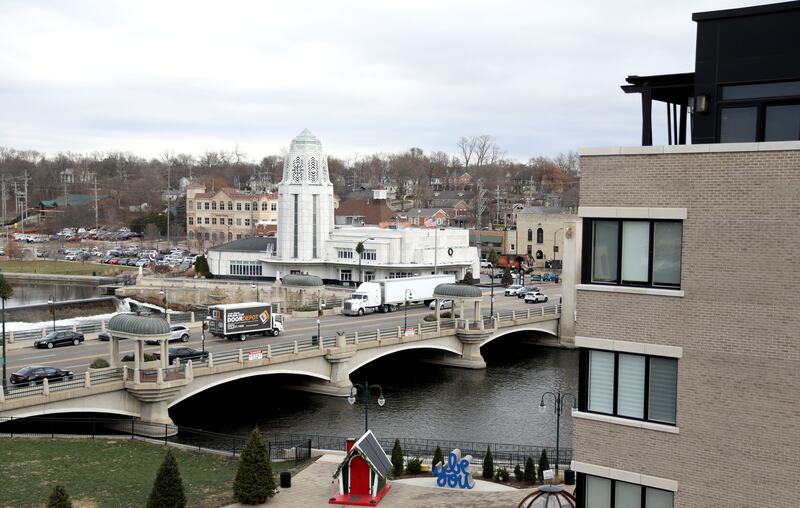
Residents of St. Charles might be feeling some sticker shock on upcoming utility bills.
The city is projecting that it will need $417 million for sewer and water capital improvements over the next decade, including $84 million for a mandated lead service line replacement project.
To help cover the costs, the city is eyeing utility rate increases for rate payers over the next four years. If approved by the City Council, the first utility rate spike would be a 17.3% increase on monthly bills, starting in June. By June 2029, the combined, compounded yearly increases would result in bills being almost 50% higher than current costs.
This means that if your monthly utility bill is currently $200, by 2029 it would be $298.31, according to figures provided by the city. This includes a 14.7% increase in year two, a 6.4% increase the third year and a 4.1% increase in June 2029.
Electricity, sewer and water costs are combined into one monthly bill for St. Charles rate payers.
The utility rate increases were moved forward on a 7-2 vote by the City Council’s Committee of the Whole during its March 16 meeting, with Alderpersons Jayme Muenz and Mark Foulkes dissenting. The City Council still needs to approve the ordinance officially, likely at the April 6 meeting.
At the March 16 meeting, Bill Hannah, the city’s director of finance, said the rate jumps will likely be readjusted in the future.
“A portion of this water rate increase is temporary,” Hannah said. “Once the city is finished with the lead service line unfunded mandate project, we will be able to roll back some of that increase.”
Muenz said she “doesn’t want to put it all on rate payers.” She asked if the city could consider any alternative funding sources or possibly eliminate or downsize some capital projects.
Alderperson Vicki Spellman said the city already agreed to “raising revenue,” meaning increasing bills, rather than cutting capital projects.
Hannah said adjustments can be made “down the road” if the city wants to explore alternative revenue sources again, such as gaming taxes, especially if bids for the construction work comes back higher than expected.
In city documents, Hannah said that finding alternative funding for the lead replacement project still remains on the table.
“While the city will continue to examine grants, loans and other potential avenues of funding for this unfunded mandate, dedicated funding needs to be identified so that the city can plan for the projects going forward,” Hannah said in city documents.
A closer look down the pipeline
The city is projecting that $183 million will be needed over the next 10 years for sewer system capital improvements. This is combined with $234 million in water fund work, which includes the lead service line replacement project. Of that, the $84 million for lead service line replacement is expected to be spent in $8.4 million annual amounts over a 10-year work period.
:quality(70)/cloudfront-us-east-1.images.arcpublishing.com/shawmedia/ERHNZ6OB2NHGNHVJ3VOWV72EI4.png)
Work on the lead replacement project is slated to begin this year. The city must replace lead service line connections that exist for around 3,400 water customers, according to city documents.
On residents’ monthly bills, if the proposed changes get the final nod from the Council, the sewer rate – a subsection of the overall utility bill – would increase 10% in each of the next three years. In year four, 2029, rates would increase 8%.
Water base rates would see an increased monthly base charge of $13-16 in year one, around a 90% increase. Year two would have $9-12 rate increases on top of the prior increase, around 35% more. Bills would see another 10% increase in the third year, and then a 5% increase concluding in year four, 2029.
Water usage rates over the same time period would increase from $6 per 1,000 gallons used to $11.70 in year one. Another jump to $16.38 per 1,000 gallons is proposed in year two, with “moderate increases” slated for 2028 and 2029.
The water rate increases would also help the city fund future water treatment projects, cover higher operating costs and increase well capacity and other infrastructure improvements, officials said.
Throughout the city, several areas of “aging water infrastructure” will be prioritized. Of the city’s 289 miles of water main, the city said more than 80 miles are around 75 to 100 years old, increasing the chances for costly breaks.
“A significant number of water main breaks result in disruption of customer water service, and result in additional costs to the utility that are borne by rate payers,” Hannah said in city documents.
Electric rates are actually lowering, with a 5% decrease effective in all rates June 2026. The city said no “future adjustments are planned over the upcoming four-year horizon.
:quality(70)/s3.amazonaws.com/arc-authors/shawmedia/0cef0bf9-a04e-4bb4-aea0-03d8ced01c00.jpg)