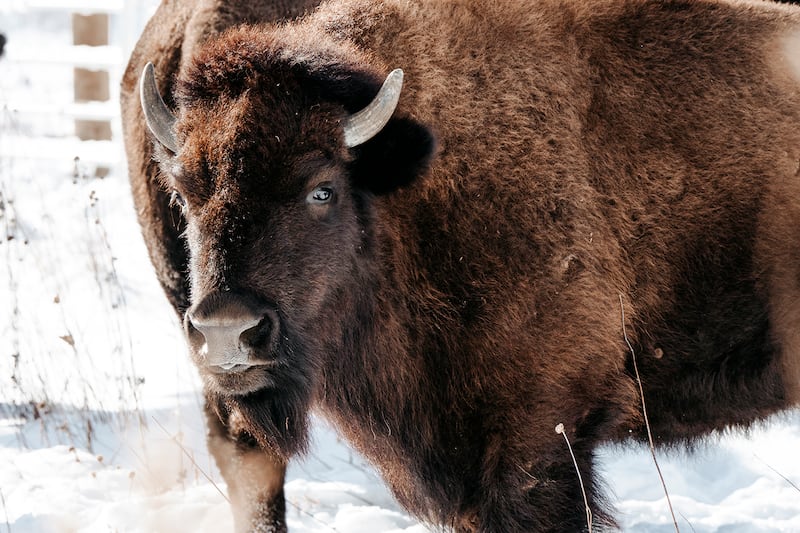
For the first time in more than 200 years, the thunder of bison hooves can once again be heard on a Kane County forest preserve prairie.
The triumphant return of American bison, the “buffalo” of lore, to Burlington Prairie Forest Preserve near Sycamore represents something more than just reestablishing the keystone species to its ancestral homeland.
It’s about planting roots, resurrecting vestiges of the Illinois tallgrass prairie, a golden sea of grasses that once waved far upon the horizon unbroken in all directions.
:quality(70)/cloudfront-us-east-1.images.arcpublishing.com/shawmedia/7RK5UIGQIJCF5IAAWCN3WJLKJY.jpg)
Herds of bison were eradicated from the Prairie State by human destruction of the tallgrass prairie and overhunting. The last recorded native bison in Illinois was humbled by a hunter’s gun in 1837.
The tall grasses nearly followed the bison’s fate, with less than one-tenth of 1% of the ecosystem surviving the conversion of the prairie to farmland and developments.
Like the resilience of prairie grasses whose roots can stretch 5 yards deep into the soil, the partnership among the Forest Preserve District of Kane County, the American Indian Center of Chicago and the company hired to manage the herd, Ruhter Bison, highlights the enduring survival of the bison spirit.
“People have wanted to bring buffalo back since we first learned our actions could cause the extinction of a species,” Benjamin Haberthur, Kane County forest preserve district executive director, said in a release. “This is something I’ve waited my entire career to see, it’s an honor to play a small part in this continental project. This is a moment that transcends generations. This day has been hundreds of years in the making, I’m glad we’re here to be a part of this historic occasion.”
Haberthur said before the first few bison, which can weigh up to 2,000 pounds, stepped off the trailer into their new Kane County home on Dec. 5, land managers spent years slowly growing remnant herds across the country to reintroduce bison to their historic North American range.
Reintroduction of bison was promised to residents as part of the 2024 Land Acquisition and Preserve Improvement Referendum. Bison are already located at Fermilab in Batavia, but what makes this project extra special is returning them to their native prairie ecosystem. There are 114 grass and flower species at Burlington Prairie Forest Preserve alone.
The uprooting of the prairie, beginning during the industrial revolution, eroded the unique soil microbiome that took thousands of years to form beneath the bison’s hooves. Countless plant and animal species intertwined with the ecosystem vanished with the bison.
With the help of conservation agencies, often seeding by hand, flowers like white wild indigo, blazing stars and pale purple coneflowers are once again blooming from the protected prairie soil.
:quality(70)/cloudfront-us-east-1.images.arcpublishing.com/shawmedia/4CH5K6FMMRER3B2MIUF7K6QKSE.jpg)
Patrick Chess, the forest preserve natural resource management director, said it’s fascinating how symbiotic every dependent part of the tallgrass prairie ecosystem is to each of the others.
Bison “feed on prairie plants, and wallow on and use the land,” Chess said. “Wallowing causes small depressions that fill with water and then create their own microclimates that provide habitat for other wildlife. Everything is interconnected. Anytime we can restore a property and bring back long-lost flora and fauna, it’s a victory.”
Before the bison explored their new haven, the American Indian Center of Chicago, which owns the herd, held a ceremonial blessing of the land.
“This is something that feels both historic and deeply personal for us as a community,” Jay Young, AIC executive director said. “It’s a ‘rematriation’ – the return of relatives who have been missing from this place for far too long. Bison have carried our stories, our teachings, and our responsibilities for generations. Welcoming them home is an important moment for our people and for the generations who will come after us.”
Young said the reintroduction represents a broader healing reconnecting his people to the land that shaped their community’s identity.
“Living in an urban area, it’s rare to stand on open prairie, feel the earth move, or be close to bison relatives in a way that reflects our teachings,” Young said. “Bringing them home opens a doorway for our community to remember who we are and to rebuild connections that history tried to sever.”
The AIC is further partnering with the forest preserve district to create educational programming so the public to learn from the bison and the ecosystem they help sustain. A community science program is being launched this spring, where community scientists can help monitor prairie health, track changes over time, and help take care of the vital ecosystem.
“This is a chance for our community to be part of the restoration of both land and relationships,” Young said.
The new herd of bison are currently acclimating to their new environment. Later this month, they will be released into the area’s larger prairie to roam around freely.
The public will be able to experience the bison this spring with events being planned to celebrate and welcome the bison back to Kane County.
You can learn more by visiting kaneforest.com.
:quality(70)/s3.amazonaws.com/arc-authors/shawmedia/0cef0bf9-a04e-4bb4-aea0-03d8ced01c00.jpg)