After getting a slow start this spring, Illinois Valley farmers say this year’s growing season is beginning to catch up as the summer months near. With that, rising fertilizer and fuel costs are changing the way farmers are handling their busy season this year.
In La Salle County, corn planting is mostly complete and soybean planting is closing in on the finish line. Recent weather has helped crops emerge, said La Salle County Farm Bureau president David Isserman.
“It was kind of variable this year,” Isserman said. “There were some places in the county that were wet at times and we were delayed a little bit.”
Isserman said conditions have improved significantly over the past couple of weeks.
“We were struggling with the cool weather, he said. ”Things just weren’t growing and now everything is just really popping.”
The latest county crop report reflected similar conditions throughout the county, according to the many farmers who contributed.
David Hall of Serena reported that corn planting is complete in his area, while soybean planting is roughly 90% complete.
Ken Beck of Mendota said, “Once it warmed up, everybody got going,” while Ken Bernard of Grand Ridge said the first planted corn and beans “were a little slow coming up but now they are looking pretty good.”
In Bureau County, Travis Cook of Ag View FS in Princeton echoed Isserman’s sentiment, noting that crops are beginning to catch up after a slightly delayed planting season.
Specifically, Cook said corn is right on schedule and earlier-planted soybeans are progressing well, though some later-planted fields are beginning to need rain.
“We’re starting to get a little dry,” Cook said. “We could definitely use some rain later this week, but overall it seems that we’re on schedule.”
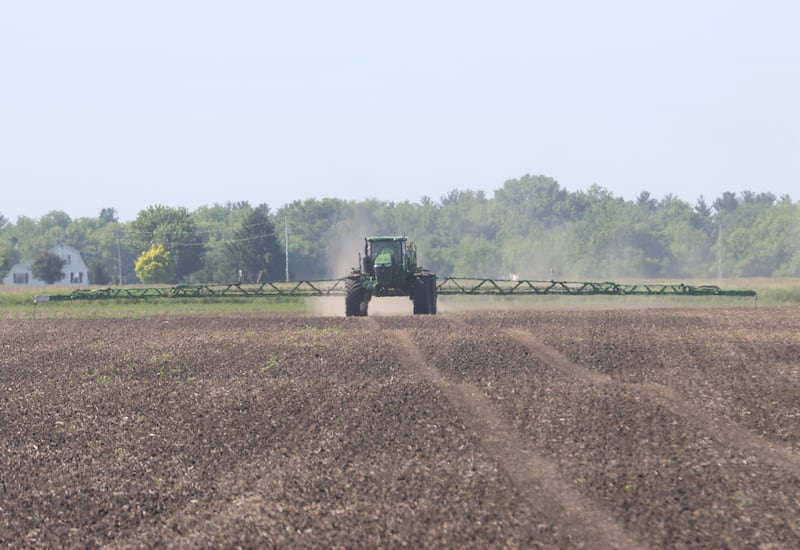
As planting season wraps up, Cook said farmers are now shifting their focus toward spraying and crop management heading into June.
“These next few weeks are really important,” Cook said. “We’re going to be very busy.”
:quality(70)/cloudfront-us-east-1.images.arcpublishing.com/shawmedia/3G3DJ6CJUNCDBFNCB3WUIBXMWQ.jpg)
Despite solid crop conditions, both Isserman and Cook both pointed out that rising input costs continue to create financial pressure for farmers.
Isserman pointed to fertilizer, fuel and equipment prices as among the biggest concerns for producers across northern Illinois.
“Fertilizer prices are just ridiculous right now,” Isserman said. “Diesel fuel prices are horrendous. It just makes your eyes water whenever you have to order diesel fuel.”
He said low commodity prices have only added to that pressure, noting recent projections showed northern Illinois farmers could lose “anywhere from $30 to $40 an acre on corn” while potentially only breaking even on soybeans.
Cook said Ag View FS has also felt the impact of rising prices of fertilizer and fuel.
“Nitrogen and fertilizer prices have been high and going higher,” Cook said.
Cook said many farmers were able to purchase fertilizer earlier in the year before prices climbed further, but those forced to buy products during the growing season are facing much steeper costs.
“If someone didn’t have anything bought as far as fertility and nitrogen and stuff, in-season here is astronomically expensive,” Cook said.
National data mirrors these local concerns, with fertilizer prices rising this year due to global supply disruptions and higher energy costs tied to natural gas.
According to The World Bank, fertilizer costs have risen by more than 12% in early 2026, with projections showing potential increases up to over 30 percent over the year.
Isserman said the higher costs are forcing some farmers to reconsider how aggressively they apply inputs throughout the growing season.
“We’re being very careful with what we put on,” Isserman said. “We’re making sure that what we put on is absolutely needed.”
Cook said some growers are reducing phosphate applications in fields where soil tests already show high nutrient levels, while focusing their fertilizer only where it is most needed.
“You can really only cut back on so many things,” Cook said. “You still need all these inputs to raise a good crop. So it’s hard sometimes to make the right economic and agronomical decision.”
:quality(70)/cloudfront-us-east-1.images.arcpublishing.com/shawmedia/CRM2XRV7CFFUPI7ZBIR57G65WI.jpg)