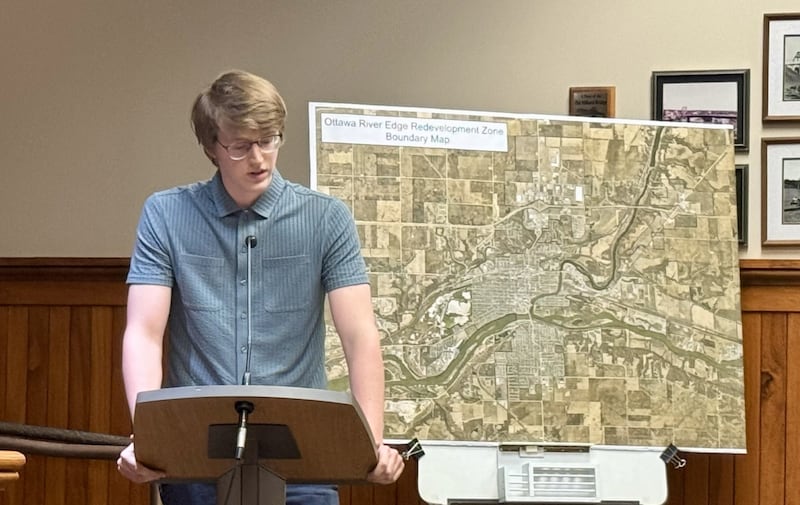
The city of Ottawa took the first step Tuesday toward becoming a designated River Edge Redevelopment Zone, a program that would enable the city to leverage new incentives to attract investments, create jobs and invest in the community.
If approved by the state, the River Edge Redevelopment Zone (RERZ) will offer tax credits, sales tax exemptions and other tools to support local businesses and attract developers.
The city held a public hearing Tuesday ahead of its regularly scheduled council meeting. It is the first of a series of approvals the city will need before joining seven other communities: Alton, Aurora, East St. Louis, Elgin, Peoria, Rockford and Sterling.
There was no public comment.
“What’s important is this is another layer of financial opportunities that we can offer to any potential developer,” Mayor Robert Hasty said. “We’re really checking all the boxes. We’re also submitting an application for an opportunity zone, which will be coming soon.”
North Central Illinois Council of Governments Community Planner Calvin Croy explained the purpose of the hearing was threefold: to consider whether the city should establish the zone, to discuss the boundaries and to review local plans, tax incentives and programs that might be implemented in connection with the zone.
“For those unfamiliar with what a River Edge Redevelopment Zone is,” Croy said, “it is a state of Illinois incentive designed to encourage economic development, historic preservation and revitalization of riverfront communities.”
Designation as a RERZ allows the city to access and offer a variety of incentives, including but not limited to state and local tax incentives, sales tax exemptions, building materials and other redevelopment tools aimed at attracting investment and supporting local businesses, Croy said.
“Most importantly, though, would be the historic tax credits and building material sales tax exemptions,” he said.
The proposed zone includes the area along the Illinois River, most of the downtown and adjacent areas going north to Interstate 80.
Hasty said the RERZ is particularly significant because tax credits are available for historic renovations.
“Given the fact that our entire downtown is in a historic district, and we have an east side resident center in a historic district,” Hasty said, “I think that is one additional unique attribute to this particular plan that might encourage someone to take our history into mind when they’re renovating some of our downtown buildings.”
Croy said the city is considering a range of redevelopment strategies and incentives, which may include targeting redevelopment of underutilized or vacant properties, support of historic preservation projects, infrastructure improvements and potential tax improvements.
In June 2024, Gov. JB Pritzker expanded the River Edge Redevelopment Zone Act to include six additional communities: East Moline, La Salle, Moline, Ottawa, Peru and Rock Island.
Ottawa Director of Economic Development David Noble said the next step in the process is for the city to pass an ordinance to adopt the plan. Then they will send the proposed zone to Springfield to be evaluated by the Illinois Department of Commerce and Economic Opportunity (DCEO).
DCEO has 90 days to approve it, Noble said. Once approved, the city will have an active redevelopment zone and citizens can begin applying.
“It should be active and up in about three months,” Noble said. “And then it lasts 30 years.”