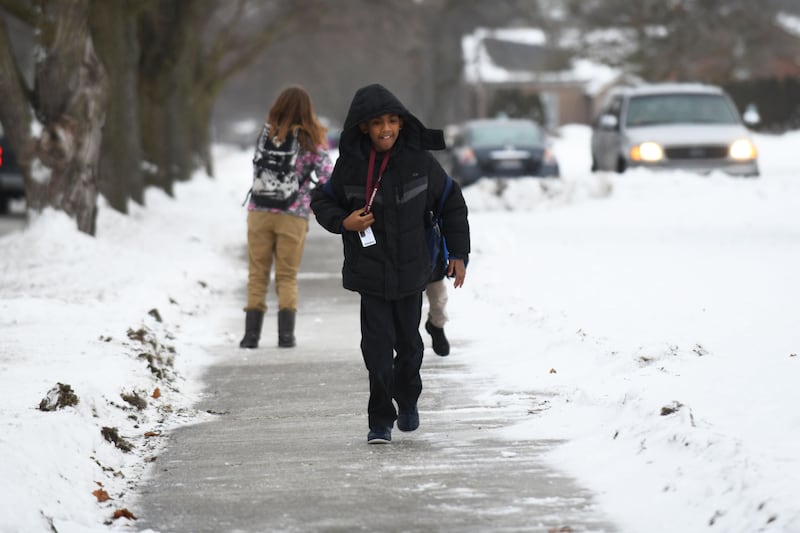
Big yellow buses were back on the roads Tuesday after the recent bout of severe winter weather resulted in two days of school closures.
Kankakee County students remained home Friday and Monday due to the combination of frigid wind chills, blowing snow and resulting poor road conditions.
Some fired up their computers and logged in to participate in class remotely. Others may have found themselves rolling over and going back to sleep.
Several districts leaned on e-learning days, which count toward the number of instructional days required in the school year, including Kankakee, St. George, Herscher, Manteno and Bishop McNamara.
In other districts, school was closed, and an emergency day – or snow day – was used. When this happens, the missed instructional day is made up elsewhere in the school calendar, typically at the end of the year.
School was canceled both Friday and Monday in the Bourbonnais Elementary, Bradley Elementary, Bradley-Bourbonnais High School and St. Anne districts.
Although the cold temperatures aren’t going away soon, e-learning days are limited, and not every school is prepared to use them.
According to the Illinois State Board of Education, e-learning days exist to preserve the continuity of learning when an emergency would otherwise result in school closing. The option existed in state statute before the COVID-19 pandemic.
To use e-learning days, a district must first have an established e-learning policy on its books.
The e-learning policy must be subject to a public hearing, approved by the school board and signed off by the regional office of education.
E-learning days only can be used in lieu of a scheduled emergency day, and they are limited to five, the minimum number of emergency days in the school calendar.
After all five emergency days are exhausted, an “act of God” day may be called for severe weather, disasters or situations beyond the district’s control, and these days don’t have to be made up later.
Each student participating in an e-learning day must receive at least five clock hours of instruction or schoolwork.
Districts have discretion over whether or not to adopt an e-learning program.
Bradley Elementary School District 61 does not have an e-learning plan in place.
Superintendent Chris Hammond said traditional snow days are preferred over e-learning because the quality of instruction is always better face to face.
“We would rather have our teachers in front of the kids instead of [sending home] packets, or maybe an hour of synchronous learning,” he said. “It’s really difficult when teachers are home with their own kids.”
The last day of school in Bradley now will tentatively be June 4 instead of June 1.
“Nobody wants to trade a January day for a June day,” he said. “But the learning that gets done on an e-learning day does not match what gets done on a normal school day.”
Likewise, Bourbonnais Elementary School District 53 does not have an e-learning policy.
Superintendent Adam Ehrman said most schools that use snow days likely haven’t approved e-learning plans, as it is an involved process.
“It’s a complex conversation that is not as binary as e-learning versus snow days,” Ehrman said.
After adapting to e-learning during the pandemic, discussions shifted to whether to continue using those methods or to return to traditional “snow days.”
Other local districts, such as Herscher School District 2 and Kankakee School District 111, have established e-learning plans.
District 2 Superintendent Rich Decman said having the option to use an e-learning day is beneficial for several reasons.
It helps teachers and students maintain distance learning skills, which were needed during the pandemic and could be required again in another emergency situation.
“We want to make sure we’re always prepared,” Decman said.
With the education and professional worlds both shifting to involve more remote work, maintaining those skills also can help prepare students for future jobs or college courses.
“Ideally, is everyday e-learning as beneficial? No,” Decman said. “But I think a few times a year, it keeps up a skill set for not only our teachers, but our students as well.”
E-learning lets teachers maintain momentum with their lessons, he said.
At the high school level, there are certain testing dates that students have to prepare for, which don’t budge because of bad weather.
“We like eliminating any longer breaks in learning,” Decman said. “It keeps some semblance of learning ongoing.”