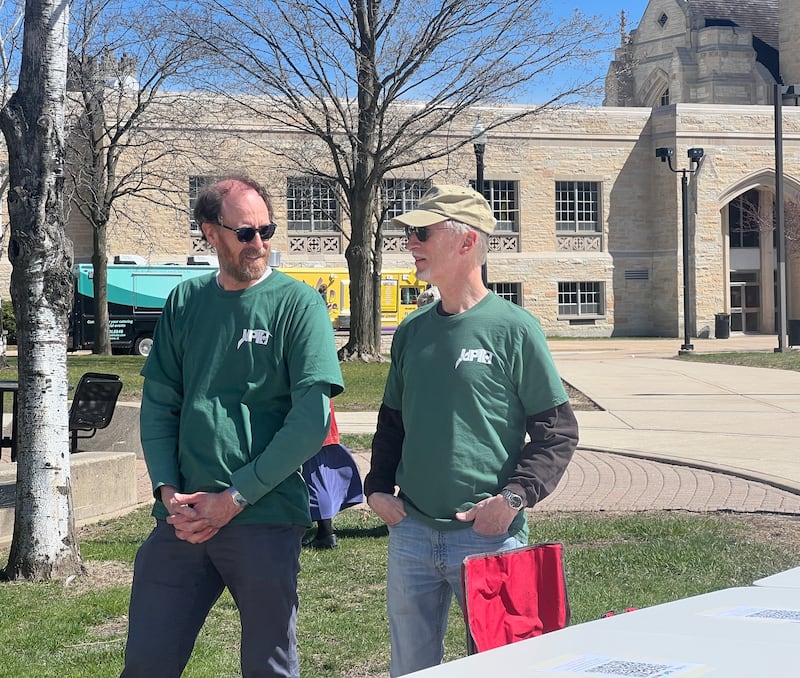
Northern Illinois University professors and instructors asked students on Wednesday to support them when they travel to Springfield this month in hopes of pressuring state legislators to pass a bill they believe will help their pupils.
Members of the Northern Illinois University United Faculty Alliance, a chapter of the University Professionals of Illinois (UPI), Local 4100, rallied in support of what would be called the Adequate and Equitable Public University Funding Act. They said the proposed legislation, House Bill 1581, would rectify a state funding system they think has been unfair to NIU and other public schools.
Suzanne Autrey, a member of the United Faculty Alliance, said about 70% of the cost to attend an Illinois public university used to be covered by the state. That’s no longer the case, multiple university educators told Shaw Local.
“Now that 70% falls on student tuition and fees, and the state covers less than 30%,” Autrey said. “It’s a major problem and a major reason why tuition and fees have become so unaffordable for students.”
The average federal loan student debt in Illinois is $39,042, the fifth highest among U.S. states, according to the Education Data Initiative.
Autrey, an assistant professor in NIU’s Department of Earth, Atmosphere, and Environment, who runs a research lab and teaches, said she thinks the cost of higher education in Illinois has grown significantly over the last decade.
“There’s been a massive increase in the cost of tuition, and it’s a huge problem,” Autrey said. “At a school like NIU, which has first-generation students, that is a huge barrier to good-paying jobs and a real future.”
:quality(70)/cloudfront-us-east-1.images.arcpublishing.com/shawmedia/KSYQ64WKTNCULACXXTSIWCHHIY.jpg)
Mark Van Wienen, the president of the NIU Faculty Alliance, said state legislators should accept the burden of finding a solution.
“[The amount of debt Illinois students have] is because the state has neglected its responsibility to fully support public education,” Van Wienen, an American literature professor, said.
To further their message, Van Wienen and others are planning to drive to Springfield on April 16 to join other educators in lobbying legislators to support House Bill 1581.
Members of the NIU United Faculty Alliance and University Professionals of Illinois encouraged students and the community to join them for what is anticipated to be an hour-long demonstration inside the Capitol rotunda.
Buses will leave the NIU Convocation Center at 7:15 a.m. on April 16 and return around 7 p.m. after traveling to Springfield. Boxed lunches will be included in the free bus service.
“We are out here because we need to send a message to our legislators that they need to begin to take responsibility for public education,” Van Wienen said. “For decades, public education in the state of Illinois has been dramatically, and even catastrophically, underfunded.”
:quality(70)/cloudfront-us-east-1.images.arcpublishing.com/shawmedia/TGJPMHJF4VCFFMM4DDU7ZF4IIY.jpg)
A report from the Illinois Commission on Equitable Public University Funding compares funding for state universities related to the institution’s adequacy target, which is how much the commission believes it would cost to achieve “adequacy for each institution.”
NIU receives funding that amounts to 55.6% of its adequacy target, the report shows. Of the 12 institutions for which adequacy targets are given, two schools have a lower percentage of adequacy target funded than NIU.
The University of Illinois Urbana-Champaign is 91.8% adequately funded, according to the commission report.
To get the support of students – and their attention – Mike Warfel and Gibson Cima played live music from the grounds of NIU’s Martin Luther King Jr. Plaza Wednesday afternoon. Among the NIU students who stopped and talked with the lobbying professors and instructors was Alejandro Ramirez.
Ramirez said he was worried about fewer class offerings for higher tuition after learning about NIU’s state funding challenges.
“I think it’s, you know, kind of unfair,” said Ramirez, a junior studying political science.
Positioned in the heart of campus, with a handful of food trucks that had set up nearby, dozens of students passed by the rallying faculty members Wednesday. Some talked with the professors, and a few stopped to listen to the music, but the rally wasn’t a ruckus affair.
“I think it’s really good and noble, what they’re doing,” Ramirez said. “I’m kind of a little bit disappointed in Gen Z just because like there’s no ... I don’t really see too many people here like Gen Z young-wise. But I think it’s just up to us to spread the word.”
:quality(70)/author-service-images-prod-us-east-1.publishing.aws.arc.pub/shawmedia/114d2561-d902-4313-913c-3ed613087b49.png)