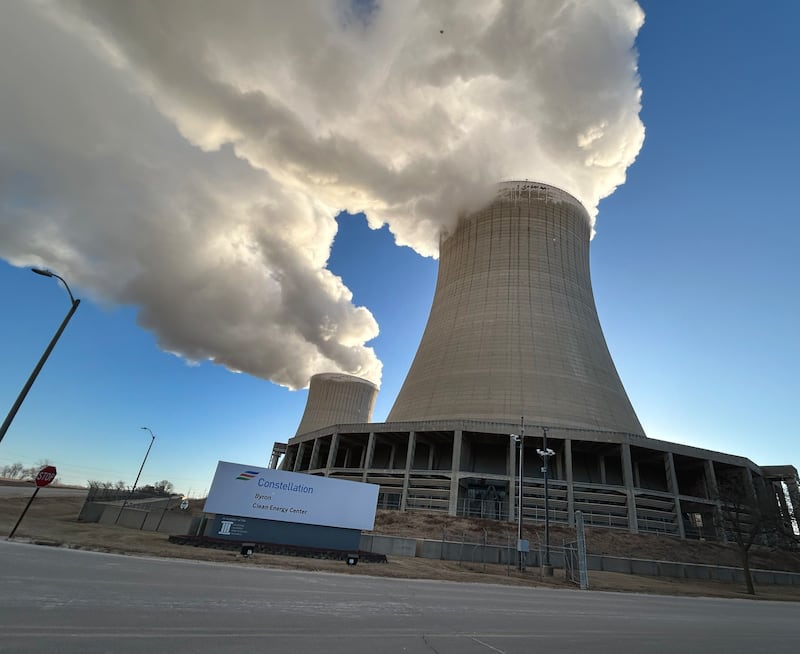
Shaw Local asked all four candidates in the 76th Illinois House District race the same question: “Should Illinois expand use of nuclear energy, including facilities like the Byron plant? What’s your vision for the state’s energy mix?”
Democrat Amy “Murri” Briel, the current state representative, answered alongside write-in Democratic challenger Tyler Thompson and Republican primary challengers Crystal Loughran and Liz Bishop as part of Shaw Local’s 2026 election questionnaire. All four support nuclear, but they part ways on what else should power Illinois’ future. The primary is Tuesday, March 17.
Nuclear: a rare point of agreement
Each candidate expressed support for keeping Illinois’ nuclear fleet running and open to expansion, citing reliability, jobs, and carbon-free generation as reasons.
Write-in candidate Tyler Thompson was the most emphatic. “Yes, nuclear energy is the future,” he wrote, saying he wants nuclear to be “front and center by the 2040s” and criticizing state politicians for moving too slowly. “For all the talks of green energy they has skipped on the future of our state,” Thompson wrote. He said he is comfortable keeping fossil fuels in the mix until nuclear supply can meaningfully replace them.
Liz Bishop pointed to the economic stakes for the region specifically. “Nuclear energy is a critical part of Illinois’ energy future,” Bishop wrote, adding that facilities like La Salle Station are “major economic anchors” for the area. She said she would support policies that keep the nuclear fleet “open, competitive, and operating safely.”
Amy “Murri” Briel offered the most concise take. “There is so much evidence to show that nuclear energy is safe and a good long-term investment,” she wrote, envisioning a future energy mix that includes nuclear alongside solar, wind, and diesel.
Crystal Loughran was the most detailed, laying out a four-part energy platform. She called nuclear “reliable, carbon-free, and always on” and said the state should streamline permitting for upgrades and next-generation reactors.
Where they diverge: coal, gas, and mandates
The sharper contrasts emerge when candidates describe what should accompany nuclear in the energy mix.
Loughran is the only candidate to explicitly defend coal. “Coal provides baseload reliability,” she wrote, arguing that “abrupt shutdowns hurt workers, communities, and grid stability.” She also wants natural gas kept in the mix for affordability, and she pushed back against what she called “one-size-fits-all mandates” that she said raise prices and threaten grid reliability.
Bishop takes a similar skeptical tone toward energy mandates, saying Illinois’ mix should be “balanced and practical” with renewables included “where they make sense.” She cited state Sen. Sue Rezin as a model, writing that Rezin “has fought to protect nuclear jobs and energy stability” and that she would share that mindset. She did not mention coal.
Briel’s vision is the most varied on paper — nuclear, solar, wind, and diesel — though she gave the least detail on how she would pursue it. She was the only candidate to specifically mention solar and wind alongside nuclear.
The race
The 76th District covers parts of the Illinois Valley region and DeKalb. Briel, the Democratic incumbent, faces write-in challenger Thompson in the Democratic primary. Loughran and Bishop are competing in the Republican primary. The winners of the March 17 primary will face each other in the November general election.
Note on methodology: This article includes summaries of candidate questionnaire responses generated with the assistance of an artificial intelligence tool. Journalists on our team reviewed, edited, and verified all summaries for accuracy and fairness before publication.
:quality(70)/s3.amazonaws.com/arc-authors/shawmedia/b945ae41-e0fd-42fd-805a-feca8401d740.png)