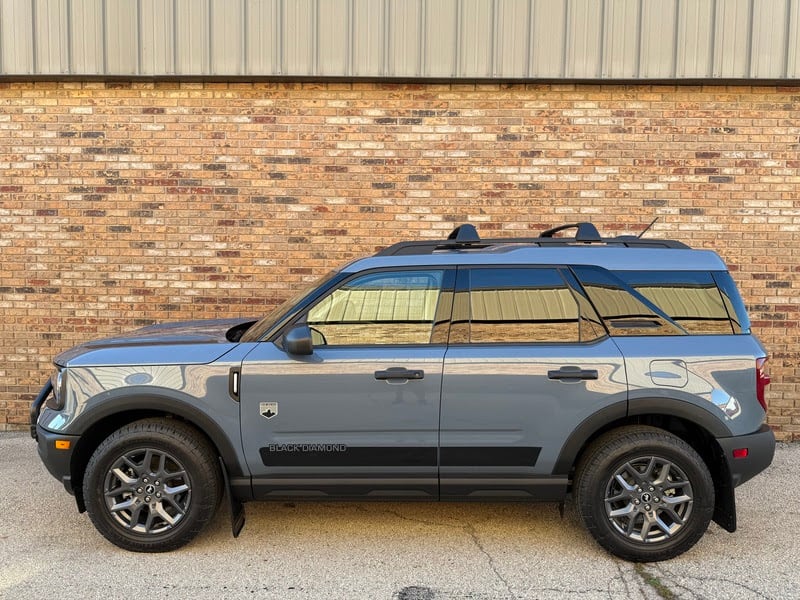
Bronco Sport shares a name with its bigger sibling, but that’s where most similarities stop. The exterior look is the first real differentiator, but there were plenty wrapped up in my Bronco Sport tester.
Just look a little closer, and the Bronco Sport takes on its own persona. Sharing the same rugged design language, upright stance, squared-off proportions, and bold “BRONCO” grille lettering as its sibling, this smaller Bronco is built on a crossover platform designed to balance everyday drivability with light-duty adventure capability.
Where the full-size Bronco is a body-on-frame off-roader designed for serious trails with removable doors and roof panels, the Bronco Sport takes a more practical route. It’s a unibody SUV with standard four-wheel drive and a more city-friendly footprint. The result is a vehicle that captures much of the Bronco’s adventurous personality without the size, cost or daily compromises of the larger model.
My Bronco Sport Big Bend 4x4 tester arrived with a handsome Azure Metallic Tri-Coat paint ($995). It was also equipped with two meaningful upgrades: the Black Diamond Off-Road Package ($2,570) and the Convenience Package ($1,695). With a base price of $30,995, the final sticker for this well-equipped example landed at $39,565, including destination. Not bad for a very capable Bronco.
Under the hood sits Ford’s 1.5-liter EcoBoost turbocharged three-cylinder engine paired with an 8-speed automatic transmission. The engine produces 180 horsepower and 200 pound-feet of torque, respectable numbers for a compact SUV that prioritizes efficiency and versatility.
Around town, I found power delivery to be smooth and responsive enough for everyday driving, and the turbo pop helps provide usable torque at lower engine speeds. The transmission generally shifts smoothly and keeps the engine in its power band without much fuss.
Fuel economy is another highlight. The Bronco Sport Big Bend is rated at 25 mpg in the city, 30 mpg on the highway, and 27 mpg combined, which are solid numbers considering that four-wheel drive comes standard across the lineup.
While perfectly adequate for commuting and suburban errands, I did find the 1.5-liter engine can feel a bit strained during aggressive highway merging. Drivers who prioritize stronger acceleration or towing capability may wish for the optional 2.0-liter turbo engine available in higher trims.
Some drivers may also notice that the three-cylinder engine produces a slightly coarse sound under heavy acceleration, something buyers accustomed to smoother four-cylinder engines might pick up on.
One of the Bronco Sport’s key advantages is that it offers genuine off-road capability compared with many compact crossovers. The Black Diamond Off-Road Package enhances that capability with upgrades designed for rougher terrain.
The package adds all-terrain tires, steel skid plates, and additional durability features that make the Bronco Sport more comfortable leaving the pavement behind. It complements the vehicle’s Terrain Management System with selectable G.O.A.T. (Goes Over Any Type of Terrain) drive modes, allowing drivers to tailor traction and throttle response for conditions such as sand, snow or mud.
I’d say that in real-world driving, the system is meant for weekend adventures, gravel roads, snowy driveways or forest trails rather than extreme rock-crawling obstacles. Ground clearance and suspension tuning allow the Bronco Sport to navigate uneven surfaces with confidence while still maintaining a very comfortable ride on the pavement.
Inside, the Bronco Sport prioritizes practicality and durability. The design is straightforward, with simple controls and materials that fit the vehicle’s go-anywhere personality.
The Convenience Package adds several useful features that make daily driving easier. Storage compartments are plentiful throughout the cabin, and the rear cargo area is both spacious and versatile for a vehicle in this class. The tall roofline not only contributes to the Bronco Sport’s distinctive exterior profile but also benefits interior space, providing good headroom for both front and rear passengers.
I found the front seats to be supportive and comfortable for long drives, and outward visibility was excellent thanks to the upright greenhouse and relatively thin roof pillars. For drivers who appreciate a commanding view of the road, the Bronco Sport will impress.
Still, I should point out a few compromises. Some interior materials feel a bit more budget-oriented than the nearly $40,000 price tag might suggest, particularly on lower portions of the dashboard and door panels. Road noise can also become noticeable at highway speeds, reminding occupants that this SUV leans more toward practicality than premium-level refinement.
Safety is another strong point for the Bronco Sport. Standard equipment includes Ford’s Co-Pilot360 suite of driver-assistance technologies designed to provide an extra layer of protection on the road. Key features include pre-collision assist with automatic emergency braking, a lane-keeping system with lane-keeping assist and alert, blind-spot monitoring with cross-traffic alert, and adaptive cruise control with stop-and-go capability and lane centering.
I found the adaptive cruise control and lane-centering features to perform smoothly and predictably, particularly on highway drives. On the road, the Bronco Sport strikes a comfortable balance between SUV ruggedness and commuter practicality.
The 2026 Bronco Sport Big Bend 4x4 ultimately succeeds by carving out its own niche. It isn’t simply a scaled-down version of the Bronco, nor is it just another compact crossover dressed up with rugged styling cues; this Bronco carries plenty of the brand’s trail-ready DNA.
• John Stein is a freelance journalist based in Chicago. He has more than 25 years of experience driving, testing and writing about the automotive industry, its latest innovations and vehicle performance.