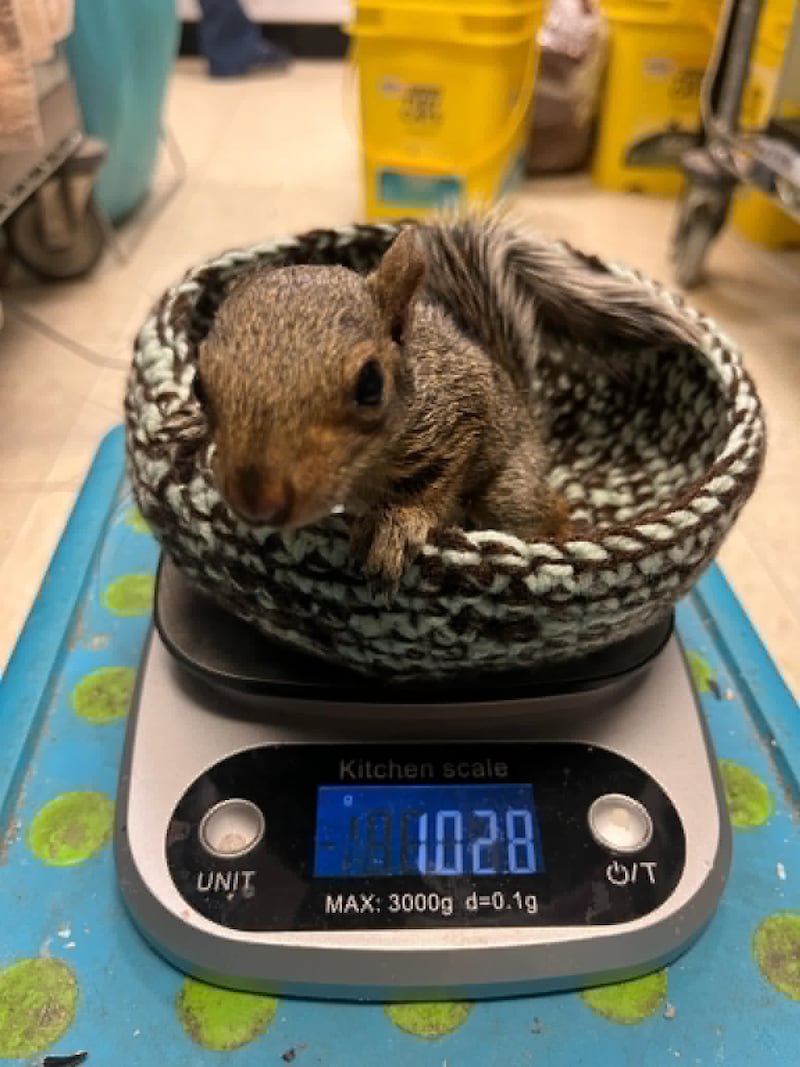
Hundreds of orphaned animals — mostly songbirds — have been able to snuggle into nests and heal thanks to a special Crochet for Wildlife program offered by the Forest Preserve District of Will County twice a year.
Eighty-one crocheted nests were donated to the DuPage Wildlife Conservation Center in Glen Ellyn after a Crochet for Wildlife program held in February, bringing the total donated over the last couple of years to 255.
The next Crochet for Wildlife program will be held from 5:30 to 7:30 p.m. Thursday, June 11, outdoors at Hidden Lakes Trout Farm at Hidden Oaks Preserve in Bolingbrook. The program will coincide with Worldwide Knit in Public Day. A second program will be held in the winter.
At the beginning of each program, participants review the nest pattern and share tips and tricks.
“And, of course, we look at an adorable slideshow of cute critters utilizing the crocheted nests,” said Brittany Schaller, an interpretive naturalist at Hidden Oaks. “The simple pattern does not change from program to program, but the size requirements for the nests requested by the DuPage Wildlife do change.”
Made with love
Program participants really enjoy seeing how their creations are used, Schaller said.
“Crocheters attending the program always comment that they are delighted that their crocheting talents are going to good use,” she said. “They love seeing the pictures of wildlife in the rehabilitation center using their nests — each one made with love.”
Skill levels vary, but all participants must have some crocheting experience, she added.
Some participants have crocheted many years ago and are looking for an excuse to pick up the ol’ G-Hook again and this program sparks their interest,” she said. “Others are crocheting machines and can bust out three or more nests during a single program while others are still working on making the flat circle part of the nest.
Speed doesn’t matter in the long run, she said.
“Participants are permitted to take their unfinished nests home to work on and return them to any Forest Preserve visitor or nature centers when they are finished.”
The pattern can be ‘addicting,’ she added.
“Once you finish one nest, you just can’t help but whip up a few more. It is also a great way to use up your yarn stash — the bits of yarn too small for a full hat or blanket can be utilized for these nests, no matter how ugly the color is, the wildlife won’t care!”
Schaller said before each Crochet for Wildlife program she asks Jana Plescia, a wildlife animal keeper at the DuPage Wildlife Conservation Center, what size nests the center needs.
Safe and cozy
Plescia said the nests provide comfort and stability for orphaned patients.
“If our orphans feel safe and cozy, they tend to do better in the rehab setting,” she explained. “With the varied sizes, we can have a family of three house finches together nice and snug in a little nest, or a mixed family of four doves together in one.”
For instance, DuPage Wildlife recently received a family of four just-hatched killdeer. Three were thriving but the fourth was lagging.
“Killdeer are super social and rely heavily on feeling a sense of security snuggling with their mom,” Plescia said. “As his siblings were walking around and over him, he was desperately trying to find his parent to nuzzle up against (he wanted that to be one of his siblings, they weren’t having it!).”
Plescia put one of the deeper nests on its side to create a small “cave” for him.
“He instantly quieted down, rested against it, and regained the strength he needed to continue to fight,” she said. “The next day, he was a new bird and he’s thriving now with the rest of his crew!”
In addition to songbirds, Plescia said nests are used for other species too, including mice, squirrels and cottontail rabbits. Nests are lined with tissue so they can be washed and reused.
“Once in a while, we use them for some adult special cases, specifically neurological or spinal trauma birds,” she said. “It helps keep them upright and secure in a high-stress environment. Giving them any sense of security and boundaries when they can’t control their bodily movements helps tremendously, mentally and physically.”
DuPage Wildlife’s focus is to provide patients with a sense of security in as natural an environment as possible, she said.
“But I think it’s important to mention how much the nests mean to staff and our seasonal staff,” she added. “It’s emotionally draining trying to help some of these sad patients, and honestly having these cute colorful nests brings us joy in a place where we see a lot of sadness. So, it’s enriching to the creatures, but also to us humans too.”