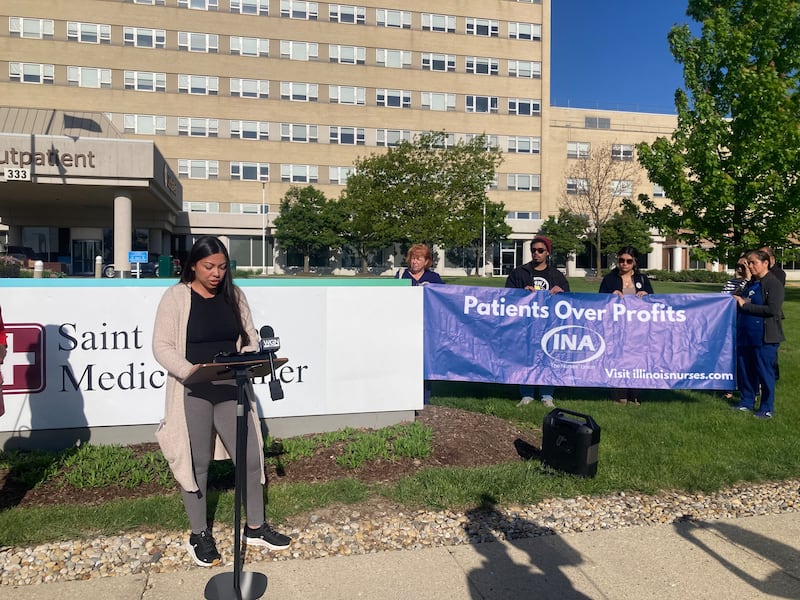
Members of the Illinois Nurses Association joined officials from Aurora outside of Saint Joseph Medical Center in Joliet on Monday, where they denounced the practices of the hospital’s owners, Prime Healthcare.
Saint Joseph Joliet was bought by Prime Healthcare, a for-profit company based in California, in March 2025, alongside seven other hospitals and seven post-acute, home health and senior living facilities, all formerly owned by Ascension.
The purchased hospitals included Mercy Hospital in Aurora, as well as the Joliet facility.
Two Joliet nurses, Kathy Wolff and Amber Velasquez, spoke at the event and alleged that working conditions have worsened at the Joliet hospital in the past year.
During its acquisition, Prime Healthcare stated it would not close any hospitals or departments for at least two years after taking ownership of the facilities.
However, Wolff, who has worked at Saint Joseph hospital for 20 years, noted that in the last year Prime has “indefinitely suspended all inpatient pediatric care, closed our ACE – acute care for the elderly – unit, and closed a post-surgical unit indefinitely. ... Prime’s actions are death by a thousand cuts for the patients and staff at Saint Joseph’s.”
The nurses also complained of a lack of supplies, including catheters.
While Saint Joseph is licensed to operate 489 beds, it is currently only running between 185 and 198 due to the cutback in services.
Aurora Mayor John Laesch said Mercy Medical Center in Aurora’s cuts and closures by Prime have cost the hospital its Level 2 trauma center status, causing hundreds of patients to be diverted to other hospitals and spend more time in transit, increasing risks to their health.
Velasquez, a cardiac nurse, said that the closure of the units in Joliet has caused patients to be sent to other facilities or to “flood remaining floors,” creating more work for the nurses working in those units.
:quality(70)/cloudfront-us-east-1.images.arcpublishing.com/shawmedia/5O2MMLF5GZCC7FVPCNDBLHZMGM.jpeg)
The nurses said the situation has also been exacerbated by Prime increasing the ratio of nurses to patients in “nearly every department” by one or two patients per nurse, even when it goes against safety recommendations from doctors and the union.
INA safety standards recommend ratios of four patients per nurse in most units, while Prime’s new rules create up to seven-patient assignments for registered nurses.
When asked to respond to the nurses’ complaints, a Prime spokesperson defended the cuts, stating, “Saint Joseph Medical Center experienced a period of significant financial distress, including approximately $90 million in annual losses until it was saved by Prime Healthcare; despite significant challenges, hundreds of jobs have been saved and created.”
The statement continued, saying “to ensure patient safety and quality, Saint Joseph suspended inpatient pediatrics due to consistently low volume” and touted an expansion of behavioral health services and geriatric emergency care.
Hiring practices and contract disputes
The nurses also have objected to the hiring of non-union licensed practical nurses who have been assigned to share duties with the registered nurses.
LPNs are healthcare professionals who work under the supervision of RNs and physicians.
RN have completed an accredited nursing program and passed the NCLEX-RN exam, and are authorized to practice.
:quality(70)/cloudfront-us-east-1.images.arcpublishing.com/shawmedia/YAXFSNSA7FBHPKWLZ67K5XE5R4.jpeg)
Union representative Kaitlynd French explained that LPNs have limits on their licenses to the jobs they can perform.
These limits mean that RNs are left doing those tasks for more patients, bringing some nurses’ patient loads closer to 12 on some shifts.
“When Prime started bringing the LPNs in in October, we asked to bargain with them,” French said. “They refused, and eventually we got one session before Christmas, but there has been nothing since. They said the LPNs were supposed to ‘complement the nurses,’ but it feels like they are replacing them.”
French said that the union had filed an unfair labor practice charge in January against Prime with the National Labor Review Board for “refusing to furnish information,” however, she stated that nothing has happened yet with that complaint.
She also said she filed a second charge on April 20 for “not bargaining in good faith.”
French said that the hope is to bring Prime back to the table in the coming months to establish clear “intentions and responsibilities” for the LPNs and RNs in these roles.
The current contract INA members have with Prime, which was reached with Ascension after a long and contentious negotiation process, lasts until January 2027.
Following the contract battle with Ascension, the nurses at Saint Joseph initially supported the sale of the hospital and were optimistic about working with the new ownership, though that opinion has changed for many.
“I had hoped that since they operate in California, which is an all-union state, that Prime had experience dealing with unions and that our contract would be honored,” Wolff said. “That has sadly not come to be. It’s even worse than with Ascension.”
“It’s way worse,” Velasquez said. “I look back and wonder how we complained about Ascension. Prime is operating with a complete disregard for moral conduct. It’s all about profits.”
:quality(70)/cloudfront-us-east-1.images.arcpublishing.com/shawmedia/3HFFGCYAZBDGLHKTFSHXVQSV2A.jpg)
The unpopular changes, as well as the reduction in hours many nurses are experiencing and expanded patient loads, have reportedly led 110 nurses to leave Saint Joseph in Joliet in the last year.
“We’re starting to get a bad reputation,” Velasquez said. “We can’t get to the patients fast enough, and Prime is driving staff away.”
Legislative action and review
Prime defends its track record, citing a recent unanimous approval by the Illinois Health Facilities and Services Review Board for it to purchase another hospital, Franciscan Health in Olympia Fields.
The decision from the board came “with praise offered for Prime’s service-line expansions and commitment to strengthening healthcare across the state,” Prime Healthcare said.
However, INA’s Lead Legislative Organizer Margot Gislain claimed that the Illinois HFSRB “doesn’t really have a mechanism to deny the sale,” stating “they have no real power.”
State Sen. Karina Villa, D-West Chicago, who represents parts of Aurora in the 25th District and serves as the chair of the Senate’s Health and Human Services Committee, agreed.
The committee will be reviewing House Bill 4757, which “will actually put teeth in and give the ability for us to fight back against Prime and the things they’re doing at Saint Joe’s and in places like Aurora,” Villa said at the Monday event.
The INA and the Illinois Department of Public Health are supporting HB 4757.
Gislain explained that the bill will allow the HFSRB to deny acquisitions and “give them the ability to make requirements of hospital owners, and enforce terms.”
She also said that while the bill would not be able to reopen facilities that have already been closed, it would allow the board to prevent further closures.
The bill has already passed the House and needs to be passed by the Senate by May 31 to reach the governor’s desk.
“When our hospitals are being gutted in this way, without care for the communities that they’re leaving behind, we need to stand up, and we need to make sure that we’re listening to our constituents, that we’re standing with the nurses, and that we’re doing all that is possible to save all the services that our communities deserve and need,” Villa said.
Although she was not present at the press conference, State Sen. Rachel Ventura, D-Joliet, noted in a statement that she is a co-sponsor of the bill and would be supporting it.
“I stand with the dedicated nurses of Saint Joseph Medical Center and recognize the vital role they play in caring for our community every day,” Ventura said. “Their commitment underscores just how important it is that our region has access to a high-quality, A-rated hospital. While I’m encouraged by the progress made under new leadership and the improvements in hospital ratings, we know there is still more work to be done. Our residents deserve consistent access to excellent care, and that means continuing to raise standards and invest in quality outcomes.”