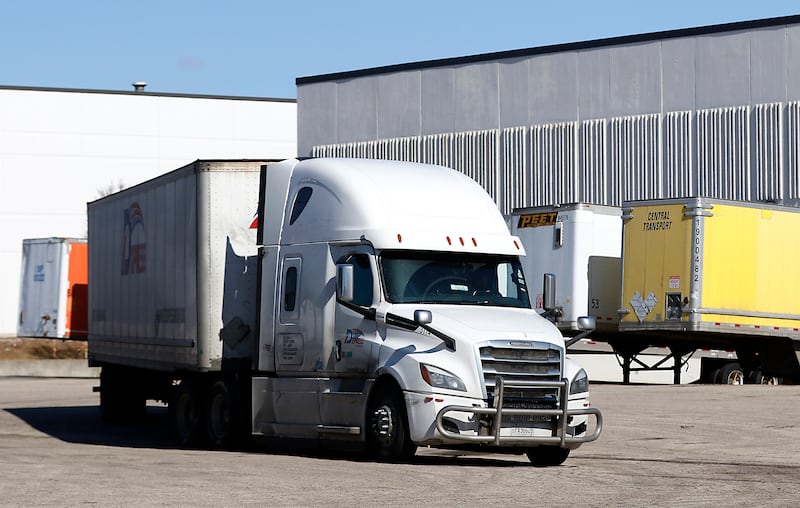
Just what impact the U.S. Supreme Court decision on tariffs will have on local business is tough to tell, one local economic development leader said.
The Supreme Court ruled on Friday that President Trump exceeded his authority when invoking tariffs based on an emergency powers act from the 1970s.
But that does not quite settle the question, said Doug Pryor, chief executive officer for the Will County Center for Economic Development.
‘It certainly doesn’t sound like this is done," Pryor said. “The [Trump] administration, I think, intends to go back and find other ways to do this.”
That would add more economic uncertainty at a time when businesses already seem to have slowed down decisions on expansion.
“It makes it harder for people to make investment decisions when you don’t know what the landscape is going to look like in a few years,” Pryor said.
:quality(70)/cloudfront-us-east-1.images.arcpublishing.com/shawmedia/WQ5P3SU6QBFERJU5RMIYERXAZA.JPG)
As of Friday, Pryor said the Supreme Court decision does not seem to have cleared up the picture even though the impact is widespread.
“I think it’s hard to find anyone who does any kind of importing that wouldn’t be impacted,” he said.
Nate DeMont, who owns custom-made guitar shop DeMont Guitars in Oswego, said the tariffs have forced him to raise prices by at least 10%.
“Hopefully some of our prices on items will go down,” DeMont said. “I did see that they were trying to figure out how to return tariffs and I’m curious how that’s going to work on some of our items.”
In addition, his business has been postponing the sale of its new products, mainly the ones that use circuit boards because of tariffs
“At least most of ours are started in Hong Kong,” DeMont said. “And we can’t afford to make the product if we also have to pay the tariffs on them.”
No one may be more affected by the Trump tariff policies than farmers.
:quality(70)/cloudfront-us-east-1.images.arcpublishing.com/shawmedia/FETJTN7UIQCVI5E6X3SACWQXRE.jpg)
But farmers were reluctant to say anything definite about the Supreme Court decision.
The Will County Farm Bureau referred to a state Farm Bureau statement that said little about the impact of the Supreme Court decision.
“Illinois Farm Bureau is closely monitoring the latest ruling from the U.S. Supreme Court regarding global tariffs,” President Philip Nelson said in a news release.
The Illinois Farm Bureau supports the use of tariffs to ensure fair trade and policies that eliminate trade barriers, which allowed room for farmers to fall on both sides of the issue, according to the release.
:quality(70)/cloudfront-us-east-1.images.arcpublishing.com/shawmedia/ZQ6NBQSOE7GF5CI3T3DQK5PTCQ.jpg)
After the Supreme Court’s decision, Gov. JB Pritzker sent a letter and invoice for $8.6 billion in tariff refunds to President Trump.
“Your tariff taxes wreaked havoc on farmers, enraged our allies, and sent grocery prices through the roof,” according to the letter. “This morning, your hand-picked Supreme Court Justices notified you that they are also unconstitutional. On behalf of the people of Illinois, I demand a refund of $1,700 for every family in Illinois. There are 5,105,448 households in my state, bringing the total damages you owe to $8,679,261,600.”
The letter warns Trump that if he does not comply, “we will pursue further action.”
State Rep. Matt Hanson, D-Montgomery, was pleased by the Supreme Court’s decision.
“Trump’s erratic tariff impositions are unconstitutional and have strained international trade, tax-paying consumers, and businesses, both big and small,” Hanson said. “Congress holds power over taxes and tariffs, not the President, but we know Trump is no stranger to making a mockery of the Constitution.”
He took note of the uncertainty about what comes next.
“There is still a lot of uncertainty about how this decision will pan out, but for now I welcome even the slightest bit of relief for the working families and local businesses – especially farmers and skills-based organizations – in our community and across the country," Hanson said.
U.S. Bill Foster, D-Naperville, also spoke in support of the Supreme Court’s decision.
“Before coming to Congress, I was a manufacturer who kept hundreds of good-paying jobs in the Midwest, so I know the damage done by Trump’s tariffs,” Foster said in a statement. “I’m relieved to see that, after months of delay, the Supreme Court has finally determined that his tariffs are unconstitutional and illegal.”
Earlier this month, the nonpartisan Congressional Budget Office found that 95% of the costs from tariffs have been paid by American consumers.
“At this point, it looks likely that Trump is going to have to find a way to pay U.S. companies back for the illegal tariffs he has collected,” Foster said. “As a start, I would suggest rescinding the $75 billion being wasted on ICE.”
DeMont is hoping the Supreme Court decision will eventually offer more certainty when it comes to the economy.
“I wish it was just something a little more stable so we could have a plan and stick with it,” he said. “The whole economy has been a little bit crazy the last couple of years. I just wish we could have a steady path and a clear path to know what we should be doing. Because it has really put [a] hiatus on some big projects we’ve been working on.”
For example, DeMont Guitars has some new guitar effects pedals that it is especially trying to market in Japan.
“With it all up in the air, it’s hard to know first if we can make them and at a price that will be affordable,” DeMont said.
:quality(70)/s3.amazonaws.com/arc-authors/shawmedia/c957a8ff-14a0-492e-82d7-3c005b3cd732.png)
:quality(70)/author-service-images-prod-us-east-1.publishing.aws.arc.pub/shawmedia/4874e1d5-91ae-4f41-9dee-92d8e733e407.jpg)