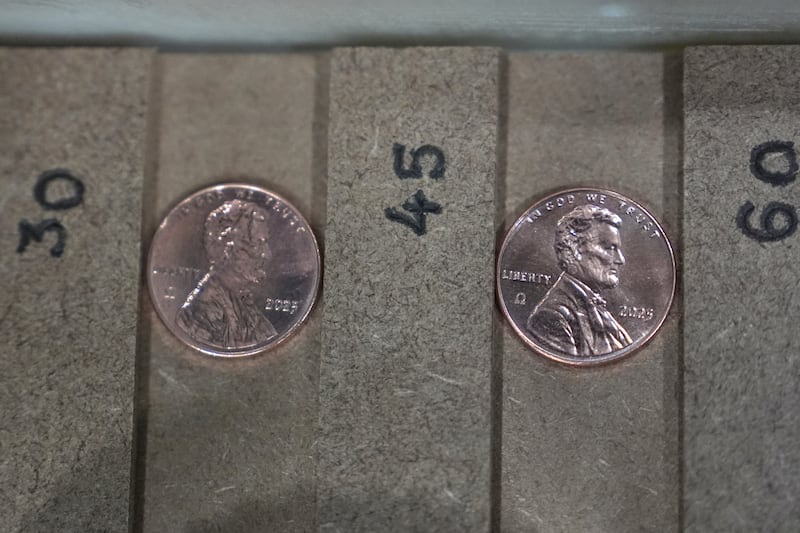
The U.S. pressed its final batch of pennies in November, but not all Will County retailers will be affected by the upcoming penny shortage in the same way.
Nour Zein, owner of Blissful Brew Coffee Co. in Lockport, said she won’t be affected because she has always rounded her prices up or down.
:quality(70)/cloudfront-us-east-1.images.arcpublishing.com/shawmedia/GD4WB32LZBDLRJKCU6F73FIP5M.jpg)
For instance, if the cost was 1 or 2 cents with tax, Zein rounded down. If the cost was 3 or more cents after tax, Zein rounded up.
“I feel like it’s been easier for customers to see the price of the product upfront rather than seeing it with tax afterwards,” Zein said. “It keeps the transaction simple and quick.”
Jana Brodeur, owner of TCBY frozen yogurt in Shorewood, said she is planning to round down the cost of purchases to make it easier for customers – and to thank them for their financial support.
Brodeur said “a decent amount of people pay in cash,” and that’s because some understand she pays fees when they pay with a card.
“People paying in cash help us operate smoothly,” Brodeur said.
Sandra Moore, owner of Candy Kouture in Joliet, is taking a different approach. She’s planning to change her prices so the total will be “without the cents.”
:quality(70)/cloudfront-us-east-1.images.arcpublishing.com/shawmedia/3TL5BMHXCVCSJHBGB6MS4JQHS4.jpg)
“It would be kind of hard to round out the pennies, where I don’t lose or even shorten my customers,” Moore said. “At the end of the day, pennies might not seem much, but they do add up.”
But that’s not the case at Chet’s Hair Studio in Joliet.
Steve Rutkowski, who runs the hair studio that his late father, Chet Rutowski, founded 70 years ago, doesn’t think a penny shortage will be problematic.
:quality(70)/cloudfront-us-east-1.images.arcpublishing.com/shawmedia/KCUTVZLB6NFCJEC6D7X2GS36CY.jpg)
“With checks and cash, most people just round up their totals for retail purchases,” Rutkowski said. “We don’t really go through that many pennies.”
Jen Howard, president of the Joliet Region Chamber of Commerce & Industry, said the chamber “hasn’t heard anything from our membership” about the penny production stoppage.
Howard said she also feels the impact of penny shortages will be minimal.
“I think that credit and debit cards have taken on the majority of sales across the board,” Howard said. “I don’t think you would find a Gen Z or millennial who has any cash on them, let alone coins.”
:quality(70)/cloudfront-us-east-1.images.arcpublishing.com/shawmedia/CYJKFF4UWFH3BE3NUIL7AV45TM.jpg)
Heather Kratz of Plainfield, owner of the home-based business The Cookie Maker, said she just assumed pennies would circulate until they stopped being available.
“At that point, I think digital payment processing would be the new normal,” Kratz said. “A vast majority of payments are digital [or] card at this point already.”
That isn’t necessarily true in the restaurant industry, where 1 in 4 transactions still are paid in cash, according to the National Restaurant Association.
Currently, many restaurant operators round down when they don’t have the exact change, which could cost restaurant operators an estimated $13 million to $14 million per month should this practice continue, according to the NRA.
“In an industry with low 3% to 5% pre-tax profit margins, rounding due to the penny shortage will start to cut into operator profitability,” according to the NRA.
:quality(70)/s3.amazonaws.com/arc-authors/shawmedia/59304215-cb18-46db-bced-9941d9413236.jpg)