Lee County officials say there’s no data center on its way to a property near Nelson amid an outpour of public protests.
Local residents’ negative reactions in recent weeks stemmed from a real-estate listing posted on the Lee County Industrial Development Association’s website – a listing that has since been removed – advertising a 387-acre property along Interstate 88 and U.S. 30 as being “prime data center development land.”
Since then, a change.org petition has been gaining signatures from those against the possibility of a data center, a Dixon man was charged with threatening LCIDA’s executive director and county officials said it’s snowballed to the point where they’re receiving emails about it everyday.
:quality(70)/cloudfront-us-east-1.images.arcpublishing.com/shawmedia/7ONZHE2PGBHAZGHC6ZBTKJZNXQ.jpg)
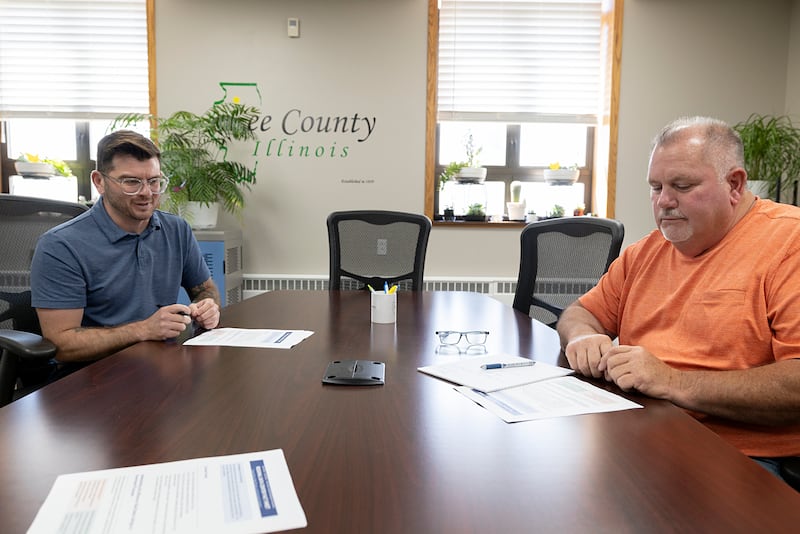
“We are just really hearing a lot of misinformation,” Lee County Administrator Jeremy Englund told Shaw Local. “We’re getting emails now where people just are so adamant that there is a development in place and why don’t they know about it? Why haven’t their voices been heard?”
As of Monday, the petition had gathered 2,571 signatures since being created June 1 by Rock Falls Alderman Marshall Doane. It cites concerns of that property being sold and rezoned for a data center that would replace working farmland and threaten the rural character and environmental health of Lee and Whiteside counties.
Harley R. Delander, 28, of Dixon, is accused of threatening LCIDA Executive Director Tom Demmer over the data center issue, according to police. He was charged May 28 with intimidation/physical harm, a Class 3 felony; and one count each of stalking/cause fear for safety and cyberstalking/cause person to fear, both Class 4 felonies, according to Lee County court records.
Delander had plans to protest data center development, and asked people to join him in showing up at Demmer’s home, according to a post on Delander’s Facebook page that included Demmer’s address. That post has since been removed.
“This case is not about limiting anyone’s right to speak, disagree, or peacefully protest,” Dixon Police Chief Ryan Bivins previously told Shaw Local. “It is about public safety. People have the right to express their views, but threats and conduct that create fear for personal safety will be investigated and addressed appropriately.”
Delander was given pretrial release and his next court appearance is scheduled at 8:30 a.m. Wednesday.
While Englund said there is no active data center development in Lee County, Lee County Board Chairman Bob Olson said officials have had discussions with a couple companies looking to develop such a center. But, Olson said, those conversations never involved a specific property and nothing ever came to fruition from them.
That’s not ”unique to Lee County," Englund said.
Data center history
In 2019, Illinois lawmakers passed legislation that provided exemptions from various state and local taxes to owners of qualifying data centers built in the state as well as a tax credit for construction worker wages paid for projects in underserved areas.
After those incentives were put in place, data center development in Illinois started ramping up and local governments across the state started getting calls from “all sorts of people” looking to get in on the incentives and identifying areas that had the energy capacity and other needed features to support that type of project, Englund said.
“We have an area outside of Nelson, obviously, that is a prime location for a data center or technology development. That is due to having excess electrical capacity due to the substation” that’s out there, Englund said.
Developers do a lot of research to identify those places, Englund said. “We were identified early on without us even going out and trying to market anything due to the electric capacity.”
Then, about a year ago, county officials implemented a technology overlay zoning district, Englund said.
“We wanted to make sure that we were prepared to have those educated conversations with them, with the zoning in place and protecting our properties, our land, our environment,” Englund said.
The purpose of that overlay district is to designate areas in the county where existing or proposed infrastructure could support a technological development such as a data center. It also imposes several regulations on that type of development, including requirements for setbacks, noise, a decommissioning plan, site restoration and potential environmental impact reports to be prepared, according to county records.
Significantly, the overlay district clarifies that no technology development can be constructed unless a county board vote approves it and building permits are obtained, according to county records.
It’s also not been applied to any one property, Englund said.
LCIDA’s job is to market Lee County, along with the city of Rochelle and Dixon, as prime areas for economic developments. It doesn’t approve zoning or issue permits, and final decisions about development projects are made by the applicable government body, Englund said.
“There might be conversations that are had with any sort of development or project prior to the public spotlight, that is mostly just initial engagement,” Englund said.
After that, in Lee County “there’s a very structured process in place...that does allow for public opinion every step of the way,” Englund said.
It starts with a company submitting a formal application to the Lee County Zoning Office. After that, a public meeting is scheduled and the county is legally required to publish proper notice of the meeting’s date, time and place in the newspaper.
The meeting is led by the county zoning hearing officer and runs similar to a court hearing. Residents may attend, hear the specific project details, ask questions and provide public comment.
Based on that meeting, the hearing officer makes a written report and a recommendation for approval, approval with conditions or denial to the county board.
The county services committee reviews the recommendation at an open public meeting before the county board discusses the request and casts a formal vote at its regular monthly meeting. If the property is within 1.5 miles of Dixon’s city limits, the city may formally object through a council vote, which increases the vote threshold required for county approval.
Members of the public are able to attend and make comments at all those meetings. Meetings are also typically streamed live on the county’s YouTube channel.
“One thing we pride ourselves with at the county is [that] everybody’s heard. That’s what’s really hard for us to take from the public,” Olson said.
“We understand the concerns,” Englund said, adding that “no matter what with any development” the public has the “opportunity to be part of the process.”
If a formal development proposal was submitted by a company looking to develop a data center, Olson said, “as board chairman, I would listen to them and listen to their project and then I would tell them, this is not a friendly area to be. One thing we learned from this process is what the community thinks of the data centers.”
Gov. JB Pritzker also announced June 5 that he is putting a stop to the tax incentives starting July 1, citing growing impacts on energy affordability and water resources, according to the Illinois Department of Commerce and Economic Opportunity.
:quality(70)/s3.amazonaws.com/arc-authors/shawmedia/0e4ec010-1273-46f1-8fc4-c5fe7fe40794.png)