Illinois’s state soil is named after a musical instrument. What is it called?
How long can a worker bee live?
On average, one dairy cow produces how many gallons of milk per day?
Almost 300 Lee County fifth-grade students swarmed the Lee County 4-H Fairgrounds in Amboy on Friday during a fact-finding mission to find the answers to those questions.
The Lee County Ag Expo marked its 20th year of educating fifth-grade students about agriculture and how it affects them.
“What is it about their day and the world they live in that involves agriculture? The answer is – everything,” said Katie Pratt, ag literacy coordinator for Lee County Ag in the Classroom, the Lee County Farm Bureau program that brings agriculture lessons into elementary school classrooms in the county.
:quality(70)/cloudfront-us-east-1.images.arcpublishing.com/shawmedia/TTFMOPDB2BCJ5DAL5ADEZCHJO4.jpg)
:quality(70)/cloudfront-us-east-1.images.arcpublishing.com/shawmedia/J6ABJEBZ3RAB5PKJC6XDMAJWXU.jpg)
:quality(70)/cloudfront-us-east-1.images.arcpublishing.com/shawmedia/KVIGO6RW6RBLZAHMP7CTNSH7MY.jpg)
:quality(70)/cloudfront-us-east-1.images.arcpublishing.com/shawmedia/2UY4CLRX3NFOVILQTHVOGIPNRU.jpg)
:quality(70)/cloudfront-us-east-1.images.arcpublishing.com/shawmedia/DQ4N6DEGPJHNRGW7K3JVZYJXJU.jpg)
:quality(70)/cloudfront-us-east-1.images.arcpublishing.com/shawmedia/O5CPUTDI4NDY3O6UTXWDICQIHU.jpg)
:quality(70)/cloudfront-us-east-1.images.arcpublishing.com/shawmedia/IZL5LEVWRJA73KRV6A3D7OFZPI.jpg)
:quality(70)/cloudfront-us-east-1.images.arcpublishing.com/shawmedia/WAXVVLR2DVERZH3NYYHU6IJ2RM.jpg)
:quality(70)/cloudfront-us-east-1.images.arcpublishing.com/shawmedia/ADJFDJS4FZBM3E5BVSGJLXBBEU.jpg)
This year, students from Ashton-Franklin Center, Amboy, Madison School in Dixon, St. Anne Catholic School in Dixon, and St. Mary Catholic School in Dixon attended the event.
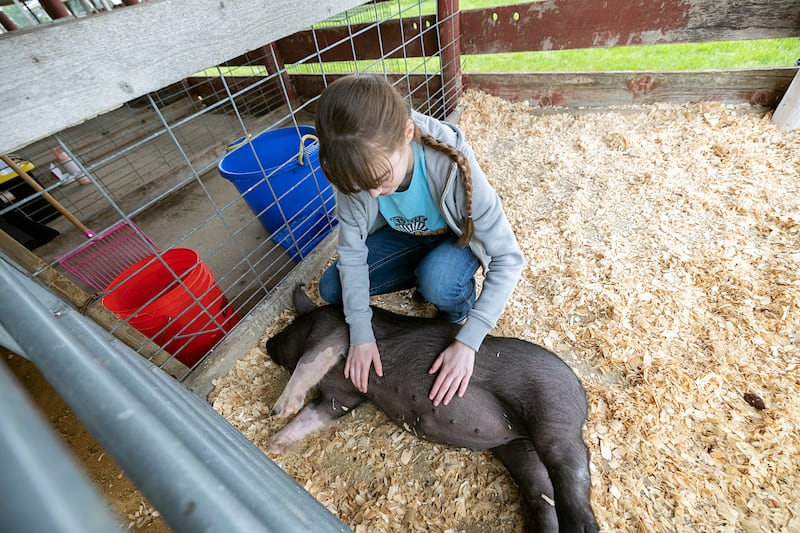
At the fairgrounds, students moved through nine different learning stations that included corn and soybeans, livestock, specialty crops like mushrooms, soil science and conservation, water and water conservation and gardening. At each station, presenters kept students engaged with a variety of activities and lessons designed around their topic.
“This year, we are super excited about Project Plant. Every student today is planting their own tomato plant. They will take their tomato plant home with information on how to take care of it. Then, we’ve invited the students back in July to exhibit their tomato plants and the products of those plants at the Lee County 4-H Fair,” Pratt said.
To mark two decades of the Ag Expo, students also went on a scavenger hunt to find answers to 20 questions related to what they were learning in the workshops. The results were totaled up after the event, and the winning classrooms will receive Popsicle parties.
Pratt, who farms with her husband and family, said getting accurate information on farming and food production to students is more important than ever.
“They are consumers of agriculture, even at their young age, and talking to them about where their food comes from and how that process happens is important. There is so much misinformation out there. These days, who knows what you are going to see and hear and read when you open a social media app on your phone, what the next wild claim about food will be and if that’s real or AI,” Pratt said.
One of the benefits for students is hearing about agriculture and food production from people who work with it every day.
“Students are getting the message of agriculture from the people who do it. They are hearing from the mushroom farmers, who grow mushrooms and sell them at farmers markets. They are hearing from FFA kids who raise goats and sheep and poultry and horses. They get to hear from the people who do the work every day,” Pratt said.
Betsy Jones is marking her 30th year of teaching fifth grade at Central School in Amboy. She said she’s learned something new every year she has brought her students to the event.
“We live in a farming community. There’s so much more to farming than farmers driving tractors. The kids get an idea of all the different jobs that people can have in agriculture. They love coming here because they find out about 4-H and they find out that you don’t have to be from a farm or live in the country to be in 4-H. It’s just an awesome experience for them to learn that they live in a farming community and all of these things are part of agriculture,” Jones said.
Pratt said the event’s framework of learning stations, presenters and topics has mostly remained the same over the years.
“We coach our presenters, and we know that hands-on activities work best. Over the course of 20 years, we’ve gotten really good at being able to hold the kids’ attention, keep them engaged and keep them active. This year, for instance, our folks who are talking about corn have a relay race. And, of course, when you have animals, the animals win the day and kids will pay attention because they love them so much,” Pratt said.
The event is organized by the University of Illinois Extension for Lee/Ogle/Whiteside, Lee County Soil and Water Conservation District, Lee County 4-H, Lee County Farm Bureau, Extension Master Gardeners and Lee County Ag in the Classroom.
The event also is supported by local businesses. Culver’s in Dixon has been a longtime supporter, donor and presenter at the event.
“Jason Roe started it. He brought frozen custard as a reward for some of the contests, then he brought it for everybody. Kayla Halfacre, of the Dixon Culver’s, has kept up the tradition of supporting the Ag Expo. Their support has been phenomenal,” Pratt said.
And the answers to those questions?
- Drummer silty clay loam, also called Drummer soil, is the state soil of Illinois.
- Worker bees can live for 5 to 7 weeks in the spring and summer.
- On average, one dairy cow will produce six to seven gallons of milk each day.
:quality(70)/s3.amazonaws.com/arc-authors/shawmedia/45a20eef-b8d1-4d42-b8b1-b5f9fb81a1b3.png)