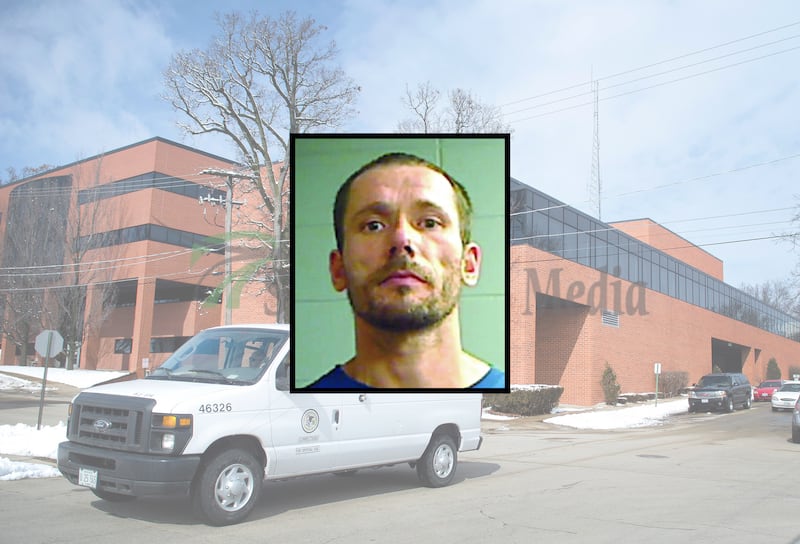
An Illinois appellate court has upheld the conviction of a Rock Falls man in connection with a fire at a Sterling apartment complex that killed three people in June 2020.
:quality(70)/cloudfront-us-east-1.images.arcpublishing.com/shawmedia/D4R4YB5I65HGLJGX2JFIQJ6JDE.jpg)
The Fourth District Appellate Court ruled March 2 that the evidence was sufficient to prove Steven W. Coleman guilty beyond a reasonable doubt and rejected his claims that his trial attorney provided ineffective assistance.
Coleman was convicted of three counts of first-degree murder, three counts of aggravated arson, and one count of residential arson in connection with the June 1, 2020, fire at the Western Apartments at 908 W. Third St. in Sterling. He was sentenced to three consecutive life sentences plus 105 years in prison.
The fire and deaths
The fire broke out in the early morning hours of June 1, 2020, killing three apartment residents: Carrie A. Hose, 49, Celina Serrano, 13, and Shyla Walker, 8, of Davenport, Iowa. Another resident, Alma Walker, suffered severe burns and spent six weeks in intensive care learning to breathe, talk and walk again. A firefighter was also injured fighting the blaze.
[ Prosecutors: Drug deal gone bad, revenge led to Sterling fire that killed 3 ]
Walker testified that she awoke around 12:30 a.m. to extreme heat and the smell of burning shingles. As smoke filled the apartment, she yelled for the children to cover themselves and come to the nearest window, but the darkness and smoke prevented her from locating them. She eventually jumped from a window to escape.
The evidence against Coleman
The court found substantial circumstantial evidence supporting the conviction:
• Two witnesses testified that Coleman stated he planned to burn down the apartment complex in retaliation for a fraudulent drug sale.
• Coleman’s brother, Jesse Coleman, testified that he drove the defendant to the Western Apartments late on May 31 with a red gasoline can in the vehicle.
• Jesse said Steven told him he needed a ride to burn the (expletive) down and dropped him off near the apartments with the gas can.
• Coleman’s girlfriend, Carly Fishbach, testified that a red gas can was missing from her garage and that Coleman was angry after discovering they had purchased fake cocaine instead of the real drug.
• Coleman’s cellphone was found approximately 20 feet from the apartment building’s front door in a black and yellow OtterBox case.
• DNA analysis showed Coleman’s DNA on the phone with a probability of occurrence of one in 210 octillion unrelated individuals.
• Cell tower data placed Coleman’s phone near the Western Apartments at 12:22 a.m. June 1, around the time the fire is believed to have started.
• Jesse testified that Coleman called him the next day, asking if he had left his phone in Jesse’s car.
• Jesse also testified that when he saw Coleman shortly after the fire, the defendant appeared uneasy and told him he “was smoked.”
Fire investigation findings
Two fire investigators testified about the fire’s origin.
Fire investigator Michael Poel testified at the 2024 trial that he found evidence that the fire originated on the upper landing area and stairs of the common entrance. He noted the carpet and flooring materials would not burn easily without an accelerant. He ruled out electrical causes after examining outlets and the electrical box, which remained intact.
:quality(70)/cloudfront-us-east-1.images.arcpublishing.com/shawmedia/IEEPIZDM6ZFHXHT6IT2QSIP2YY.jpg)
Poel testified that while a fire K-9 found positive indications of accelerant on charred wood, samples tested negative for flammable liquids. However, he explained that gasoline can completely burn away or be washed away by firefighting efforts, and that water from firefighting operations could have diluted or removed evidence of accelerant.
Michael Dettman, who was a Sterling Fire Department deputy chief at the time of the fire and served as incident commander, testified about burn patterns and damage he observed, noting the amount of damage was inconsistent with the limited fuel load in the apartment.
Defense arguments rejected
Coleman’s defense expert, forensic fire consultant Marc Fennell, criticized the state’s investigation as incomplete and argued that alternative causes – including sewer gas or electrical problems – had not been adequately ruled out. Fennell said he would expect to find physical evidence of gasoline if it had been used.
However, the appellate court found that Fennell’s criticisms went to the weight of the evidence rather than its admissibility, and that the jury was entitled to assess the credibility of both experts.
Appellate court’s ruling
The court rejected Coleman’s arguments that the state failed to prove guilt beyond a reasonable doubt, writing that the circumstantial evidence was sufficient when viewed in the light most favorable to the prosecution.
“Speculation that another person might have committed the offense does not necessarily raise reasonable doubt as to the guilt of the accused,” the court wrote.
:quality(70)/cloudfront-us-east-1.images.arcpublishing.com/shawmedia/6U4YNQSPEVDTRAB6FK2WBNRSQU.jpg)
The court also rejected Coleman’s claims of ineffective assistance of counsel, finding that even if his attorney had objected to certain evidence, the trial court would have been within its discretion to admit it, and that the other evidence against Coleman was so strong that exclusion of the challenged evidence would not have changed the outcome.
Sentencing issues
Coleman also challenged his sentence, arguing that the consecutive sentences exceeded statutory limits. The court rejected this argument, finding that while life sentences do not count as “terms of years” for sentencing calculation purposes, his other convictions – including three aggravated arson counts carrying maximum 60-year extended sentences – supported the 105-year aggregate sentence imposed.
The appellate court affirmed the conviction and sentence on all counts.
:quality(70)/s3.amazonaws.com/arc-authors/shawmedia/9bb5f897-be4a-42b8-9507-9193a7f43c2d.png)